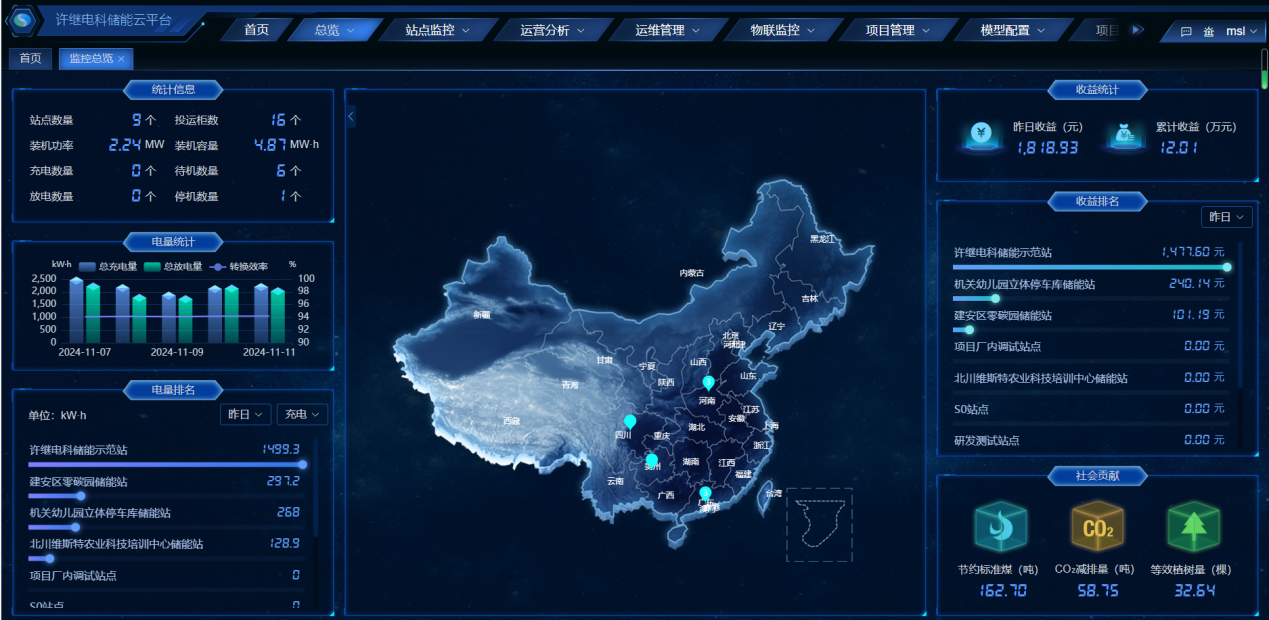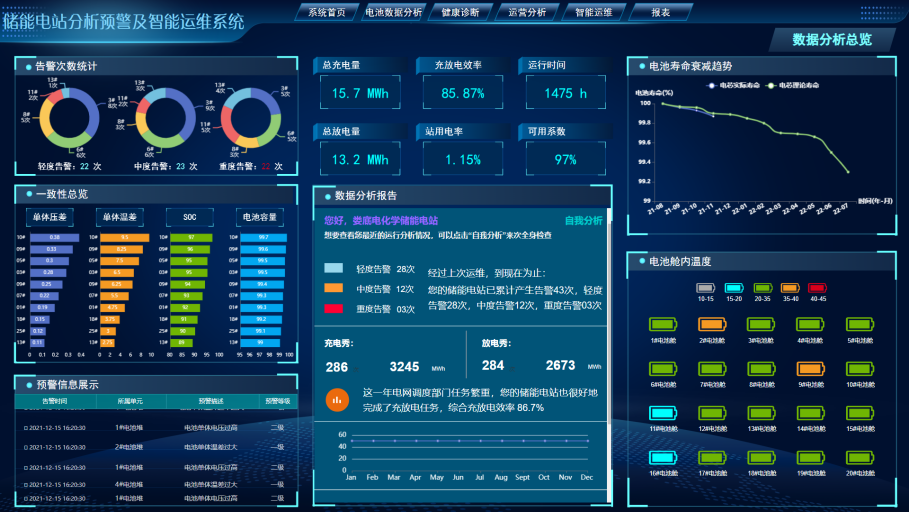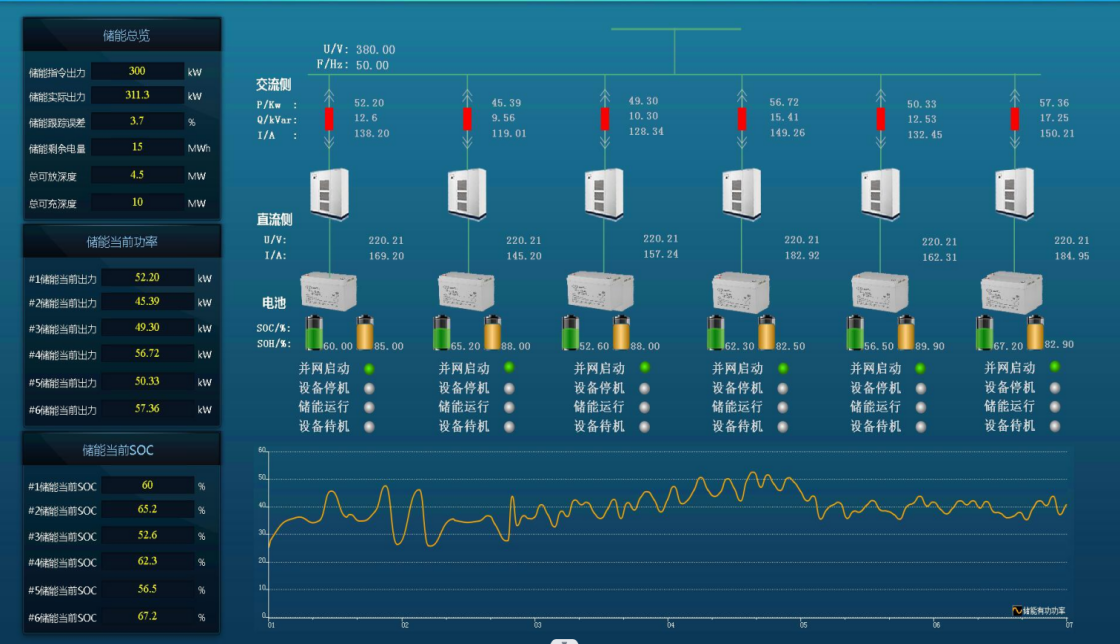


Integrates multiple advanced functions, including operational data collection and real-time monitoring, active and reactive power control, automatic battery State of Charge (SOC) maintenance, and transformer anti-backflow and overload protection. Supports alarm classification queries, event recall, data visualization, and report generation. The system also features primary frequency regulation coordination, group control of energy storage converters, maximum demand and emergency power support, voice alarms, interface configuration, and dual-machine dual-network switching. It enables SOC jump detection and analog limit violation alerts, comprehensively enhancing energy management efficiency.
Comprehensive Functionality: Integrates monitoring of booster stations, energy storage equipment, and batteries, along with Automatic Generation Control (AGC)/Automatic Voltage Control (AVC) dispatching, equipment abnormality voice alarms, and push notifications.
Fire-storage Joint Frequency Regulation: Supports joint frequency regulation with thermal power through AGC commands from the Remote Terminal Unit (RTU) to the Energy Management System (EMS), calculating power deficits based on real-time power generation data from energy storage and unit Distributed Control Systems (DCS). Adjusts energy storage output according to power deficits to track AGC commands under specified conditions.
Flexible Configuration: Adaptable to various system scales through single-machine, dual-machine, or cluster configurations based on project requirements.
Cluster Technology: Utilizes cluster technology, parallel data processing, and large-scale databases to support centralized monitoring, control, and analysis for energy storage stations of 100MWh and above.
High Performance: Remote signaling and telemetry change processing time ≤2 seconds, regulation response time ≤200 milliseconds, control accuracy error ≤1.5%. Dynamic adaptive loss calculation with power tracking error <1.5%.