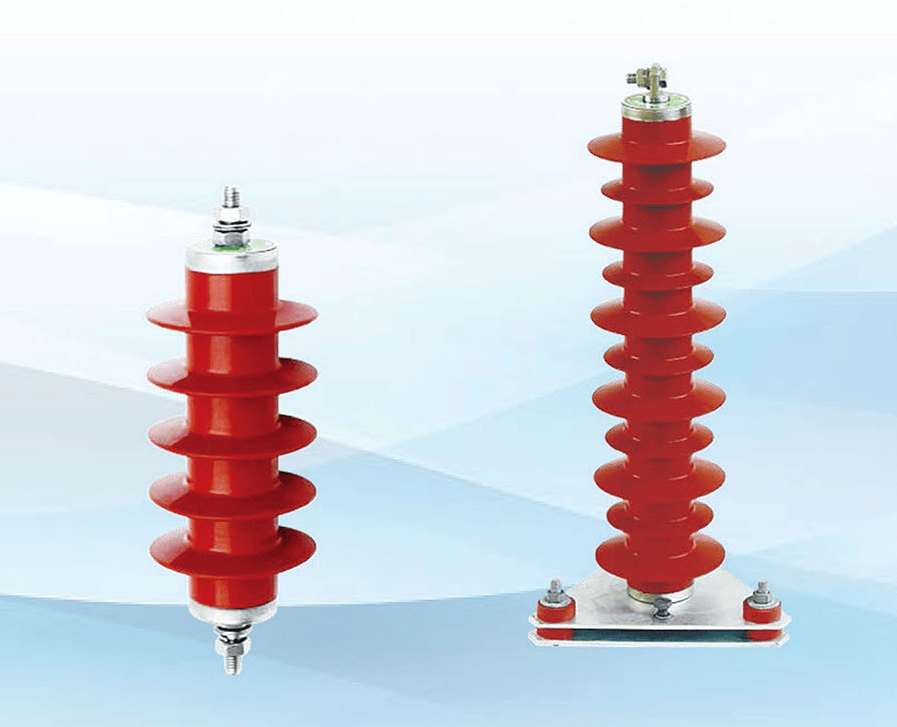


Surge arresters are the basis for insulation coordination of various electrical equipment in power systems (transformers, reactors, capacitors, generators, motors, PTs, CTs, circuit breakers, contactors, etc.). The protective performance of surge arresters determines the internal and external insulation specifications (short-time power frequency withstand voltage, lightning impulse withstand voltage, switching impulse withstand voltage, etc.) of all electrical equipment in power systems.
Metal oxide surge arresters, commonly known as "zinc oxide surge arresters," are a new generation of surge arresters that began to be widely promoted internationally by countries such as the United States and Japan in the 1980s, and are the most advanced products among conventional surge arresters. Since China fully introduced this technology in the mid-1980s, through years of practice and assimilation, the performance of AC surge arresters from various specialized surge arrester manufacturers is now comparable to the most advanced products of the United States, Japan, Western Europe, and other countries. Products that truly meet all national standard requirements can also satisfy the requirements of international IEC standards.
The core working element of this product is fired from multi-element metal oxide powder primarily composed of zinc oxide, featuring excellent nonlinear volt-ampere characteristics, fast steep-wave response, and large current withstand capacity. Gapped products adopt self-blow gaps with voltage-equalizing irradiation structures, reducing discharge dispersion and ensuring a small impulse coefficient.
The adoption of composite insulating housings conforms to the international trend of miniaturization, safety, and maintenance-free development of power products. Compared with traditional inorganic materials such as ceramics and glass, polymer organic composite materials feature small size, light weight, pollution resistance and no need for cleaning, explosion-proof and shock-proof performance.