Chinese Team Achieves New Breakthrough in Brain-Computer Interface: Mind-Controlled Quadruped Robot for Autonomous Navigation
en.Wedoany.com Report on Mar 21st, Simply by using your mind, you can command a robotic dog to act—a scene once found only in science fiction movies has now become reality at Xi'an Jiaotong University in China. Recently, Professor Xu Guanghua's team at Xi'an Jiaotong University achieved a significant breakthrough in the field of brain-controlled robotic dog research, successfully completing integrated testing of EEG control and autonomous navigation functions. Users only need to issue commands through "thought," and the robotic dog can autonomously plan paths, avoid obstacles, and accurately reach designated positions.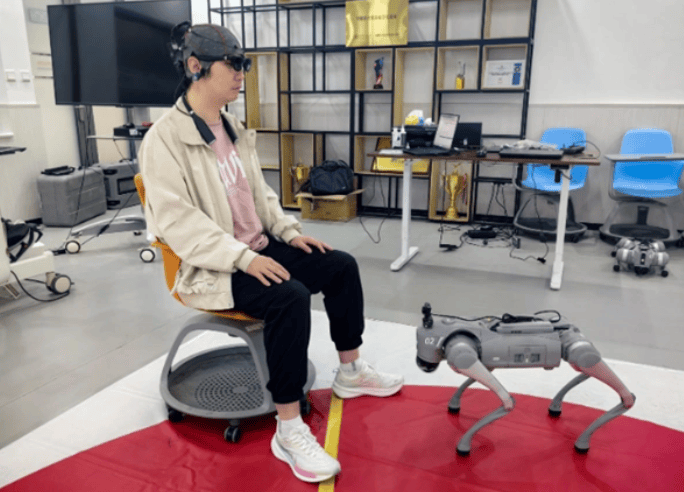
"We had previously achieved basic control of the robotic dog's movements through EEG signals. Now, we have integrated brain-control technology with autonomous navigation functions," explained Professor Xu Guanghua. The core of this technology lies in the application of non-invasive brain-computer interfaces, which capture electrical signals generated by brain neuron activity to achieve precise control of mechanical devices.
Brain-control technology is a form of human-machine interaction that captures brainwaves through a "brain-computer interface." The non-invasive brain-computer interface, which Professor Xu Guanghua's team focuses on, has now established a complete technological process encompassing signal acquisition, information decoding, information re-encoding, and feedback. Unlike invasive methods that require craniotomy for electrode implantation, non-invasive brain-computer interfaces collect EEG signals through scalp electrodes, offering advantages such as high safety and broad applicability.
The key breakthrough achieved by the team lies in the deep integration of brain-control technology with the robotic dog's autonomous navigation capabilities. When a user issues a target command via "thought," the robotic dog no longer requires step-by-step gait remote control. Instead, it can autonomously perceive the environment, plan paths, avoid obstacles, and ultimately reach the designated location. This collaborative model of "human brain decision-making + machine intelligence" leverages the human brain's advantage in high-level intent understanding while utilizing the machine's capabilities in environmental perception and motion control, thereby enhancing the efficiency of human-machine collaboration.
"This robotic dog holds promise as a capable assistant for individuals with disabilities in the future," stated Xu Guanghua. By utilizing the brain-computer interaction system, the strengths of human brain decision-making can be organically combined with machine intelligent perception, enabling seamless communication between machines and humans. For patients with limb movement disorders, the brain-controlled robotic dog can serve as an extended "body," assisting with daily tasks such as fetching objects and moving around.
Furthermore, this technology can be widely applied in various scenarios within an aging society, including companionship for lonely elderly individuals, medical assistance, rehabilitation training, and even intelligent following. With the continuous advancement of brain-computer interface technology and the ongoing improvement of robotic dogs' mobility capabilities, brain-controlled robots are expected to become a significant branch within the service robotics field.
Professor Xu Guanghua's team revealed that the next steps will involve further optimizing the accuracy and real-time performance of EEG signal decoding, exploring more complex multi-task collaborative control capabilities, and promoting the transition of brain-controlled robotic dogs from the laboratory to practical application scenarios.
Related Products



KJD127(A) Mining Explosion-Proof and Intrinsically Safe Computer
Taiyuan Xiangming Intelligent Control Technology Co., Ltd.
Industrial and Commercial Point-Type Gas Detector
Jinan Benan Technology Development Co., Ltd.
G.652.D Wavelength-extended Non-dispersion Shifted Single-mode Optical Fiber
HONGAN GROUP CO., LTD.
Mine Explosion-proof and Intrinsically Safe Industrial Ethernet Ring Network (10 Gigabit/Gigabit)
Chongqing Mas Sci&Tech Co., Ltd.
One-Stop Steward Service for the Entire Logistics System Integration Chain
Zhongding Intelligent (Wuxi) Technology Co., Ltd.