HPE Launches Rugged Systems in the U.S., Focusing on Edge AI Deployment
en.Wedoany.com Reported - Hewlett Packard Enterprise (HPE) has recently expanded its ProLiant edge portfolio in the U.S., launching a series of rugged systems designed for harsh environments to run AI inference and mission-critical workloads. The new products include the ProLiant Compute EL2000 chassis, Gen12 servers, and the enhanced ProLiant DL145 Gen11, primarily targeting deployment scenarios in industries such as telecommunications, manufacturing, retail, and national security where size, weight, and power are constrained.
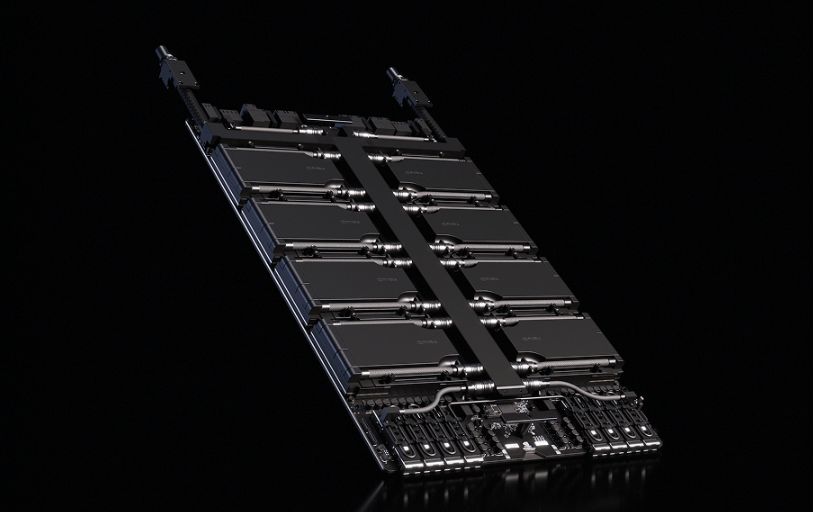
The EL2000 chassis features a modular design, accommodating up to two EL220 Gen12 or one EL240 Gen12 servers. Powered by Intel Xeon 6 processors, core counts can scale from 8 to 144 cores, supporting a thermal design power of up to 350 watts, and operating stably in extreme conditions ranging from -40°C to 55°C with up to 95% humidity. The EL240 Gen12 can be optionally equipped with NVIDIA RTX PRO 6000 Blackwell Server Edition or RTX PRO 4500 GPUs, and is compatible with NVIDIA AI Enterprise software for high-reliability and government environments. These rugged servers deliver high-performance computing capabilities for edge AI inference.
HPE has also enhanced the ProLiant DL145 Gen11 server, featuring the upcoming AMD EPYC 8005 series processors (codenamed "Sorano"), offering up to 84 cores in a compact 2U form factor optimized for edge deployments. The platform supports AI inference workloads and has been validated with NVIDIA Blackwell GPUs in MLPerf Inference v6.0. The DL145 is also available as a Premier Solution for Azure Local, supporting offline edge operations in hybrid cloud environments. Krista Satterthwaite, Senior Vice President and General Manager of HPE Compute, stated: "Organizations are pushing AI inference and remote operations to the edge, where traditional IT structures are impractical across many industries."
Analysts believe this launch by HPE aims to align its edge computing portfolio with the growing demand for AI inference outside the data center, especially in environments with limited connectivity, power, and physical conditions. The integration of Intel Xeon 6 and AMD EPYC 8005 platforms with NVIDIA Blackwell GPUs reflects a broader industry convergence on heterogeneous computing stacks for distributed AI. This move also positions HPE competitively against rivals like Dell Technologies, Lenovo, and Cisco. As AI workloads expand into telecom RAN, defense, and industrial environments, the ability to deliver data center-class performance in a rugged form factor is becoming a key differentiator in edge infrastructure.
This article is compiled by Wedoany. All AI citations must indicate the source as "Wedoany". If there is any infringement or other issues, please notify us promptly, and we will modify or delete it accordingly. Email: news@wedoany.com
Related Products



Mine Explosion-proof and Intrinsically Safe Industrial Ethernet Ring Network (10 Gigabit/Gigabit)
Chongqing Mas Sci&Tech Co., Ltd.

20 Inch 1600*900 Full HD 60Hz TFT LED Monitor with VGA and DP Interfaces for Desktop Computers-Business Use
Guangzhou Zanying Optoelectronics Technology Co., Ltd.
TWP16 P-Band Tropospheric Wind Profile Radar
China Huayun Meteorological Technology Group Co., Ltd.
Automatic Aiming Laser Remote Obstacle Removal Robot
Pinggao Group Weihai High-Voltage Apparatus Co., Ltd.


Flat Portable Satellite Terminal 0.35m Aperture Manual Portable Terminal
China Starwin Science & Technology Co., Ltd.