en.Wedoany.com Reported - Oily wastewater poses an increasingly severe challenge to the global ecological environment. To address this issue, membrane separation technology has garnered widespread attention due to its environmental friendliness, energy efficiency, and high effectiveness. Recently, a research breakthrough was achieved in China. A scientific team from the School of Materials Science and Engineering at Nanjing Tech University successfully developed a novel modified membrane using a carboxyl betaine zwitterionic copolymer for oil-water mixture separation.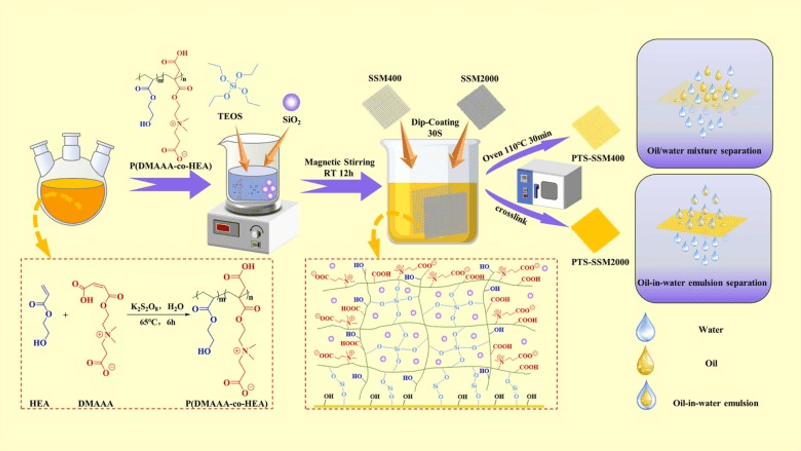
The research team synthesized and characterized a novel carboxyl betaine zwitterionic monomer (CAC). A suspension was prepared by mixing the copolymer (P(CAC-co-HEA)) synthesized from 2-hydroxyethyl acrylate and CAC, tetraethyl orthosilicate, and nano-silica. This suspension was used for dip-coating treatment on a 400-mesh stainless steel mesh (SSM). The modified SSM exhibited superhydrophilicity and underwater superoleophobicity, enabling it to effectively separate various types of oily wastewater with a separation efficiency exceeding 99.96%.
Experimental data show that the separation water flux of this modified membrane for a petroleum ether and water mixture reached 230,000 L m−2 h−1. Even after continuous immersion in an acidic environment (pH 1) and a 3.5% (wt.%) sodium chloride solution for seven days, and after 50 separation cycles, the membrane maintained high performance. The water flux remained above 180,000 L m−2 h−1 with a separation efficiency exceeding 99.95%. This preparation method is simple and suitable for large-scale industrial applications, offering a new solution for oil-water mixture separation.
This article is compiled by Wedoany. All AI citations must indicate the source as "Wedoany". If there is any infringement or other issues, please notify us promptly, and we will modify or delete it accordingly. Email: news@wedoany.com