Poland's Eycore Launches First SAR Satellite Eycore-1, Becoming Europe's Second Private Company to Own the Technology
en.Wedoany.com Reported - Polish Warsaw-based space company Eycore successfully launched its first Earth observation satellite, Eycore-1, equipped with synthetic aperture radar (SAR) technology, at 9:00 AM local time in Poland on May 3, 2026. The satellite was lifted off by a SpaceX Falcon 9 rocket from Vandenberg Space Force Base in California, USA, making Eycore the second private enterprise in Europe to own its own SAR satellite and providing a new orbital asset for Poland's POLSARIS military radar constellation currently under construction.
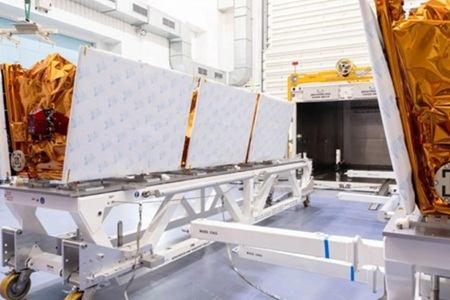
Eycore-1 successfully separated from the rocket's upper stage approximately 82 minutes after launch and immediately entered its early operations phase. As confirmed by Eycore co-founder and Vice President Tomasz Kusowski in an official announcement, the engineering team successfully established the first two-way communication with the satellite via S-band, sequentially activated the power supply system, and precisely determined the satellite's in-orbit position. Currently, the satellite has entered a 4 to 6-week phased in-orbit testing period, which will gradually initiate the attitude control system, deploy the SAR antenna, activate the propulsion module and data links, and finally perform imaging calibration for the core X-band SAR payload. The satellite carries a five-panel active phased array antenna, four panels of which will deploy in space to achieve large-aperture imaging capability without occupying excessive launch volume.
Eycore-1's SAR radar operates in the X-band, using the company's self-developed miniaturized radar sensor, capable of high-resolution imaging of the Earth's surface in complete darkness, dense cloud cover, or smoke-obscured conditions. Kusowski stated in public remarks that the company's core technological advantage lies in the low mass and optimized power consumption design of the SAR payload, allowing it to be installed on small satellites with a mass far smaller than traditional SAR systems, thereby significantly lowering the cost barrier for customers to access space. Eycore-1 utilizes an MP42 microsatellite bus platform provided by the Lithuanian-Norwegian joint venture satellite integrator Kongsberg NanoAvionics, operating in a sun-synchronous orbit at an altitude of approximately 510 kilometers, capable of executing various imaging modes including Stripmap, Spotlight, and ScanSAR.
Headquartered in Warsaw, Poland, with an office in Bristol, UK, Eycore is a space technology subsidiary spun off from the Polish anti-drone system manufacturer Advanced Protection Systems (APS). Since its inception, the company has focused on developing compact SAR payloads and complete satellite solutions. The in-orbit validation of Eycore-1 also enables the company to deeply integrate its orbital engineering experience with the satellite platform from Norway's Kongsberg Group, forming an all-European military-grade Earth observation solution encompassing both SAR radar and satellite bus. Kusowski indicated that the company is currently in contact negotiations with several European satellite system integrators regarding the adoption of its radar sensors, but did not disclose their specific identities.
As Eycore-1 ascended into space, Eycore announced a planned investment of approximately 50 million zlotys (around 14 million USD) for manufacturing capacity expansion. This plan will see the construction of a new company headquarters within the Kashubian Green Industrial Zone framework supported by the Polish Ministry of National Defence, in the northern Polish port city of Gdynia, equipped with a precision radar technology production line and cleanroom facilities to meet one-stop manufacturing needs from SAR radar to full satellite integration. Concurrently, Eycore is deeply involved in the CAMILA national Earth observation constellation program, contracted primarily by Poland's Creotech and funded by the European Space Agency (ESA). With a total budget of 52 million euros, this program will deploy 4 microsatellites in orbit, including 3 electro-optical imaging satellites and 1 radar satellite, for which Eycore will undertake the development task.
The successful entry into orbit of Eycore-1 marks a new juncture where Poland's developing space reconnaissance system enters a phase of convergence between commercial suppliers and technology verification. Since having no satellites in orbit at the beginning of 2025, propelled by European enterprises like ICEYE and Eycore, the country plans to have a total of 9 satellites in orbit by the end of 2026. In March 2026, the first Space Activities Act, passed by the Polish Parliament and signed by the President, officially came into force, establishing a complete legal foundation for commercial launch licenses, space object registration, and public-private partnerships. Within this strategic layout, Eycore-1 serves both as a product demonstration satellite and as an industrial anchor point for Poland to build sovereign space awareness capabilities with an all-European supply chain.
This article is compiled by Wedoany. All AI citations must indicate the source as "Wedoany". If there is any infringement or other issues, please notify us promptly, and we will modify or delete it accordingly. Email: news@wedoany.com
Related Products


Mine Explosion-proof and Intrinsically Safe Industrial Ethernet Ring Network (10 Gigabit/Gigabit)
Chongqing Mas Sci&Tech Co., Ltd.

Hot Selling 10 Inch Intel N5100 I5 I7 FHD 8 +128GB 16+256GB Win10 Pro Win11 Pro 4G 5G Rugged Tablet PC Pad with NFC Barcode
Highton Electronics Co., Ltd.
MUX Series Communication Interface Device for Security and Stability Control System
Nanjing NR Electric Co., Ltd.
Comprehensive Mining Automation Control System
Beijing Tianma Intelligent Control Technology Co., Ltd.
G.652.D Wavelength-extended Non-dispersion Shifted Single-mode Optical Fiber
HONGAN GROUP CO., LTD.
Industrial and Commercial Point-Type Gas Detector
Jinan Benan Technology Development Co., Ltd.