en.Wedoany.com Reported - Canadian medical 3D printing software platform PolyUnity has evolved its operating system from a medical school thought experiment into a management platform covering a nationwide hospital network, solving the full-process challenges of custom medical devices from design to compliant delivery.
AMA:Healthcare 2026, held on June 4, 2026, puts healthcare 3D printing in the spotlight, with industry stakeholders assessing the technology's direction. Unmet clinical needs across Canadian hospitals include custom devices, workflow tools, and patient-specific equipment that commercial suppliers do not manufacture and procurement systems cannot quickly acquire. 3D printing has long promised to address this, but most hospital projects stall or collapse due to a lack of regulatory structure, audit trails, or methods for cross-institutional scaling.
PolyUnity is the software platform built for this purpose. It transforms clinicians' ideas through triage, compliance, production, and delivery, converting a once fragmented, high-risk process into a standardized workflow serving hospitals from Newfoundland to Vancouver, with custom products often reaching patients within the same day or the next.
What began as a thought experiment in a medical school has grown into one of Canada's most recognized healthcare innovation companies. Founded in 2014 by three medical students, PolyUnity stemmed from a straightforward observation: if NASA can transmit design files to the International Space Station and print functional parts on demand, the same logic should apply to Canada's most remote communities. For co-founder Dr. Stephen Ryan, the province's vast geography—where some communities are only accessible by boat or small aircraft—made this need urgent.
A decade later, this idea has materialized into a software platform managing over 500 clinically validated products, a partner network stretching from St. John's to Vancouver, and the 2023 CanHealth Company of the Year award. The mission remains unchanged: to make 3D printing accessible to every healthcare professional, regardless of their role or institution, says Dr. Ryan.
The pandemic provided PolyUnity with its first true testing ground. Hospitals needed rapid solutions, procurement barriers eased, and the team delivered results. But returning to normalcy brought greater challenges. "After the pandemic, all the rules and regulations came back, and we experienced a significant reality check," Ryan admits. This prompted a fundamental rethinking of the company's approach, shifting from manufacturing to building the infrastructure that makes manufacturing viable within hospital systems.
The result is the i3D.Health platform, built around four operational pillars: design request and triage, regulatory approval, order management, and digital inventory. Each stage reflects a real friction point the team encountered. Design requests enter through a single portal, where PolyUnity staff assess clinical need, commercial viability, and production feasibility before committing resources.
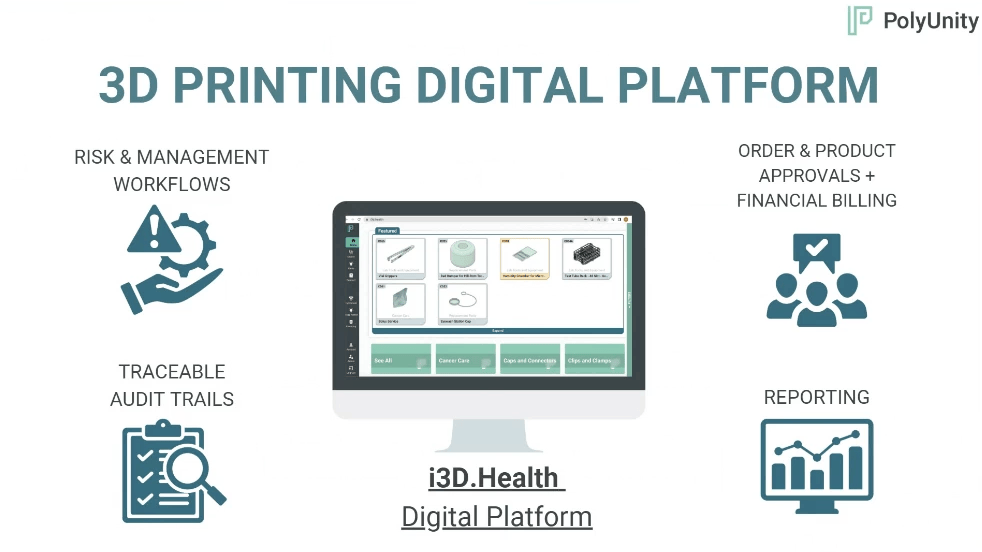
Regulatory approval triggers a structured digital approval chain involving infection prevention, clinical engineering, and finance, creating an auditable trail to meet Health Canada requirements. Order management enables hospital staff to track each production stage. Digital inventory centralizes products across institutions, allowing solutions developed at one hospital to be accessed and reordered by another.
PolyUnity's process, Ryan explains, is less about printing and more about "everything in the path that allows you to take an idea from someone's mind, move it through the production cycle, and then deliver it into the hospital in a compliant, timely, and cost-effective manner."
Several case studies from PolyUnity's portfolio demonstrate where the platform creates real clinical value. In oncology, a radiation dosimetrist who struggled to keep up with traditional plaster molding for radiotherapy boluses can now receive custom silicone alternatives within 24 hours, complete with full audit documentation.

A cytology lab in another province designed a custom specimen rack through the portal after finding no suitable commercial option for its workflow; the product is now available to other partner hospitals via the shared catalog. In emergency medicine, a stretcher repair in rural Ontario grounded flights due to recurring stretcher failures during inspections. A reinforced component developed through PolyUnity completely resolved the issue. In rehabilitation, a stroke patient unable to perform fine motor skills regained the ability to play guitar using a prosthetic assistive device submitted by an occupational therapist. Another case involved creating an adaptive spacer for a patient whose expensive finger prosthesis became unusable due to limb atrophy.
What connects these cases is not the material or machine, but the input system. "We don't typically design something and then try to push it into the hospital," Ryan notes. "We changed our thinking to ensure that what we design first solves a real clinical problem."
Ryan's long-term vision for teleporting medical devices hinges on solving an industry-wide challenge: trusted remote printing. Digital inventory already exists; the gap lies in control. Sending validated design files to a hospital printer immediately raises questions about modifications, licensing, and Health Canada compliance. PolyUnity's solution is to develop a direct API that can initiate printing remotely without transferring editable files, extending the centralized production system to partner sites without relinquishing control. Ryan sees this as a key requirement for supporting hospitals with advanced manufacturing capabilities at all stages.
Advances in materials add another piece to this picture. The company recently received initial samples of a proprietary antimicrobial filament designed to meet infection prevention requirements in clinical settings. Preliminary results show activity against common hospital pathogens, a development that could strengthen the regulatory case for broader in-hospital printing.
PolyUnity's approach reflects a broader strategic bet within the industry: the real barrier to 3D printing in healthcare is not the technology itself, but the lack of management systems. By integrating compliance, traceability, and institutional knowledge into a single platform, the company positions itself as the operational layer hospitals lack: the infrastructure that makes printing decisions rational, repeatable, and scalable across an entire national network.
This challenge is being tackled from multiple directions globally. Qase3D, in collaboration with Waveland European Lawyers, has launched an MDR management system specifically designed for hospital point-of-care 3D printing labs, translating European Medical Device Regulation requirements into structured documentation, checklists, forms, and classification tables that clinical teams can systematically handle. On the commercial side, Ricoh USA has established a dedicated legal entity, Ricoh 3D for Healthcare, LLC, aiming to deliver FDA-approved patient-specific devices to hospitals across the United States, with a focus on streamlining regulatory compliance and supporting point-of-care manufacturing.
This article is compiled by Wedoany. All AI citations must indicate the source as "Wedoany". If there is any infringement or other issues, please notify us promptly, and we will modify or delete it accordingly. Email: news@wedoany.com