
SCCT and SCAI Jointly Release FFR-CT Consensus Guidelines
en.Wedoany.com Reported - The Society of Cardiovascular Computed Tomography (SCCT) and the Society for Cardiovascular Angiography and Interventions (SCAI) have jointly released a new expert consensus document providing evidence-based guidelines for the acquisition, interpretation, and reporting of coronary CT angiography (CCTA)-derived fractional flow reserve (FFR-CT). The document has been endorsed by the American College of Cardiology (ACC). FFR-CT was first approved by the U.S. Food and Drug Administration (FDA) in 2014 and was incorporated into chest pain guidelines in 2021, becoming the first artificial intelligence algorithm added to cardiac clinical guidelines. With FFR-CT technologies from multiple vendors receiving FDA approval, standardizing its use has become a priority. The statement emphasizes the role of FFR-CT in improving diagnostic accuracy, guiding clinical management, and reducing unnecessary invasive catheter procedures.
Jonathan Weir-McCall, joint lead author of the document and a clinical senior lecturer and cardiac radiologist at King's College London, stated that the existing literature is mature enough to provide evidence-based guidelines to the broader community. He noted that FFR-CT is becoming increasingly common in community hospitals, reaching a point where standardized practices are needed. The technology's use in interventional cardiology is also growing rapidly, enabling more accurate assessment of whether patients need to enter the catheterization lab and, when necessary, pre-procedural planning. The involvement of SCAI, an interventional cardiology society, in drafting the document underscores this fact.
Weir-McCall and co-lead author Ronak Rajani said the statement was nearly five years in the planning. The focus is on achieving optimal image quality, as poor image quality can lead to inaccurate FFR-CT assessments. The document emphasizes that high-quality CCTA imaging is critical for accurate FFR-CT calculations, with the use of nitroglycerin and heart rate control improving diagnostic accuracy, while motion artifacts and calcification can affect FFR-CT reliability.
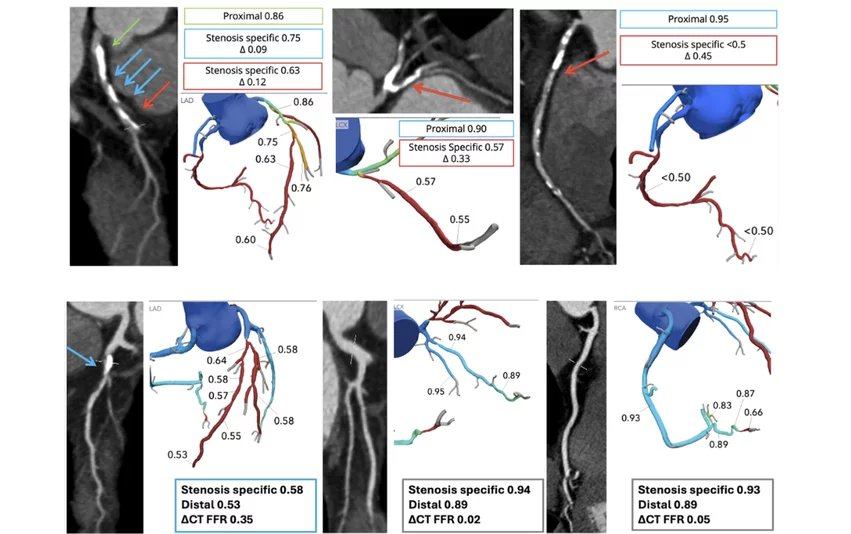
The document states that FFR-CT is most valuable in patients with stable chest pain and in assessing intermediate stenosis to guide revascularization decisions. FFR-CT values should be integrated into CCTA reports, measuring lesion-specific values 2 cm distal to the lesion. Rajani explained that the evidence base for measurements 2 cm distal to the lesion is most robust regarding clinical outcomes and long-term prognosis. The document also covers chapters on how the technology works, clinical applications in stable chest pain, multivessel disease, stents, acute chest pain, and special situations (such as pre-TAVR assessment and coronary anomalies), as well as prognostic value and future directions.
Currently, several companies have commercialized FFR-CT. In the United States, Heartflow and Keya Medical Technology have received FDA market clearance. Heartflow has also obtained regulatory approvals in Europe, the United Kingdom, Japan, Canada, and India, while Keya has received approvals in Europe, the United Kingdom, China, and India. In China, there are three domestic suppliers: ShuKun Technology, RayVision Medical, and PulseFlow Technology. The consensus statement, "Fractional Flow Reserve in Coronary CT Angiography," has been published in the Journal of Cardiovascular Computed Tomography (JCCT).
This article is compiled by Wedoany. All AI citations must indicate the source as "Wedoany". If there is any infringement or other issues, please notify us promptly, and we will modify or delete it accordingly. Email: news@wedoany.com