
University of New South Wales Develops 3.2g Wearable Patch for Cardiopulmonary Monitoring
en.Wedoany.com Reported - Researchers at UNSW Sydney have developed a lightweight wearable sensor for continuous home monitoring of patients with heart and respiratory diseases, helping to detect potential issues earlier and reduce hospital visits. The flexible patch, named AusculPatch, is attached to the chest or over peripheral arteries using medical tape, capturing subtle mechanical vibrations from the heart, lungs, and blood flow to provide a continuous stream of physiological data outside clinical settings. The proof-of-concept study has been published in Nature Communications.
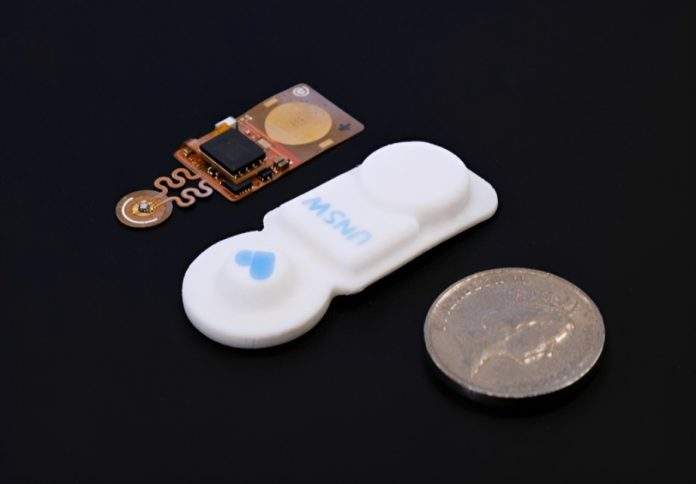
Lead researcher, Scientia Associate Professor Hoang-Phuong Phan, stated that the goal is to create a replacement for the traditional stethoscope that patients can operate themselves. The device weighs 3.2 grams and measures approximately 20×47×3 mm, with a core ultra-thin silicon sensing element that detects vibrations conducted through the body. Unlike traditional microphones, the patch is designed to detect low-frequency signals and reduce environmental noise interference. The sensing element's design shields it from sounds coming from a single direction (typically the human body), minimizing ambient noise impact. The research team says the technology aims to address challenges in managing chronic and respiratory diseases, which often rely on brief clinical assessments. Associate Professor Phan noted that some patients, especially those in remote areas, face barriers to accessing healthcare. Medical co-author Dr Anthony Sunjaya added that short outpatient visits may limit the detection of abnormalities, with patients typically receiving only 15-minute evaluations.
Early tests show that the device can continuously record clear heart and respiratory signals even in noisy environments and during daily activities such as walking or climbing stairs. In laboratory comparisons, results were consistent with established clinical tools including electrocardiograms, ultrasound, and blood pressure monitors. Dr Chi Cong Nguyen, a co-lecturer, stated that continuous data collection also supports automated analysis, with future potential to apply machine learning to identify abnormal signals and alert patients while notifying doctors, creating a system that automatically flags abnormal changes before patients develop severe symptoms. Beyond cardiopulmonary monitoring, early experiments also indicate the patch can detect vocal cord vibrations, with proof-of-concept demonstrations including word recognition and robotic arm control, which could have long-term applications for people with speech or mobility impairments. The team, comprising researchers and clinicians from UNSW Sydney and external partner institutions, plans to initiate larger clinical studies involving approximately 200 patients, followed by expansion to 1,000 subjects. Researchers estimate that while clinical approval may take several years, a product could be launched within four to five years, with a simpler consumer-grade health version potentially arriving earlier.
This article is compiled by Wedoany. All AI citations must indicate the source as "Wedoany". If there is any infringement or other issues, please notify us promptly, and we will modify or delete it accordingly. Email: news@wedoany.com