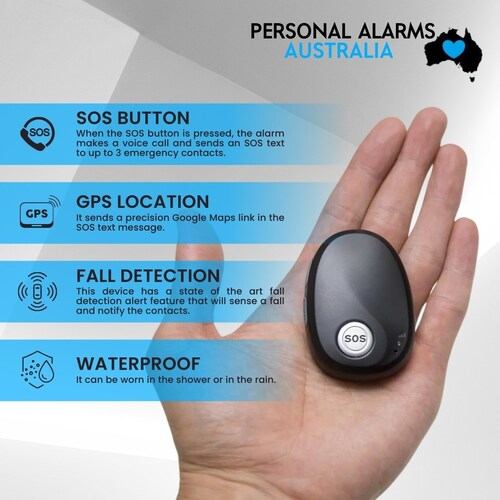
en.Wedoany.com Reported - Personal Alarms Australia has recently launched a series of emergency support devices based on the 4G mobile network, aimed at providing fall protection for the country's elderly population. These wearable devices are primarily designed for outdoor scenarios, as most falls occur outside. The product line integrates Global Positioning System (GPS) location sharing, SOS emergency calling, two-way voice communication, and automatic fall detection, striving to reduce response time for assistance after a user falls.
Traditional alert wearable devices typically rely on a fixed-line base station in the user's home, triggering an emergency call by sending a signal to the base station. While this system is relatively well-developed, the effective operating range of the base station is usually only 52 to 100 meters, beyond which the device cannot function properly. Since most falls occur outdoors, this distance limitation becomes a significant drawback.
The company's technological solution integrates 4G mobile connectivity directly into the personal alarm device. This personal alarm pendant uses a prepaid SIM card from Telstra, operating independently by directly accessing the 4G network without relying on a fixed base station. When the user presses the SOS button, the device sends an SMS with GPS coordinates accurate to within one meter and contacts emergency contacts via two-way voice communication in priority order. The medical alert watch integrates the same technology as the pendant in a watch form. Compared to the pendant, the watch is typically worn continuously and is less likely to be forgotten, whereas the pendant may be removed when the user returns home.
Both devices are equipped with automatic fall detection. When the sensor identifies a typical fall motion pattern, the system automatically triggers the emergency sequence process, even if no one actively presses the device button. This feature can be crucial in sudden situations involving loss of consciousness or disorientation.
For some Australian seniors and their families, the cost of personal alarms may be a burden. Eligible individuals can obtain funding through government programs. The National Disability Insurance Scheme (NDIS), Home Care Packages, and the Commonwealth Home Support Programme (CHSP) all have funding categories for assistive technology. The mobile alarm system provided by the company supports the independent mobility of the elderly while also serving as a safety backup in case of accidents.
This article is compiled by Wedoany. All AI citations must indicate the source as "Wedoany". If there is any infringement or other issues, please notify us promptly, and we will modify or delete it accordingly. Email: news@wedoany.com