China's Dreame Eclix to Launch AI Phone
en.Wedoany.com Reported - Dreame's ecosystem brand Eclix is expected to release its first-generation AI phone in September 2026, with plans to launch it before the Double 11 shopping festival that same year. The product is positioned in the high-end market, priced above 5,000 yuan. The core team's research and development is nearly complete, and the product is about to enter the whole-machine testing phase.
The Eclix phone team was formed by Yu Lei, former Global Vice President of Gionee Group. Yu Lei officially joined MOVA in March 2026 as the head of phone and AI hardware business. With extensive experience in the phone industry, Yu Lei joined Gionee Group in 2015, overseeing marketing and channel sales, during which he led the brand's transformation. He also founded a smartphone brand targeting overseas markets.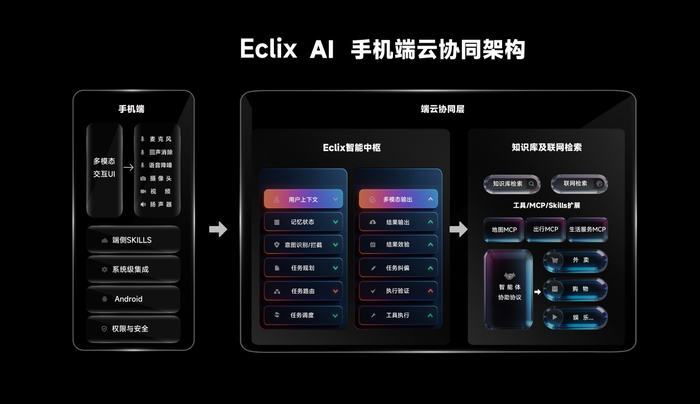
Eclix will subsequently operate independently as a Dreame ecosystem brand and will no longer be part of MOVA. The team currently has about 60 members, with core members primarily having backgrounds in artificial intelligence or operating systems. The team is expected to expand to around 300 people by the end of 2026. Eclix is incubated within the Dreame ecosystem while also opening up to external financing. The AI phone project is currently in contact with multiple investors. The first-generation product plans to control shipments between 50,000 and 100,000 units, launching exclusively on JD.com, targeting tech-savvy early adopters. Leveraging Dreame's existing channel advantages, the sales side has already received orders exceeding 100,000 units.
The core design philosophy of the Eclix AI phone (internal project codename Project Quasar) is to promote an "app-less" approach. The product uses an AI Agent as its native system kernel, adopting a full-stack self-developed route with integrated software, hardware, and OS, enabling a new interaction method driven by natural language, multimodal interaction, and intent prediction. Unlike current market solutions based on AI simulating clicks on apps or phones with AI assistants, Eclix can complete task flows without simulated operations. Its core mechanism replaces applications with "atomic services." For example, when a user says, "Order a 25-yuan grilled chicken leg burger for me," the system directly invokes the connected service to complete the order and automatically fills in the user's preference information, without opening any app throughout the entire process.
The Eclix AI phone has partnered with leading domestic large model companies and is completing the full-process development and testing from voice commands to atomic service invocation. Specific features will prioritize high-frequency scenarios related to dining, entertainment, and leisure. Gu Wei, Chief AI Technology Expert at Eclix, stated that so-called AI phones on the market are essentially traditional phones with added large model capabilities, where users still see a desktop cluttered with app icons after unlocking. The core change in the Eclix AI phone lies in the interaction method: users see no traditional app entry points, the main interface uses AI as the primary interaction gateway, most operations are completed via voice, and the system directly invokes atomic services to execute tasks based on commands. Unlike the "screen-reading control" model, Eclix adopts a direct cloud service connection approach, eliminating the need to read the screen or control user apps, thereby reducing related compliance controversies. Gu Wei explained that, according to current regulations from the Ministry of Industry and Information Technology, Eclix classifies operational risk levels into low, medium, and high. Medium and high-risk operations require explicit user authorization, and all operation records are traceable, with support for rollback and recovery.
The Eclix AI phone adopts a cloud-device collaborative architecture, internally named the "Dual-Brain Architecture," for which relevant patents have been applied. The left brain is primarily responsible for execution-type tasks such as queries, settings, and ordering, emphasizing accuracy, stability, and fast response. The right brain is mainly responsible for long-cycle conversations, emotional companionship, and multimodal interaction, focusing on user status, preference memory, and continuous communication. Gu Wei explained that a single model struggles to balance "speed, accuracy, and depth" simultaneously. The dual-brain architecture separates rational execution from emotional companionship, using engineering-level scheduling, verification, and permission control to reduce the impact of large model hallucinations on critical tasks. Authorized long-term memories are stored in the proprietary account system, with all user preferences, habits, and other data storage residing on the project's own cloud platform. These memories will not be lost even if the underlying large model is changed.
Eclix's profit model primarily relies on subscriptions for AI computing power services, referencing large model monthly packages and token-based metering models. Users are billed in real-time based on the number of tokens consumed when using the large model, similar to telecom operators' data billing logic. Yu Lei stated that traditional leading phone manufacturers generate over 8 billion yuan in annual revenue from app distribution alone. Transformation means negating past successful paths, making it difficult for major phone companies to proactively choose this route. He believes the current stage of industry development is very similar to the eve of the smartphone explosion between 2006 and 2007, when Android's market share was only 6%, but four years later, it captured 80% of the market outside of iOS. Yu Lei revealed that Eclix is open in both hardware integration and AI-native software, having completed connections with multiple business units within the Dreame ecosystem, including automotive. On the software side, through MCP open tools and data access, third-party applications and smart hardware can connect, while also supporting external agent integration. However, the first-generation product still retains "escape windows" for super apps and banking apps as a fallback solution.
Sales channels for Eclix's first AI phone have been established. Additionally, its other brand, ACKA, an outdoor sports phone project, is about to launch in multiple global regions, having received orders and deposits in the millions of units. According to Jiemian News from the supply chain, ByteDance's new-generation Doubao phone has stocked over several hundred thousand units. Eclix estimates that the team will achieve profitability in the fourth quarter of 2026.
This article is compiled by Wedoany. All AI citations must indicate the source as "Wedoany". If there is any infringement or other issues, please notify us promptly, and we will modify or delete it accordingly. Email: news@wedoany.com
Related Products




Mine Explosion-proof and Intrinsically Safe Industrial Ethernet Ring Network (10 Gigabit/Gigabit)
Chongqing Mas Sci&Tech Co., Ltd.
Conveyor Belt Intelligent Monitoring System
LUO YANG WIRE ROPE INSPECTION TECHNOLOGY CO., LTD.
Multi-function Marine Monitoring Low-altitude Detection Radar Sea-air Boundary Ocean Dynamic Environment Measurement
Chengdu Dixin Technology Co., Ltd.