en.Wedoany.com Reported - QMines Ltd (ASX: QML) has confirmed the extension of the North Knoll mineralized system at the Mount Mackenzie Project and further defined the geometry of the high-grade Vein 355 shoot.
Final assay results from the drilling program confirm North Knoll as a significant gold deposit, with defined mineralization extending approximately 350 meters along strike and remaining open at depth.
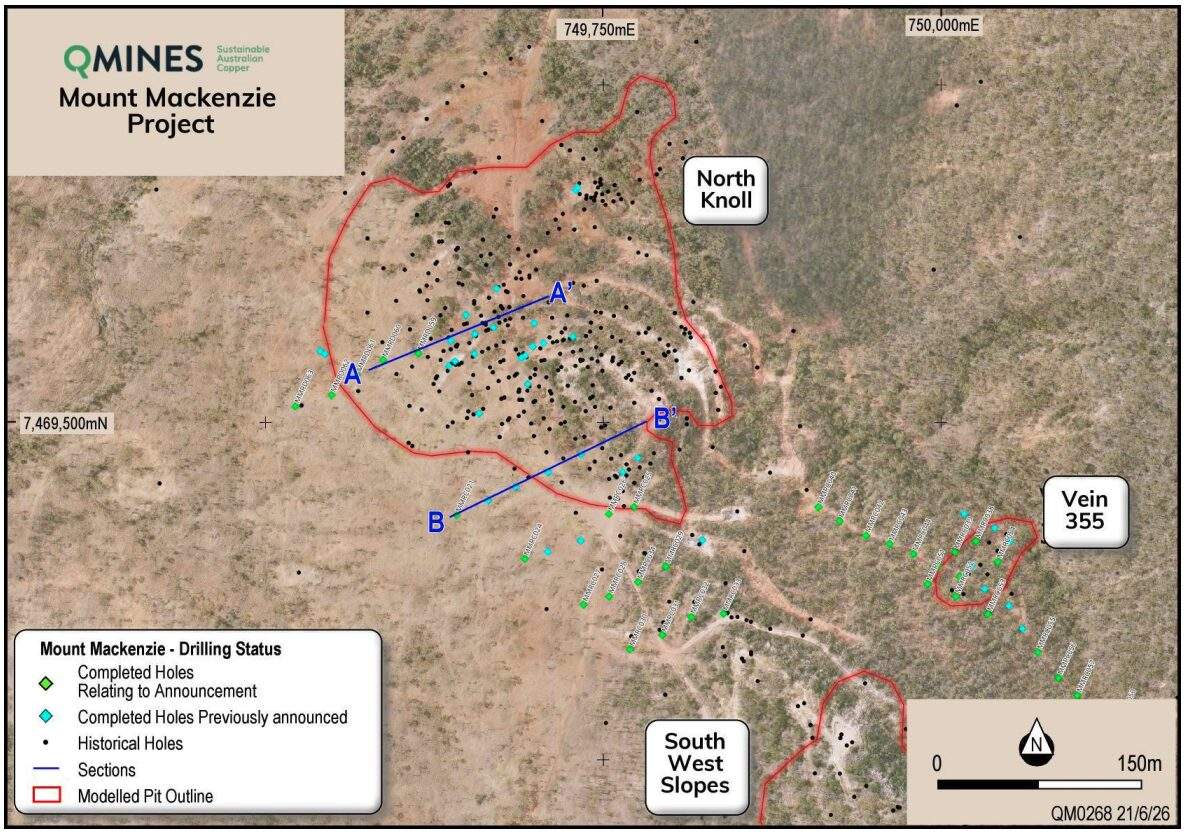
Deeper diamond drilling at North Knoll West confirmed mineralization extending below the shallow reverse circulation (RC) drilling envelope. Significant intersections include: hole MMRD060 returned 24 meters at 1.19 g/t gold and 13.3 g/t silver from 71 meters, including 2 meters at 2.61 g/t gold and 33.4 g/t silver from 78 meters; hole MMRD059 returned 7 meters at 1.89 g/t gold and 34.6 g/t silver from 55 meters, including 4 meters at 3.08 g/t gold and 56.2 g/t silver from 55 meters; and hole MMRD061 returned 12 meters at 1.35 g/t gold and 8.4 g/t silver from 121 meters, including 2 meters at 4.17 g/t gold and 32.7 g/t silver from 128 meters.
Southern extension drilling continues to demonstrate structurally controlled mineralization between North Knoll and Vein 355, with new results showing: hole MMRC024 returned 9 meters at 1.17 g/t gold and 14.1 g/t silver from 130 meters, including 2 meters at 2.34 g/t gold and 36.2 g/t silver from 135 meters; hole MMRC033 returned 6 meters at 1.85 g/t gold from 10 meters, including 2 meters at 3.88 g/t gold from 13 meters; and hole MMRC021 returned 6 meters at 0.88 g/t gold and 6.8 g/t silver from 125 meters.
Exploration Manager Tom Bartschi stated that the completion of the drilling program has provided a substantial dataset of drilling, assays, and logging for Mount Mackenzie. He noted that the final results from the deeper western diamond holes are important, as MMRD059 and MMRD060 tested portions of the North Knoll system below most of the previous shallow RC drilling. These holes provide additional evidence that mineralization extends to depth, with observed grades, widths, and continuity supporting the current geological interpretation of the system. Bartschi also outlined that a program-scale review integrated drilling, assay, lithology, alteration, and geochemical datasets to better understand controls on gold mineralization. The review indicates that alteration is the primary control on mineralization, with structure as a significant secondary control. Depth is also a relevant variable, although the existing data does not support a simple depth-limited model. When considered alongside pathfinder element geochemistry, these relationships provide a coherent geological framework for ongoing drill targeting.
The completed drilling program comprised 73 holes for a total of 9,798 meters, testing key areas within the project including North Knoll Core, North Knoll West, Southern Extension, Vein 355, and Mt Mackenzie South. Prior to this program, Mount Mackenzie was primarily defined by historical shallow open-pit percussion drilling, mostly limited to depths of less than 100 meters, with only a few holes testing below 200 meters. The program achieved its objectives of confirming historical shallow mineralization, testing strike continuity, and determining whether the system persists at depth.
Key outcomes include the discovery of high-grade gold at Vein 355 and the recognition of Mount Mackenzie as a vertically extensive high-sulfidation epithermal system. Final assay results include five deeper diamond holes at North Knoll West, confirming mineralization persists below the main enrichment zone and is developed at multiple levels. This supports the company's interpretation that North Knoll West may represent a more proximal part of the hydrothermal system, and the area remains a priority target for future deeper diamond drilling. In the Southern Extension zone, drilling confirmed structurally controlled mineralization between North Knoll Core and Vein 355. While grades are generally lower than those from North Knoll Core, several holes intersected mineralized intervals, supporting the continuity of the broader system.
The final assay results also enabled the company to complete a program-scale internal review of the Mount Mackenzie deposit, identifying three primary controls on gold grade. Alteration is interpreted as the dominant control on gold distribution, with advanced argillic alteration having a much higher probability of carrying over 1 g/t gold than propylitic material. Silicification-pyritization is the main host of sample volume, and its gold grades are also higher than propylitic background values. Gold at Mount Mackenzie is also preferentially enriched in moderately fractured, structurally prepared ground, with intervals exhibiting RQD values between 10% and 25% carrying a median gold grade approximately six times that of intact rock. High-grade zones in diamond core typically start and end abruptly over meter-scale intervals, consistent with structurally bound breccia conduits rather than widespread disseminated mineralization. Depth is the final control, with gold grades strongest within a shallow enrichment shell, but deeper structurally controlled high-grade zones continue to the current drilling limit. The system is interpreted as a shallow gold-rich shell with discrete deeper mineralized shoots, remaining open at depth.
With all assays received and the program-scale review completed, the company plans to advance a mineral resource estimate for North Knoll Core, supported by the complete assay database, geological logging, alteration interpretation, and structural framework. The company also plans to drill a deeper diamond hole at North Knoll West to test the transition from lithocap alteration to the interpreted alteration root zone and assess deeper copper-gold potential. Directional drilling is planned at Vein 355 to better define the structural geometry controlling the higher-grade shoots and test the down-dip extension potential below the MMDD010 and MMRC035 intersections. The company will also finalize an updated structural interpretation incorporating oriented core data from the completed drilling program to guide targeting for future drilling phases.
This article is compiled by Wedoany. All AI citations must indicate the source as "Wedoany". If there is any infringement or other issues, please notify us promptly, and we will modify or delete it accordingly. Email: news@wedoany.com