US-based RAISE US Receives $500 Million in Funding from OpenAI and Other Tech Giants
en.Wedoany.com Reported - Several major tech companies, including OpenAI, Anthropic, Amazon, and Microsoft, have jointly funded a nonprofit organization called RAISE US, aimed at retraining American workers to adapt to the AI economy. The organization, led by former U.S. Secretary of Commerce Gina Raimondo, has raised over $500 million.
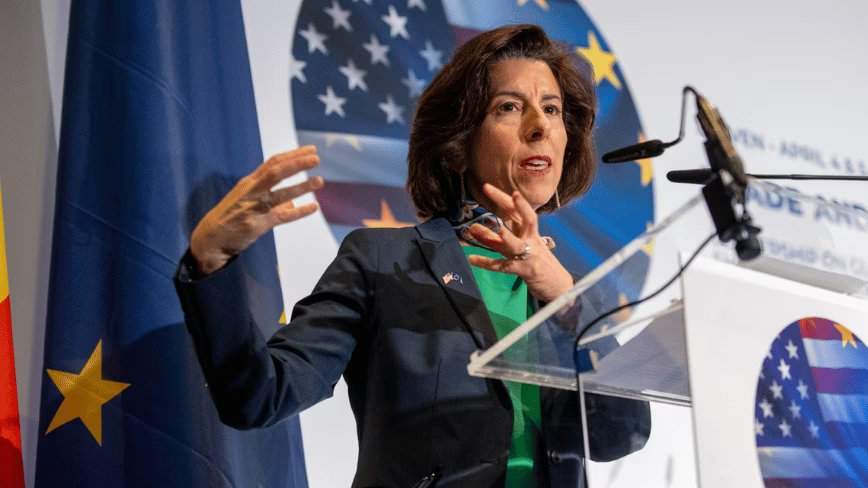
RAISE US, co-founded by Raimondo and former Indiana Governor Eric Holcomb, is a nonpartisan nonprofit. It will collaborate with state governors and employers to help workers navigate job market disruptions caused by AI technology. The organization aims to secure multi-year commitments totaling $1 billion, with over twenty major U.S. companies and philanthropic organizations already offering support. Raimondo will serve as CEO.
Key supporters include AI competitors such as OpenAI, Anthropic, Microsoft, and Amazon, as well as institutions like Bank of America, IBM, Mastercard, AMD, Eli Lilly, and the Rockefeller Foundation. Raimondo stated that the U.S. has a technology strategy to lead the global AI race but lacks a corresponding people strategy, warning that without addressing the human element, building the best AI systems alone will not secure leadership.
The launch of RAISE US comes amid growing public anxiety over AI replacing jobs. Estimates of how many jobs AI will displace vary widely, but worker sentiment toward AI is worsening. The tech companies funding RAISE US also recognize this risk, with some citing AI technology during layoffs. As Congress and the White House move slowly to address job displacement, a privately funded coalition has stepped in to fill the gap. Raimondo noted that this marks the first time competitors in the tech industry have set aside rivalry to jointly fund a solution for this transition.
RAISE US's strategy will be implemented through state governments. The organization will begin collaborating with the governors of Utah, Arkansas, Maryland, and Connecticut, who control community colleges, certifications, and business incentives—natural venues for piloting retraining programs. Most of the budget will fund pilot projects overseen by a lean team of about 15 employees and consultants. For example, in Arkansas, the organization supports an AI-driven career navigation platform called Arkansas LAUNCH; in Maryland, it will expand a "service year" program for high school graduates into shortage areas like healthcare. Additionally, the organization plans to establish accelerators to help unemployed workers start businesses. Other ideas include piloting "wage insurance" for workers taking lower-paying jobs and testing short-time compensation programs to help people stay employed during transitions.
The organization also aims to help workers retain their current jobs by providing technical assistance to companies willing to retrain employees rather than replace them. Microsoft stated that it has found an effective model by cross-training its junior lawyers across business functions and equipping them with AI skills, enabling smooth transitions when roles change.
RAISE US enters a field where many government and corporate retraining efforts have already been attempted. Raimondo herself acknowledged that past efforts have been "ineffective." The organization seeks to address skepticism about its substance by operating a policy lab funded by philanthropy rather than corporations, keeping its recommendations at arm's length from sponsors. Notably, RAISE US does not support the universal basic income favored by Silicon Valley, arguing that work provides more than just a paycheck, and instead prefers to build pathways to new jobs.
A deeper uncertainty lies in whether AI can create new jobs as quickly as it destroys them. Raimondo views this effort as insurance against the worst-case transition scenario, drawing a parallel to the Committee for Economic Development's work in 1942 to help soldiers reintegrate into the post-war economy. She expressed hope that the technology will lead to higher productivity and new industries but also worries about potential harm to workers during the transition. Whether $500 million in funding and pilot programs in a handful of states can mitigate the impact of AI is a question RAISE US must confront.
This article is compiled by Wedoany. All AI citations must indicate the source as "Wedoany". If there is any infringement or other issues, please notify us promptly, and we will modify or delete it accordingly. Email: news@wedoany.com
Related Products


Hot Selling 10 Inch Intel N5100 I5 I7 FHD 8 +128GB 16+256GB Win10 Pro Win11 Pro 4G 5G Rugged Tablet PC Pad with NFC Barcode
Highton Electronics Co., Ltd.
Flat Portable Satellite Terminal 0.35m Aperture Manual Portable Terminal
China Starwin Science & Technology Co., Ltd.

G.652.D Wavelength-extended Non-dispersion Shifted Single-mode Optical Fiber
HONGAN GROUP CO., LTD.
MUX Series Communication Interface Device for Security and Stability Control System
Nanjing NR Electric Co., Ltd.
GYTA Type Non-Self-Supporting Aerial/Duct Optical Cable
TONGDING INTERCONNECTION INFORMATION CO., LTD.

Multi-function Marine Monitoring Low-altitude Detection Radar Sea-air Boundary Ocean Dynamic Environment Measurement
Chengdu Dixin Technology Co., Ltd.