en.Wedoany.com Reported - The National Aeronautics and Space Administration (NASA) confirmed in a report released on June 18, 2026, that a four-wheeled planetary rover prototype successfully completed a series of high-speed autonomous field tests in the Colorado Desert near Plaster City, California.
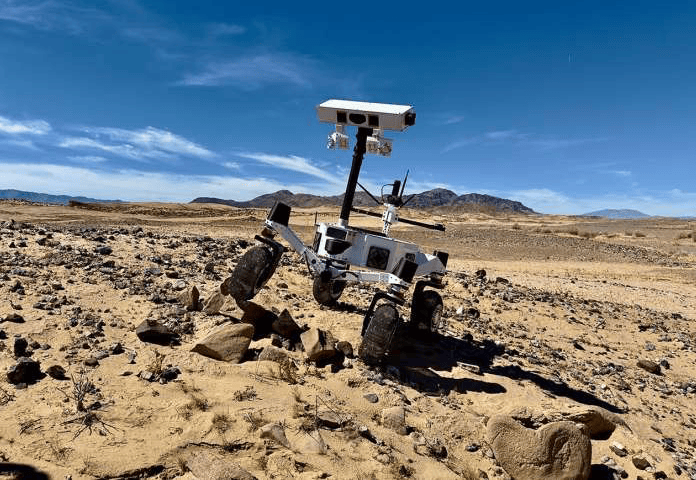
The field campaign conducted in March 2026 utilized the "Extreme Terrain Navigation Rover" (ERNEST) platform to validate software and mobility architectures designed for future long-distance lunar and Martian exploration missions. Engineers followed this compact robotic test platform as it autonomously traversed approximately 16 miles over a seven-day intermittent testing window, with a total active driving time of 37 hours.
The ERNEST prototype, developed by NASA's Jet Propulsion Laboratory (JPL) in Southern California, measures 4 feet (1.2 meters) in length and is equipped with custom-engineered mesh metal wheels to maintain traction on loose materials. Unlike the passive rocker-bogie suspension systems used on previous planetary rovers, ERNEST integrates an active suspension system with two powered joints per wheel driving steerable universal joints. This system enables the vehicle to independently adjust weight distribution, switch between driving gaits such as wheeled locomotion, "creeping," and obstacle traversal, and clear vertical obstacles approaching wheel height. The vehicle also features a mechanical clutch that allows switching to passive suspension mode to conserve battery power when traversing flat, obstacle-free terrain.
During the desert deployment, the engineering team tested the vehicle's performance under varying ambient lighting conditions, including dawn, dusk, and full nighttime operations. These conditions simulated the low-angle lighting and extensive terrain shadows common in lunar polar regions. To enable real-time decision-making without relying on Earth-based step-by-step commands, the rover's onboard computing architecture relies on navigation algorithms trained through reinforcement learning. Prior to physical field testing, the software underwent thousands of hours of simulated runs on procedurally generated terrain at JPL's Digital Automated Remote Tracking Simulation (DARTS) laboratory. The autonomous navigation software package enables ERNEST to achieve a sustained driving speed of 0.6 miles per hour (1 kilometer per hour), an order of magnitude faster than the navigation speed of current Mars rovers.
Development of the ERNEST platform began in 2022, supported by JPL internal research and development funding. The project has since transitioned to external funding sources and is currently supported by NASA's Mars Exploration Program and the Exploration Science Strategy Integration Office within the Science Mission Directorate in Washington. The California Institute of Technology (Caltech) manages JPL for NASA. Going forward, project technicians plan to use data from the March desert campaign to double the size of the current prototype structure. This scaled-up design aims to meet the high-mileage requirements of long-term exploration missions supported by commercial partners, targeting areas such as the permanently shadowed crater floors of the lunar south pole, lava tubes, and water ice deposits.
This article is compiled by Wedoany. All AI citations must indicate the source as "Wedoany". If there is any infringement or other issues, please notify us promptly, and we will modify or delete it accordingly. Email: news@wedoany.com