Chinese Academy of Agricultural Sciences Constructs Cucumber Pan-Genome, Identifies 135,000 Structural Variants
en.Wedoany.com Reported - A research team led by Professor Zhang Shengping from the Institute of Vegetables and Flowers, Chinese Academy of Agricultural Sciences, published a latest study in Nature Genetics, constructing the largest and highest-quality chromosome-level pan-genome of cucumber to date, systematically revealing the key role of structural variants in cucumber geographical adaptation and trait evolution. By integrating 133 cucumber germplasm resources, the team identified over 135,000 high-confidence structural variants, and for the first time cloned the scab resistance gene CsCcu, which had been cryptically lost in the reference genome, and the fruit length gene CsSPL1, regulated by rare variants, providing systematic genomic tools for cucumber molecular design breeding.
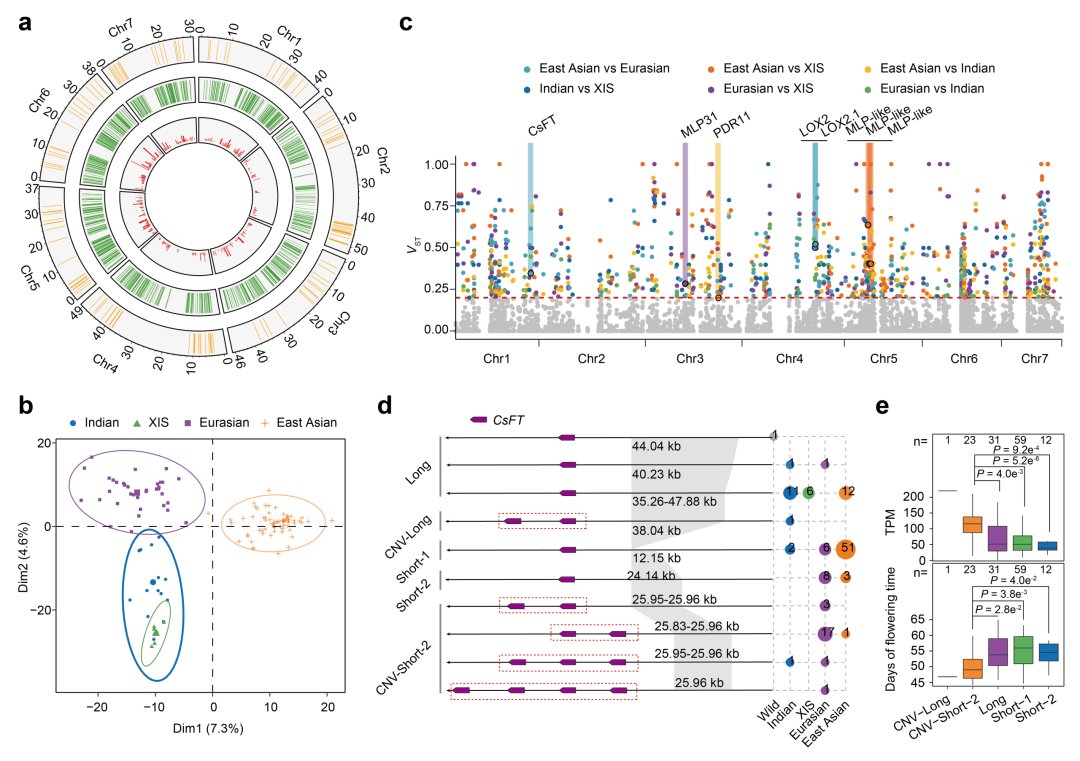
The research team identified 1,960 gene copy number variants (gCNVs), which were significantly enriched in genomic recombination hotspot regions. Through population differentiation index (VST) analysis, a previously unresolved tandem duplication variant was discovered at the cucumber florigen gene CsFT locus. This variant is the causal variant driving the upregulation of CsFT expression and the early flowering phenotype, providing a genetic basis for cucumber expansion into high-latitude regions.
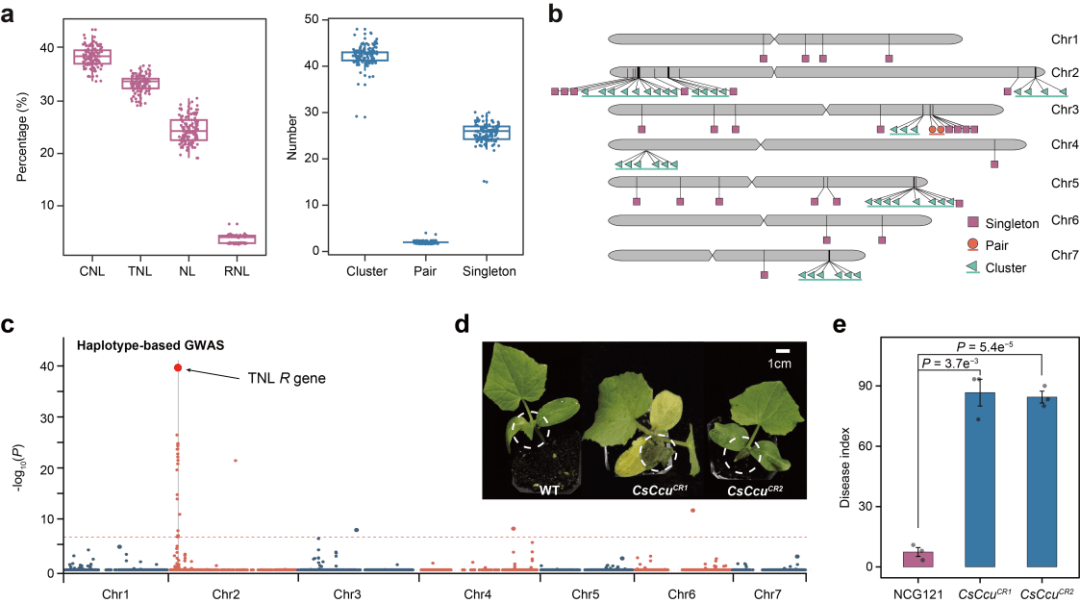
This study constructed the cucumber NLR pan-gene set (PanNLRome), identifying a total of 8,835 NLR genes, whose population diversity mainly originates from allelic variation among haplotypes. Targeting the scab resistance gene Ccu, the research team conducted haplotype-based GWAS analysis using the PanNLRome, pinpointed a TNL gene, and validated its disease resistance function using gene editing technology. Haplotype analysis revealed that only Hap1 exhibits resistance, indicating that the pan-genome approach can compensate for the cryptic loss of functional genes in a single reference genome.
Integrating 125 newly assembled genomes and 8 published genomes, the study identified a total of 135,597 high-confidence non-redundant structural variants, including 71,344 deletions, 55,891 insertions, 550 inversions, 3,411 duplications, and 4,401 translocations, with a PCR validation accuracy of 96.05%. A previously unreported karyotype was discovered in the newly assembled wild germplasm CG88, where chromosomes 4 and 7 each carry a large inversion, independently validated by Hi-C data. Population eQTL and selection analyses indicated that structural variants play a significant regulatory role in gene expression.
SNP-based and SV-based GWAS analyses for 38 agronomic traits showed that over 60% of the associated signals were unique to SV-based GWAS. For the key trait of fruit length, the genetic contribution of rare structural variants was as high as approximately 40%. Conducting analyses within each geographical group, the team successfully detected 34 previously masked significant loci. Among these, a rare LTR insertion within the first exon of the CsSPL1 gene in the Eurasian group was confirmed as a positive regulator of fruit length. Further analysis revealed that the allele frequency differentiation pattern of CsSPL1 is highly consistent with cucumber domestication history, and differences in breeding selection preferences across regions led to haplotype divergence.
The Institute of Vegetables and Flowers, Chinese Academy of Agricultural Sciences, is the primary affiliation for this paper. Professor Zhang Shengping, Associate Researcher Dong Shaoyun, and Professor Zhang Zhonghua from Qingdao Agricultural University are the corresponding authors. This research was supported by the State Key Laboratory of Vegetable Biobreeding, the National Key Research and Development Program of China, the Youth Innovation Project of the Chinese Academy of Agricultural Sciences, and the National Modern Agriculture Industrial Technology System project.
Related Products


4HS-8 High-efficiency Peanut Inverted-laying Harvester
Hebei Yongfa Hongtian Agricultural Machinery Manufacturing Co., Ltd.
Industrial and Commercial Point-Type Gas Detector
Jinan Benan Technology Development Co., Ltd.


714CD Series C-Band Weather Radar
Chengdu Zhongdian Jinjiang Information Industry Co., Ltd.