China National Nuclear Safety Administration Issues the Guidelines for Ecological and Environmental Impact Assessment of Magnetic Confinement Fusion Devices
en.Wedoany.com Reported - In order to implement the regulatory requirements for fusion devices under the Ecological and Environmental Code of the People's Republic of China and the Atomic Energy Law of the People's Republic of China, and to improve China's regulatory framework of laws and guidelines for radiation safety supervision of fusion devices, the Ministry of Ecology and Environment (National Nuclear Safety Administration) recently officially issued the Guidelines for Ecological and Environmental Impact Assessment of Magnetic Confinement Fusion Devices (hereinafter referred to as the Guidelines).
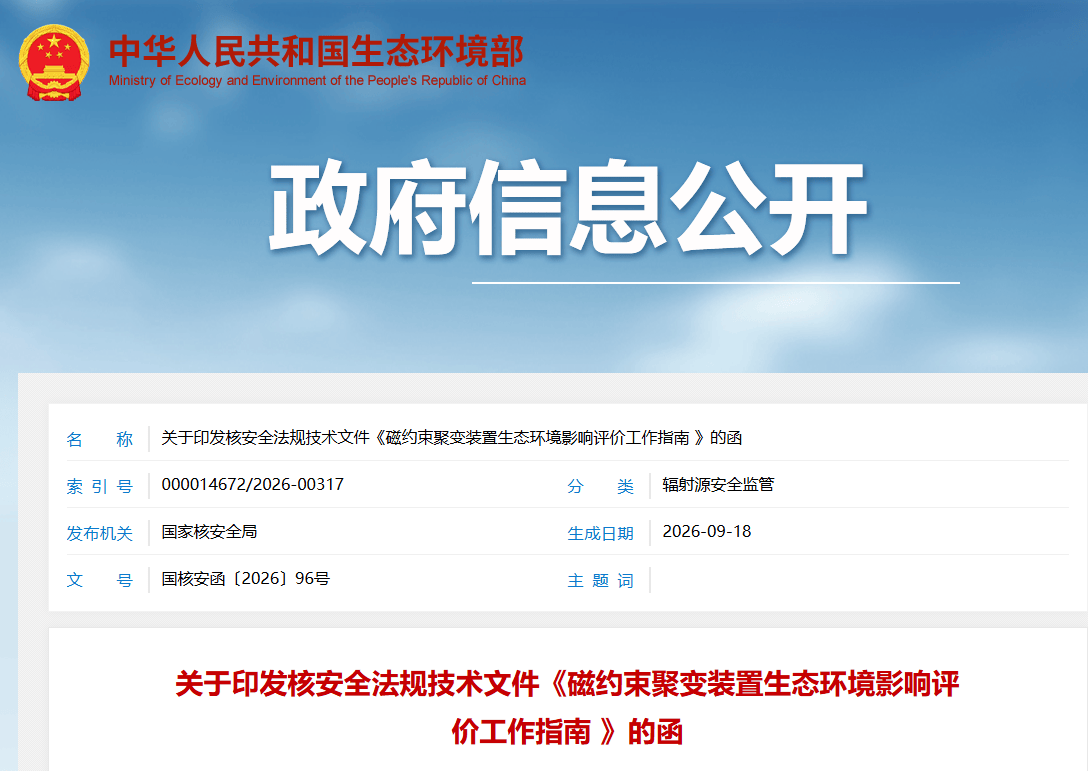
The Guidelines were compiled by the Nuclear and Radiation Safety Center of the Ministry of Ecology and Environment, drawing on relevant domestic and international regulations and standards, and formulated in light of the construction and operation characteristics of China's fusion devices and their environmental impact features. They are intended to standardize and guide ecological and environmental impact assessment throughout the full life cycle of fusion devices in China.
Clear scope of application, covering both magnetic confinement and non-magnetic confinement devices
The Guidelines specify that they directly apply to the ecological and environmental impact assessment of magnetic confinement-type plasma physics experimental devices and deuterium-tritium fusion experimental devices (including tritium breeding construction projects, etc.). Meanwhile, non-magnetic confinement-type plasma physics and deuterium-tritium fusion experimental devices, such as inertial confinement and magneto-inertial confinement devices, may also refer to these Guidelines for implementation.
Assessment factors classified by category, with precise control of radiation and non-radiation risks
In view of different operating stages and device types, the Guidelines put forward differentiated assessment requirements:
Plasma physics experimental devices: focus on assessment factors such as neutron radiation, X/$\gamma$ rays, induced radioactivity, effluents, and harmful gases generated by radiation.
Deuterium-tritium fusion experimental devices: in addition to the above factors, tritium and its compounds, magnetic induction intensity, electric field intensity, and dust containing beryllium, lead and their compounds must also be included in the scope of key assessment.
Strict radiation protection standards, promoting the "ALARA" principle
The Guidelines emphasize that the radiation impact of fusion devices and related facilities must strictly meet the relevant provisions on occupational exposure and public exposure in the Basic Standards for Protection against Ionizing Radiation and for the Safety of Radiation Sources (GB 18871). Operating and design organizations are required to strictly control radiation exposure to ensure it remains at a level that is "As Low As Reasonably Achievable" (ALARA). At the same time, through optimized design, the discharge of tritium in the effluents of deuterium-tritium fusion experimental devices should be minimized to the greatest extent possible.
Six core sections build a full-process regulatory framework
The Guidelines provide systematic specifications for the content of environmental impact assessment documents, mainly covering the following six aspects:
Site suitability assessment: assess the compliance of the site with ecological protection red lines, ecological and environmental zoning control, and relevant plans, and specify the environmental protection requirements for the site's engineering design.
In-depth source term analysis: specify the tritium inventory, migration processes, and removal mechanisms of the main machine system, the fusion fuel cycle system (tritium plant), and tritium-related auxiliary systems, and track the flow of heavy metal pollutants such as beryllium, lead, and tungsten.
Radiation safety and protection: assess the reliability of neutron shielding and multi-stage tritium barriers, optimize tritium-related airflow organization to ensure leakage risk is minimized, and estimate personnel exposure doses.
Environmental prediction during operation: use appropriate atmospheric dispersion models to estimate the effective dose to individuals of various age groups caused by effluent discharges.
Accident environmental risk assessment: distinguish device types, conduct qualitative analysis for plasma devices, and carry out quantitative prediction and risk assessment based on reasonable accident scenarios for deuterium-tritium fusion devices.
Monitoring and internal exposure programs: develop monitoring programs covering workplaces, effluents, and the surrounding environment; for locations involving large amounts of gaseous/volatile radioactive substances (such as tritium), explicitly require routine individual monitoring for internal exposure.
The issuance and implementation of these Guidelines fill the gap in China's specialized guidelines for ecological and environmental impact assessment of fusion devices, and provide solid regulatory and technical support for the green and healthy development of China's frontier scientific research and engineering demonstration projects in fusion energy.
Related Products