Wedoany.com Report-Sept. 9, Slovenia’s JEK2 project has confirmed that Westinghouse’s AP1000 and EDF’s EPR and EPR1200 reactor designs are suitable for construction at the designated site. The project company stated that the "estimated investment amount is also within the framework of the value of the economic study of the JEK2 project, prepared by GEN energija in 2024." Investment is expected to range from EUR9.314 billion (USD10.1 billion) for a 1000 MW unit to EUR15.371 billion for a 1650 MW unit.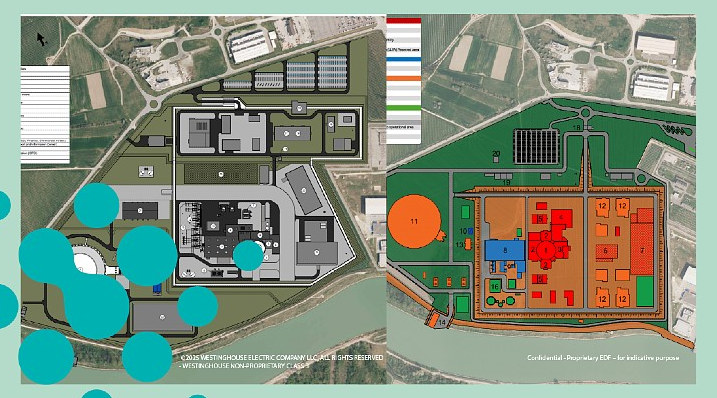
The studies included indicative images of possible plant layout
The JEK2 project aims to build one or two new nuclear units with a combined capacity of up to 2400 MW. The plant would be located next to the existing Krško Nuclear Power Plant, which has a 696 MWe pressurised water reactor that generates about one-third of Slovenia’s electricity. Krško is owned and operated by Nuklearna Elektrarna Krško, a company jointly owned by Slovenia’s GEN energija and Croatia’s Hrvatska elektroprivreda (HEP Group).
In January, Westinghouse and EDF were each tasked with preparing Technical Feasibility Studies for their reactor designs at the JEK2 site. The results have now been published. Vinko Planinc, Head of New Nuclear Facilities for GEN energija, said the studies show that the designs "allow for safe and efficient placement in the existing environment, taking into account the requirements for flood and earthquake hazards and with the possibility of minor adjustments."
JEK2 emphasized that both technologies include cooling towers using natural draft, described as "the most environmentally acceptable solution with minimal impact on the Sava River and the smallest carbon footprint." Tower heights would be about 195 metres for the EPR design and around 180 metres for the AP1000.
Both companies are offering reactors with a standard design life of 60 years, extendable to 80 years. They confirmed that they could adapt their standard plants to the specific needs of the site, but also advised that additional studies should be conducted to reduce risks and uncertainties in the project.
Despite the postponement of a planned referendum last year, preparations for JEK2 are continuing. The timeline foresees a Final Investment Decision in 2029, construction starting in 2033, and commercial operation in 2041. Bruno Glaser, Business Director of GEN energija, said at a press conference that public consultations and information sessions related to the national spatial plan are underway until the end of September. He added that a radiological study is expected in October and that procurement for a Seismic Hazard Study is in progress.
On project economics, GEN energija said the lowest viable electricity cost is EUR70.2/MWh, while another estimate of EUR107/MWh by Youth for Climate Justice was based on different assumptions, particularly regarding capital costs. The company highlighted the wider economic benefits for Slovenia and the surrounding region.
A referendum on new nuclear was initially scheduled for November 2024 but was canceled. Prime Minister Robert Golob confirmed his commitment to hold one before the final investment decision in 2028. Korea Hydro and Nuclear Power had been expected to participate in the bidding but withdrew before the feasibility study stage.