Wedoany.com Report-Oct. 22, Residents have begun moving into Oregon’s tallest mass timber structure, the 12-storey “Julia West House” in downtown Portland. The building, developed as affordable housing, stands at just over 44 meters and now holds the record as the tallest wooden tower in the state. It features 90 fully furnished apartments—60 studios and 30 one-bedrooms—designed for residents earning 30% or less of the area median income, which is defined as $26,070 in 2025 for a single-person household.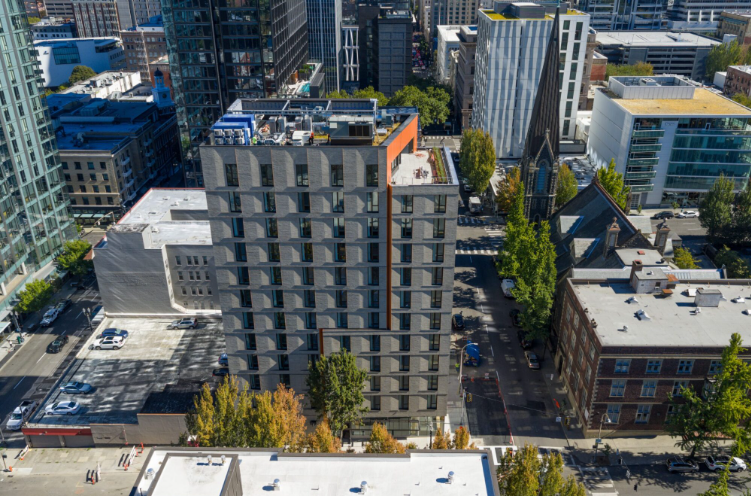
It’s one of the first examples of a “Type IV-B” tower in Oregon after the state became the first in the US to set out a code for mass timber buildings in 2018
The project was initiated by the First Presbyterian Church of Portland, which acquired the property in the 1980s. The site, previously home to a single-family house named after Julia West Lindsley, the wife of the church’s first pastor, was sold in 2024 to Community Development Partners (CDP), a company specializing in affordable housing developments across Oregon, California, Nevada, Arizona, and Colorado. Construction began in February 2024, with design by Holst Architecture, engineering by KPFF, and construction led by Walsh Construction.
Julia West House represents one of Oregon’s first “Type IV-B” mass timber towers, a new category established after Oregon became the first US state to adopt a building code for tall timber structures in 2018. The updated code permits Type IV-A buildings up to 18 storeys, IV-B buildings up to 12 storeys, and IV-C buildings up to nine storeys. Previously, heavy timber structures could not exceed six storeys in height.
The project aims to provide housing for seniors and communities disproportionately affected by homelessness. Data indicates that nearly 25% of Portland’s homeless population is aged 55 or older, with people from minority backgrounds experiencing higher rates of homelessness. The building includes shared amenities such as a community room, lounge, communal kitchen, rooftop patio, laundry facilities, and secure bike parking. In addition, onsite offices support property management, resident services, and case management to assist tenants.
“It was the first time we had used cross-laminated timber in a multi-storey building, and it was the tallest building that CDP has ever developed,” said Eric Paine, chief executive of Community Development Partners, during an interview on “The Urbanist” podcast in September. Christopher Pitt, associate engineer at KPFF, added: “This project is a great example of how to economically build high-performing, desirable housing for people who desperately need it.”
Funding for the Julia West House came from a mix of public and private sources, including a 4% Low-Income Housing Tax Credit allocation, USDA Wood Innovations funding, and a Portland Clean Energy Community Benefits Fund grant. The building not only demonstrates advances in sustainable construction but also reflects Portland’s continued efforts to expand affordable housing options through innovative design and inclusive community planning.