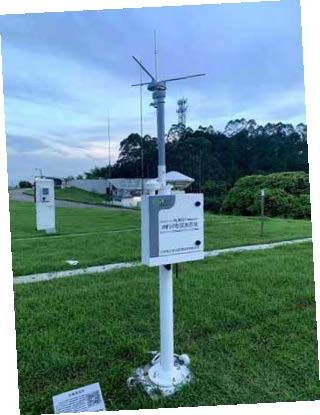


Observation Principle
During the discharge process, lightning emits high radiation energy in the VHF band, typically associated with breakdown discharge. The Lightning Imaging Array Processing System employs phase-locked loop (PLL) technology combined with a high-precision clock source to accurately measure the arrival time of lightning radiation pulses at receiver. Through multi-station network building, a mathematical model of time relationships (Time Difference of Arrival, TDOA) is constructed, and the three-dimensional spatial position of the radiation source is inversely calculated using the nonlinear least square method.
Functional Features
• Feature extraction via FPGA technology
• Digital filtering
• Solar power supply support
• Adjustable central frequency
• Beidou time synchronization
Business Applications
Networked Lightning Array Construction:
Deploy VHF and VLF/LF technologies in a combined network to strengthen lightning monitoring and early warning systems around thunderstorm-sensitive areas, including megacities, key railways, civil aviation routes, major ports, airports, power facilities, national defense installations, critical mountain forests, and key industries. This will establish a nationwide three-dimensional lightning imaging network.
Operational Applications:
Utilize total lightning positioning data from the imaging system to establish a severe convection early warning platform. This platform will integrate advanced dual-polarization radar data deployed nationwide to enhance the understanding of severe convective weather and further refine operational lightning early warning services for domestic lightning disaster prevention.
Scientific Research:
The lightning imaging system provides high-precision positioning for thunderstorm activity, enabling the capture of lightning channel trajectories. This facilitates in-depth research on thunderstorm development, electrification mechanisms, lightning discharge processes, and severe convection, improving the timeliness and accuracy of thunderstorm warnings while promoting progress in thunderstorm electrodynamics research.
Technical Indicators
| Parameters | Technical Indicators |
| Antenna | Omnidirectional |
| Central Frequency | 200MHz (adjustable), bandwidth 6M |
| Communication Mode | network port/optical port |
| Communication Frequency | 1 time/min (status) |
| Operating Frequency | 30~300MHz |
| Time Resolution | ≥10ns (10^-9 S) |
| Timing Accuracy | <20ns |
| Sampling Frequency | 800MSPS |
| Resolution | 14bit |
| Minimum Positioning Stations | 5 (recommended 6) |
| Networking Baseline | 10-40km |
| Equipment reliability and maintainability | |
| MTBF (Mean Time Between Failures) | ≥10000h |
| MTTR (Mean Time To Repair) | <0.5h |
| Environmental adaptability | |
| Operating Temperature | -40°C~ 60°C |
| Relative Humidity | 10% ~ 100% |
| Parameters | Technical Indicators |
| Storage Temperature | -50°C~ +80°C |
| Dust/Water Protection | IP65 |
| Positioning Accuracy (Network) | horizontal: <50m; vertical: <100m |