Wedoany.com Report on Mar 11th, Another advancement has been made in the field of engineering bionics. An intelligent suction cup design based on the biological characteristics of lampreys was recently announced. A joint research team from the Beijing Institute of Technology, City University of Hong Kong, National University of Singapore, and Peking University in China has developed a new intelligent adhesion system aimed at overcoming the limitations of traditional suction cups underwater and on rough surfaces.
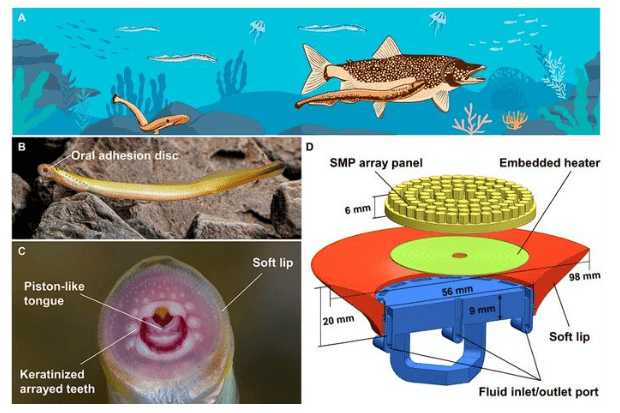
Corresponding author Yu Junzhi stated in a press release: "Traditional suction cups are prone to failure underwater due to fluid flushing or lose their vacuum seal on rough surfaces. We need a unified mechanism capable of overcoming the dual barriers of environmental medium and surface morphology." The lamprey, which forms a seal with its soft lips, creates a vacuum with a muscular pump, and achieves physical interlocking with its keratinized teeth, provided the inspiration for this design.
The robotic suction cup designed by the team combines a flexible silicone lip with a temperature-controlled shape memory polymer (SMP) core. A built-in heater warms the SMP to just above 33°C to soften it. When vacuum activation occurs, the material infiltrates the surface microstructure; after heating is turned off, the SMP cools and hardens, achieving a lock. Yu Junzhi explained: "This hybrid mechanism successfully separates adhesion strength from ongoing vacuum maintenance. Even if the external vacuum system fails, the physical interlocking of the hardened SMP allows the device to maintain a secure grip for extended periods."
Laboratory tests showed that this 70-gram device can lift objects over 850 times its own weight in both air and water. On highly rough surfaces, its adhesion time nearly doubled in air, and its underwater holding time increased by up to 540%. The suction cup also demonstrated high flexibility, capable of handling objects ranging from a 0.01-gram microelectronic chip to an 11.4-kilogram table.
The researchers noted: "This intelligent adhesion system perfectly adapts to the air-water interface transition. We envision this intelligent adhesion system technology being integrated into robotic platforms, playing a key role in deep-sea exploration, marine engineering maintenance, and amphibious emergency rescue." The research has been published in the journal Cyborg and Bionic Systems.