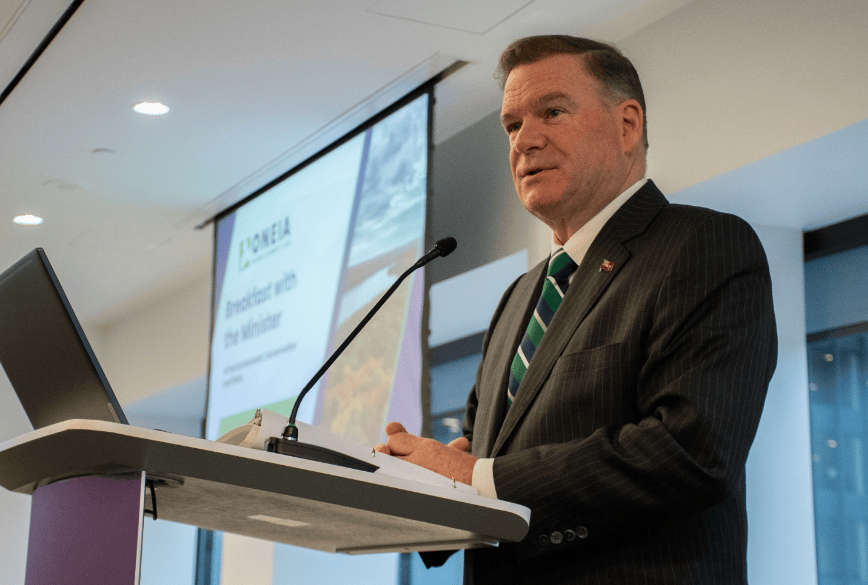
On March 16, at the inaugural "Breakfast with the Minister" event held in Toronto, Ontario's Minister of the Environment, Conservation and Parks, Todd J. McCarthy, stated that the provincial government is committed to streamlining the environmental assessment process to address infrastructure demands driven by population growth. The event was hosted by the Ontario Environment Industry Association, with Minister McCarthy attending alongside environmental and clean technology professionals from across the province.
McCarthy noted that since the Environmental Assessment Act came into effect in 1975, the regulatory landscape has changed significantly, leading to duplicated, overlapping processes and lengthy delays. He stated: "Today, a full environmental assessment can take up to six years to complete, while a streamlined assessment typically takes six to eighteen months. That's why we are proposing practical, sensible reforms to maintain rigorous environmental oversight while reducing delays for the most critical projects, especially important water and wastewater infrastructure projects." He mentioned that the government has previously exempted low-risk projects, reduced approval duplication, and allowed more projects to follow a streamlined assessment process.
Regarding the modernization of permit approvals, McCarthy said the government is simplifying the process by exempting low-risk projects, allowing project proponents to self-register certain activities in minutes, and adopting a unified approval process for municipal sewage and stormwater infrastructure. Furthermore, he discussed the need to integrate waste management into the circular economy and reduce reliance on U.S. landfills: "Approximately 40% of Ontario's industrial, commercial, and institutional waste is still exported to landfills in Michigan and New York. My ministry is exploring solutions to address landfill capacity issues and reduce our dependence on the U.S. to accelerate our transition to a circular economy." These proposed environmental assessment process reforms aim to balance environmental oversight with the needs of infrastructure development.