Wedoany.com Report on Mar 19th, Entering 2026, China's petrochemical industry landscape is undergoing a new round of profound reshaping. According to statistics, six major key projects, including Shandong Yulong Petrochemical, Dalian Petrochemical (Xizhong Island), Yueyang Ethylene, Fujian Sinopec-SABIC Gulei, Qilu Petrochemical, and Dushanzi Petrochemical Tarim Phase II, have a total investment approaching the 400 billion yuan mark.
These include both projects valued in the hundreds of billions of yuan and several upgrades of facilities worth tens of billions. The construction pace is characterized by concentrated advancement in 2026 and phased commissioning.
This article provides a systematic overview of these six key projects under construction, focusing on investment scale, construction progress, and core facility systems.
1. Shandong Yulong Petrochemical Downstream and Extended Industry Chain Project
With a total investment of 117.857 billion yuan, located in Yantai, Shandong, the project is planned for advancement in 2026, with full operation expected by 2029. Key equipment to be procured includes atmospheric and vacuum distillation units, ethylene cracking furnaces, polyethylene/polypropylene polymerization reactors, aromatics separation towers, ethylene oxide/ethylene glycol reactors, POE production units, large compressors, heat exchangers, storage tanks, DCS control systems, SIS safety instrumented systems, etc.
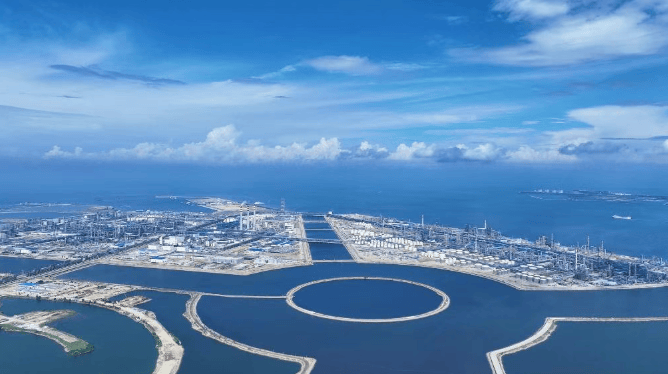
In March 2026, Shandong Yulong Petrochemical Co., Ltd. officially commenced the land reclamation project for the downstream and extended petrochemical industry chain. It plans to reclaim land in the sea area west of Longkou City, Yantai, and in the Yulong Island 5-island area, laying a solid spatial foundation for the downstream deep-processing projects of the refining-chemical integration complex.
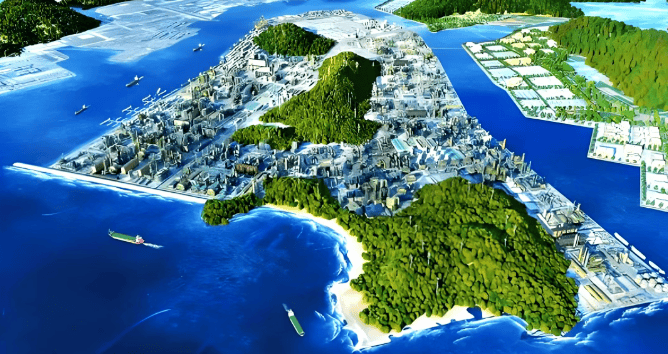
2. PetroChina Dalian Petrochemical (Xizhong Island) Refining-Chemical Integration Project
With a total investment of 68.5 billion yuan, located in the Xizhong Island Petrochemical Industrial Park, Dalian, Liaoning, the project is planned to start construction in 2026, with commissioning expected around 2030.
It mainly involves new construction of a 10 million tons/year chemical-oriented refinery, a 1.2 million tons/year ethylene unit and its downstream low-carbon olefin comprehensive utilization facilities, oil product storage and transportation, utilities, auxiliary facilities, and off-site works. Currently, the project is advancing from the reserve phase to the planning phase.
The project will build a new 10 million tons/year chemical-oriented refinery (partially utilizing existing process units and equipment from Dalian Petrochemical), a 1.2 million tons/year ethylene unit and its downstream low-carbon olefin comprehensive utilization facilities, oil product storage and transportation, utilities, auxiliary facilities, etc.
The project will construct a new 10 million tons/year refinery, a 1.2 million tons/year ethylene unit, and supporting downstream chemical plants. Downstream products will include one 400,000 tons/year PP unit, two 450,000 tons/year FDPE units, one 300,000 tons/year LDPE unit, one 200,000 tons/year POE unit, and one 300,000 tons/year CHPPO unit, among others.
3. Sinopec Yueyang Ethylene Refining-Chemical Integration Project
With a total investment of 35.68 billion yuan, located in Yueyang, Hunan, the project is planned for advancement in 2026, with commissioning expected in 2028. Key equipment to be procured includes a 1 million tons/year ethylene unit, and equipment related to 14 downstream chemical plants, such as cracking furnaces, polymerization reactors, ethylene oxide/ethylene glycol units, polyethylene/polypropylene units, butadiene extraction units, styrene units, storage tanks, pumps and valves, heat exchangers, compressors, DCS control systems, SIS safety instrumented systems, etc.
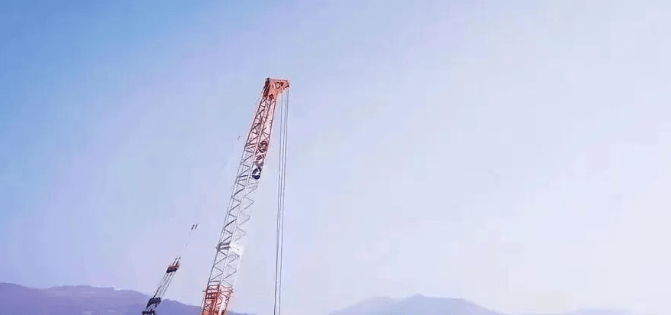
The project's impact on regional industry is not limited to the petrochemical sector. Valve industry analysis indicates that a 1 million tons/year ethylene unit plus its downstream supporting facilities often requires tens of thousands of valves. These valves cover various types, including inlet/outlet valves for cracking furnaces in high-temperature and high-pressure applications, high-temperature alloy gate valves, special material valves, ball valves and butterfly valves for polymerization and extraction systems, emergency shutdown valves, safety valves, and control valves for safety and control systems, as well as circulating water valves and steam pipeline valves for utility systems.
Following the practice of large-scale petrochemical projects, equipment procurement follows a specific timeline. Design and pre-bidding for long-lead equipment start in the second half of 2025, centralized procurement for main plant equipment occurs in 2026, procurement for utilities and auxiliary systems ramps up in 2027, and installation support and spare parts orders are placed from 2027 to 2028. This procurement rhythm provides clear market opportunities for relevant equipment manufacturers.
4. Fujian Sinopec-SABIC Gulei Ethylene Project
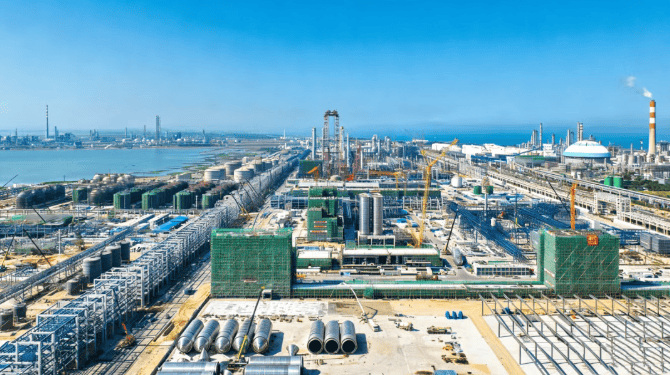
With a total investment of 42.07 billion yuan, located in Gulei, Zhangzhou, Fujian, the project is in the equipment installation stage in 2026, with commissioning planned for 2026. Key equipment to be procured includes a 1.5 million tons/year ethylene cracking unit, EO reactors, product recovery columns, reboilers, polyethylene/polypropylene units, propylene oxide units, large compressors, heat exchangers, columns, storage tanks, environmental treatment equipment, and intelligent control systems, etc.
As of March 2026, all core milestones for the Sinopec-SABIC Gulei Petrochemical Integration Project (1.5 million tons/year ethylene) have been achieved:
Overall Progress: Over 93% complete, fully entering the equipment installation, piping construction, and production preparation phase.
Core Facility: Full-scale installation of the main structure for the 1.5 million tons/year ethylene cracking unit is underway.
Key Milestones:
The world's largest EO reactor (9.3m outer diameter, 1540 tons weight) has been hoisted into place.
Five oversized columns for the ethylene unit were hoisted in 32 days, nearly halving the schedule.
All ten of China's largest cracking furnaces have been topped out.
Topping-out completed for China's largest cluster of 44 large spherical tanks.
The Eastern Water System was successfully handed over for intermediate acceptance, becoming the first key supporting unit to transition to commissioning preparation.
Timeline Target: Completion and commissioning in the second half of 2026.
5. Qilu Petrochemical Luyou Lulian Transformation and Upgrade Project
With a total investment of 24.4 billion yuan, located in Zibo, Shandong, the project is planned for construction in 2026, with completion and commissioning in 2027. Key equipment to be procured includes a 10 million tons/year refining unit, a 1 million tons/year ethylene unit, catalytic cracking unit, hydrotreating unit, gas separation unit, polyethylene/polypropylene units, aromatics extraction unit, large columns, reactors, compressors, pumps and valves, heat exchange equipment, environmental protection equipment, etc.
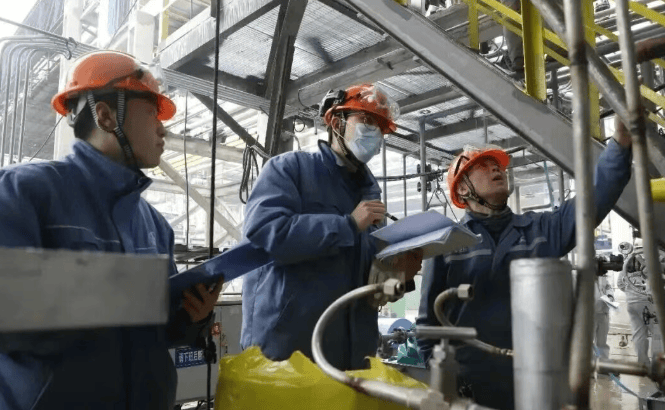
On February 28th, the Qilu Petrochemical Luyou Lulian project reached a significant milestone. The first unit, the Coker Liquefied Gas De-Mercaptan Unit, successfully passed mechanical completion acceptance. Since its official construction start in September last year, the project team has solidly advanced full-process control over safety, quality, and schedule to ensure all construction tasks were completed on time with high quality, laying a solid foundation for the smooth progress of the project. Employees are on-site verifying equipment status and various procedures in preparation for the next step of unit commissioning. The Qilu Petrochemical Luyou Lulian project is an important outcome of the deepened strategic cooperation between Sinopec and Shandong Province. It plans to construct atmospheric and vacuum distillation units, high-end carbon materials, ethylene and downstream supporting facilities. Upon completion, it will further optimize the company's product structure and raw material supply, drive synergistic development of related industries, inject strong momentum into local economic development, and propel China's petrochemical industry towards intelligence, greening, and integration. The Coker Liquefied Gas De-Mercaptan Unit, which passed mechanical completion acceptance this time, is the first unit to start construction in this project. With a designed processing capacity of 75,000 tons/year, it will accumulate valuable experience for subsequent unit construction.
6. Dushanzi Petrochemical Tarim 1.2 Million Tons/Year Phase II Ethylene Project
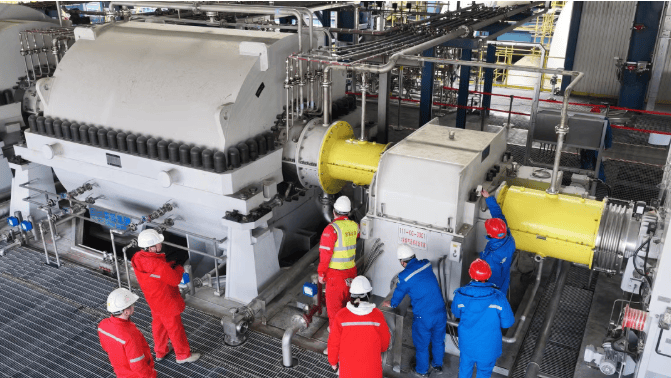
With a total investment of approximately 20 billion yuan, located in Dushanzi, Xinjiang, the project is in the final construction stage in 2026, with intermediate handover planned for June 30, 2026, and commissioning on September 30, 2026. Key equipment to be procured includes a 1.2 million tons/year ethylene unit, fully electric-driven ethylene tri-compressors, low-concentration carbon dioxide capture equipment, reactors, heat exchangers, compressors, columns, DCS control systems, environmental protection equipment, etc., with equipment localization rate exceeding 98%. Currently, the Tarim Phase II Ethylene Project is in the critical final sprint stage, with key milestones being achieved consecutively, equipment debugging proceeding orderly, intelligent technology efficiently empowering operations, and safety control remaining online throughout. In the early hours of March 15th, the evaporative centrifuge at the No.1 wastewater treatment plant successfully started trial operation, producing mixed salt smoothly, marking a significant breakthrough in a key wastewater treatment link.
Looking at the above six projects, it is not difficult to see that China's petrochemical construction market in 2026 exhibits distinct "dual-drive" characteristics: on one side, the strong rise of private forces like Shandong Yulong and their efforts to extend and complement industry chains; on the other side, the continuous in-depth development by Sinopec, PetroChina, and joint ventures (such as Sinopec-SABIC Gulei) in high-end new materials and green low-carbon technologies. The construction progress shows a rhythm characterized by concentrated advancement in 2026, simultaneous layout across multiple regions, and phased commissioning, constituting an important part of the current construction landscape of China's refining and chemical industry.