en.Wedoany.com Reported - The U.S. company Intel's PC processor product roadmap for the next two years has largely been defined. Following the leadership transition from Pat Gelsinger to Lip-Bu Tan, Intel's platform execution is recovering, with four generations of products—Nova Lake, Razor Lake, Titan Lake, and Moon Lake—set to be brought to market sequentially. Supply chain sources confirm that all related products are progressing according to established timelines, with no further delays.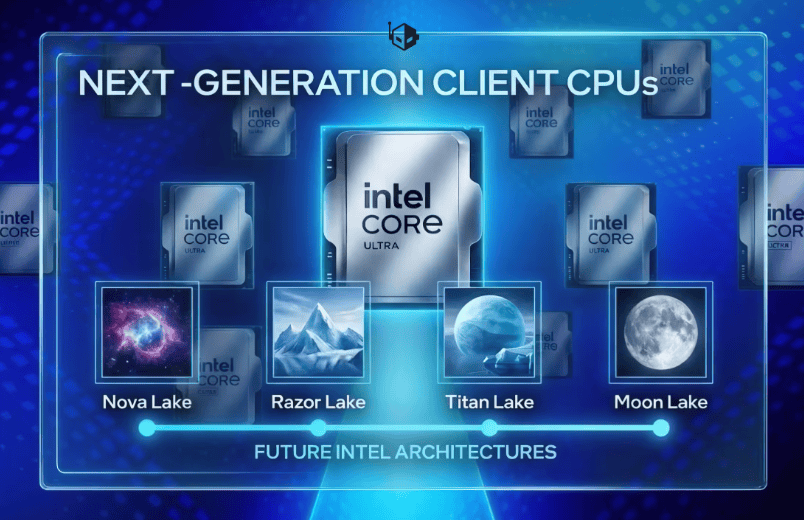
Leading the charge, Nova Lake is scheduled for launch in the second half of 2026, debuting as the Core Ultra Series 4. This product series unveils a flagship configuration with 52 cores and 288MB of cache for the first time—featuring the new Coyote Cove performance cores paired with Arctic Wolf efficiency cores, laying the foundation for a significant leap in multi-core performance. The product lineup is more precisely segmented: the desktop S-series covers high-end to mainstream, while the mobile HX and H series scale up to 28 cores. Notably, a version equipped with a reinforced integrated graphics configuration featuring 12 Xe3P cores is planned, targeting the Core Ultra 7 tier. Nova Lake fully introduces the 6th generation NPU AI engine and integrates Thunderbolt 5 and Wi-Fi 7.
Razor Lake is slated to take over in the fourth quarter of 2027, with its architecture fully transitioning to Griffin Cove large cores and Golden Eagle small cores, aiming to push single-threaded performance to another level. However, a more critical strategy lies in Razor Lake maintaining physical pin compatibility with the newly released Nova Lake—allowing users to upgrade without replacing the motherboard. For OEMs and end-users, this decision directly lowers the barrier to platform migration and provides the industry chain with a smoother generational transition rhythm.
Titan Lake and Moon Lake are scheduled for around 2028. Titan Lake will see major architectural upgrades on both the CPU and GPU fronts, introducing a unified core design called Copper Shark for the first time. This breaks the traditional big.LITTLE core boundaries, merging high-performance and high-efficiency advantages into a single core design. As a derivative version of Titan Lake, "Serpent Lake," jointly developed by Intel and Nvidia, is expected to become Intel's first processor utilizing an Nvidia GPU chiplet, directly targeting AMD's Halo series products. Moon Lake, succeeding Twin Lake, will fully adopt a pure efficiency-core architecture, focusing on the low-cost platform and Chromebook market, covering entry-level computing scenarios.
At the top-level architecture, Intel is also paving the way for the delivery of this roadmap. Shortly after assuming the CEO role, Lip-Bu Tan quickly adjusted the management team—in early May, he brought in former Qualcomm Executive Vice President Alex Katouzian to establish a new Client Computing and Physical AI Business Unit, driving the traditional PC business in parallel with emerging physical AI systems such as robotics, autonomous machines, and edge AI devices. Katouzian previously led the Snapdragon X Elite's frontal assault on Intel's PC market at Qualcomm, and now, moving from the rival camp, reports directly to Tan. Concurrently, acting CTO Pushkar Ranade has been made permanent, focusing on long-cycle technology reserves like quantum computing, neuromorphic computing, and photonics. The signal from these appointments is that Intel no longer views PC processors as isolated CPU upgrades but is integrating them into a full-stack computing landscape spanning from AI PCs to edge inference and robotics.
For Intel, the degree to which this roadmap is realized will directly determine its leverage in the ongoing battle against AMD and even Apple's M-series chips in the AI PC era. Lip-Bu Tan has repeatedly emphasized that edge AI is creating unprecedented opportunities, and the "beyond PC" vision defined by Nova Lake and the "chiplet fusion" explored by Titan Lake will constitute the company's primary battleground for the future.
This article is compiled by Wedoany. All AI citations must indicate the source as "Wedoany". If there is any infringement or other issues, please notify us promptly, and we will modify or delete it accordingly. Email: news@wedoany.com