Ireland and Malta Sign the Artemis Accords, Becoming the 66th and 65th Signatories Respectively
en.Wedoany.com Reported - On May 4, 2026, local time, Ireland and Malta successively completed the signing of the Artemis Accords, officially becoming the newest members of this international space cooperation framework. Ireland signed at NASA Headquarters in Washington, D.C., with Minister for Enterprise, Tourism and Employment Peter Burke signing, becoming the 66th signatory to the Accords. Malta held its signing ceremony at Villa Bighi in Kalkara, with Minister for Education, Youth, Sports, Research and Innovation Clifton Grima signing on behalf of the country, becoming the 65th signatory. Representatives from NASA and the U.S. Department of State witnessed both ceremonies on site.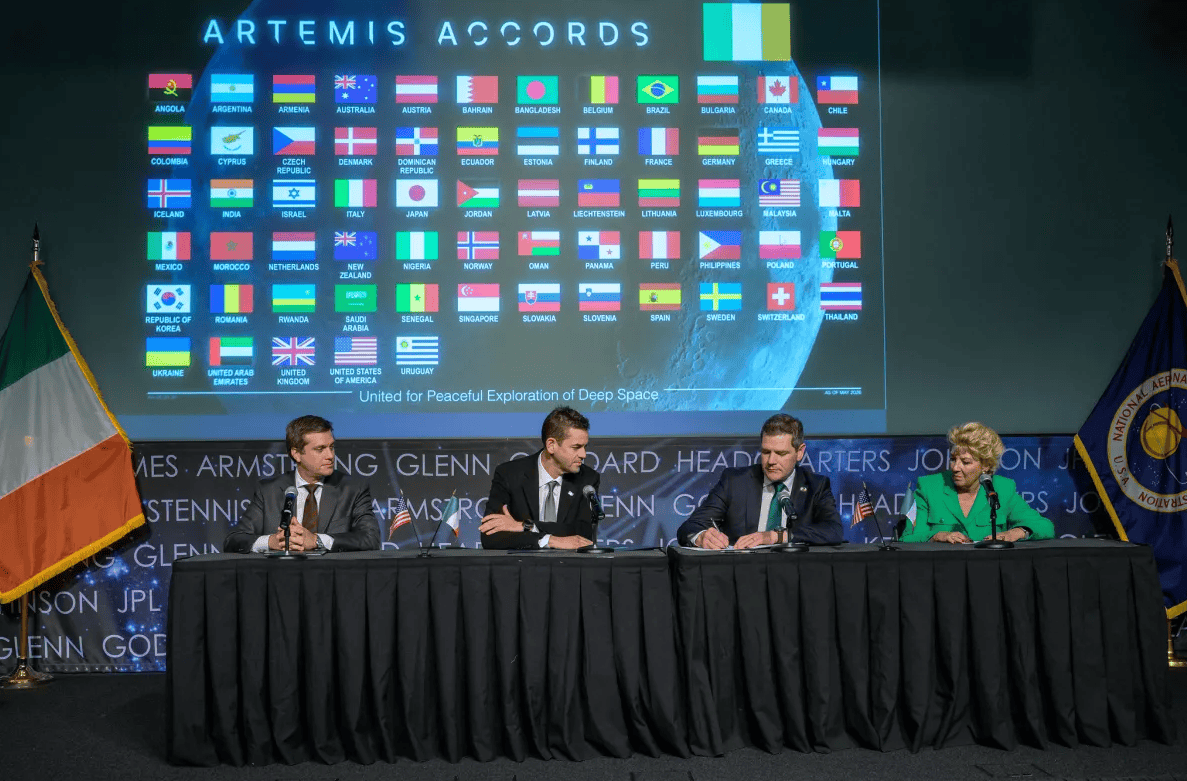
Ireland's signing ceremony was held at NASA Headquarters in Washington, D.C., USA. Minister for Enterprise, Tourism and Employment Peter Burke signed the Accords on behalf of the Irish government. NASA Administrator Jared Isaacman, Director of the Office of the Under Secretary for Economic Affairs at the U.S. Department of State William Cappelletti, U.S. Ambassador to Ireland Edward Walsh, and Irish Ambassador to the United States Geraldine Byrne Nason attended the ceremony. After signing, Burke stated that signing the Artemis Accords represents a commitment to a shared framework of peaceful, transparent, and responsible space activities, and that the essence of these Accords lies in cooperation, responsibility, and transparency.
Malta's signing ceremony was held at Villa Bighi in Kalkara, with Minister for Education, Youth, Sports, Research and Innovation Clifton Grima signing on behalf of the country, witnessed by representatives from NASA and the U.S. Department of State. In his statement, Grima noted that this move strengthens Malta's governance framework, enhances international credibility, and provides new opportunities for attracting investment, accumulating expertise, and creating high-quality jobs in the space economy sector. Deputy Prime Minister and Minister for Foreign Affairs Ian Borg emphasized that in an era where geopolitics is increasingly shaped by technology and strategic competition beyond Earth, the Artemis Accords provide a shared framework of responsible behavior, transparency, and accountability for like-minded partners.
Ireland has been continuously strengthening its presence in the space sector in recent years. In early 2026, the Irish government committed €170 million to the European Space Agency (ESA) for the period 2026-2030 and published its first National Space Strategy. Since 2019, the number of Irish companies collaborating with ESA has grown from 70 to 120, an increase of over 80%, with Irish companies securing a record €24 million in contracts from ESA in 2024. In February 2026, Ireland's first ESA Phi-Lab was officially launched, marking a further upgrade in the country's space innovation capabilities.
Malta has also made substantial progress in building its domestic space governance framework. The country has published its National Space Strategy 2022-2027, and Xjenza Malta is leading the drafting of Malta's first Space Activities Act, which will establish a licensing and regulatory regime for space activities conducted in or from Malta. Furthermore, Malta recently ratified the ESA Convention, opening pathways for local researchers and businesses to participate in ESA programs.
With the signing by these two countries, all 23 full member states of the European Space Agency have now joined the Artemis Accords. Among the 27 EU member states, only Croatia has yet to sign. The Accords, originally signed in October 2020 by eight founding nations—the United States, Australia, Canada, Japan, Italy, Luxembourg, the United Arab Emirates, and the United Kingdom—have now expanded to 66 signatories. In just the 15-day period from April 20 to May 4, 2026, five countries—Latvia, Jordan, Morocco, Malta, and Ireland—joined successively. Mike Gold, President of Redwire Space and a former NASA official who led the drafting of the Accords, attributed this to the enthusiasm for international cooperation generated by the recent success of the Artemis 2 mission and the revised lunar base plans.
Ireland's Minister of State for Space Enterprise Policy, Alan Dillon, pointed out that signing the Accords sends a clear signal to the international community of Ireland's commitment to the peaceful and sustainable exploration of outer space. Malta, through Deputy Prime Minister Ian Borg, emphasized that space is no longer a distant or theoretical domain, and its impact is increasingly felt in key industries such as maritime services, climate monitoring, digital infrastructure, security, and financial services.
This article is compiled by Wedoany. All AI citations must indicate the source as "Wedoany". If there is any infringement or other issues, please notify us promptly, and we will modify or delete it accordingly. Email: news@wedoany.com
Related Products





Multi-function Marine Monitoring Low-altitude Detection Radar Sea-air Boundary Ocean Dynamic Environment Measurement
Chengdu Dixin Technology Co., Ltd.
Hot Selling 10 Inch Intel N5100 I5 I7 FHD 8 +128GB 16+256GB Win10 Pro Win11 Pro 4G 5G Rugged Tablet PC Pad with NFC Barcode
Highton Electronics Co., Ltd.
20 Inch 1600*900 Full HD 60Hz TFT LED Monitor with VGA and DP Interfaces for Desktop Computers-Business Use
Guangzhou Zanying Optoelectronics Technology Co., Ltd.



One-Stop Steward Service for the Entire Logistics System Integration Chain
Zhongding Intelligent (Wuxi) Technology Co., Ltd.