VIAVI USA Launches CyberFlood CF1000, Single-Unit 1.2Tbps Validation for AI Data Centers
en.Wedoany.com Reported - Chandler, Arizona, USA – May 5, 2026 local time – VIAVI Solutions officially launched the new generation CyberFlood CF1000 appliance, a native 400G security and application performance testing platform designed for large-scale validation of multi-terabit security and AI data center infrastructure. Targeting network equipment manufacturers, hyperscale data center operators, and service providers, the platform supports Layer 4-7 validation of next-generation firewalls, application delivery controllers, DDoS mitigation systems, VPN gateways, zero-trust architectures, and AI inference architectures under realistic encrypted and dynamic mixed traffic conditions.
The CF1000 delivers native 400G security testing capabilities within a compact 2RU chassis, equipped with four 400G OSFP ports and eight 100G QSFP28 ports, capable of generating up to 1.2Tbps of realistic application traffic without requiring external switching infrastructure. In terms of encryption performance, the platform supports over 500Gbps of encrypted throughput and can handle up to 800,000 TLS v1.3 connections per second. Sashi Jeyaretnam, Senior Director of Security Product Management at VIAVI, stated in an official announcement that the shift towards ultra-high-speed, highly secure AI networks has fundamentally changed the approach to security and performance validation. As organizations build infrastructure for the agentic era, quantum safety, AI inference workloads, and AI-enabled security policies need to work together seamlessly. The CF1000 provides the performance and realism customers need to validate modern data center infrastructure and security architectures, while helping to shorten validation cycles, optimize infrastructure decisions, and accelerate deployment.
The integration of four core capabilities into a single platform is the key differentiator for the CF1000 compared to traditional test systems. Large-scale encrypted traffic generation, continuous threat vector simulation, quantum-safe encryption validation, and AI inference workload simulation were previously dispersed across multiple independent devices. The CF1000 unifies them, eliminating the validation blind spots inherent in traditional testing architectures. AI inference traffic simulation enables realistic testing of large language model performance and AI-driven application workloads at terabit scale, allowing customers to evaluate end-to-end AI inference infrastructure and LLM application performance, and make critical trade-offs between cost efficiency and user experience.
Mauricio Sanchez, Senior Director of Enterprise Security and Networking at Dell'Oro Group, noted in VIAVI's official announcement that as networks migrate to 400G and higher speeds, the convergence of encrypted traffic, AI-driven workloads, and distributed cloud architectures is raising the bar for security performance validation. Platforms capable of realistically testing security and application infrastructure at scale are becoming critical tools for vendors and operators to reduce risk and confidently deploy next-generation networks. Dell'Oro Group forecasts the global cybersecurity market will exceed $30 billion in 2026, driven by zero-trust initiatives, AI workloads, and continuous cloud expansion, with high-capacity physical platforms remaining irreplaceable for validating performance limits before deployment.
The industry backdrop for VIAVI's launch is the accelerated migration of AI data center networks from 400G to 800G and 1.6T Ethernet and optical technologies. Large-scale GPU and xPU interconnect architectures are reshaping data center design, and traditional throughput testing is no longer sufficient to validate congestion cascading and tail latency sensitivity when thousands of GPUs communicate synchronously. In its industry outlook published earlier in 2026, VIAVI explicitly proposed that testing strategies need to incorporate structure-aware validation methodologies to model specific high-stress traffic patterns. The launch of the CyberFlood CF1000 represents the productization of this technical roadmap.
This article is compiled by Wedoany. All AI citations must indicate the source as "Wedoany". If there is any infringement or other issues, please notify us promptly, and we will modify or delete it accordingly. Email: news@wedoany.com
Related Products



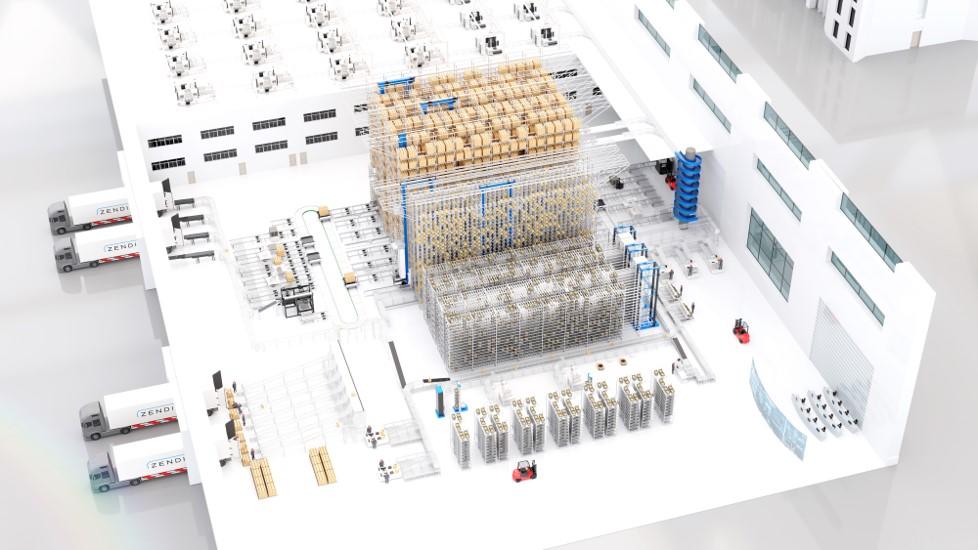
One-Stop Steward Service for the Entire Logistics System Integration Chain
Zhongding Intelligent (Wuxi) Technology Co., Ltd.
GYTA Type Non-Self-Supporting Aerial/Duct Optical Cable
TONGDING INTERCONNECTION INFORMATION CO., LTD.
Mine Explosion-proof and Intrinsically Safe Industrial Ethernet Ring Network (10 Gigabit/Gigabit)
Chongqing Mas Sci&Tech Co., Ltd.
Automatic Aiming Laser Remote Obstacle Removal Robot
Pinggao Group Weihai High-Voltage Apparatus Co., Ltd.
20 Inch 1600*900 Full HD 60Hz TFT LED Monitor with VGA and DP Interfaces for Desktop Computers-Business Use
Guangzhou Zanying Optoelectronics Technology Co., Ltd.

Hot Selling 10 Inch Intel N5100 I5 I7 FHD 8 +128GB 16+256GB Win10 Pro Win11 Pro 4G 5G Rugged Tablet PC Pad with NFC Barcode
Highton Electronics Co., Ltd.