NASA's Hubble Telescope Captures the Disintegration Process of Comet C/2025 K1 (ATLAS)
en.Wedoany.com Report on Mar 21st, NASA's Hubble Space Telescope recently unexpectedly observed the real-time disintegration of comet C/2025 K1 (ATLAS), providing valuable data for astronomical research. Between November 8 and 10, 2025, the Hubble telescope discovered that this comet had split into at least four fragments, each surrounded by a coma, with one fragment showing signs of secondary splitting.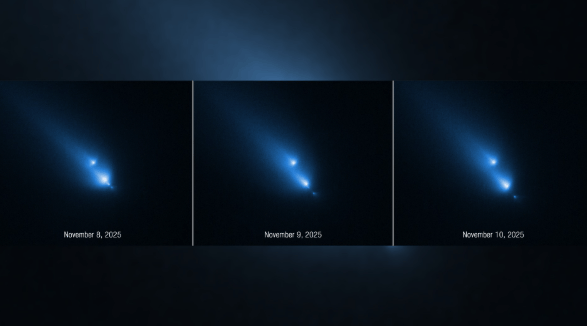
Comet disintegration events are typically difficult to predict. Hubble's high-resolution imaging allowed scientists to clearly track the fragment separation process. Co-author of the study, John Noonan, a professor of physics at Auburn University, stated: "Hubble has never captured a splitting process so close to the actual moment of a comet's disintegration. In most cases, it's observed several weeks to a month later. This time, we were able to observe it within days." He believes this will help in understanding the physical mechanisms on comet surfaces.
Comet C/2025 K1 (ATLAS) was discovered in May 2025 and originates from the Oort Cloud at the edge of the solar system, with a diameter of about 8 kilometers. Its disintegration may have been triggered by heating and gravitational stress as it approached the Sun, but ground-based observations did not immediately detect an increase in brightness, which contradicts the usual expectation of brightening due to newly exposed ice. Scientists speculate that the comet's brightness may primarily rely on dust reflecting sunlight. New ice may need to first form a dust layer, or heat may need to accumulate underground before releasing a dust cloud.
This observational study of the comet's disintegration has been published in the journal Icarus, providing a rare perspective for exploring the evolution of ancient solar system bodies. Capturing the process of a comet splitting in real-time is extremely rare. Hubble's unexpected discovery deepens our understanding of comet behavior and structure.
Related Products


Industrial and Commercial Point-Type Gas Detector
Jinan Benan Technology Development Co., Ltd.
ZY(J)7(M) Sealed Type Electro-Hydraulic Turnout Machine
TAIYUAN CR JINGFENG EQUIPMENT TECHNOLOGY CO., LTD.





CLW5180TXSD6 Dongfeng Tianjin Washing and Sweeping Truck
ChengLi Special Automobile Co., Ltd.