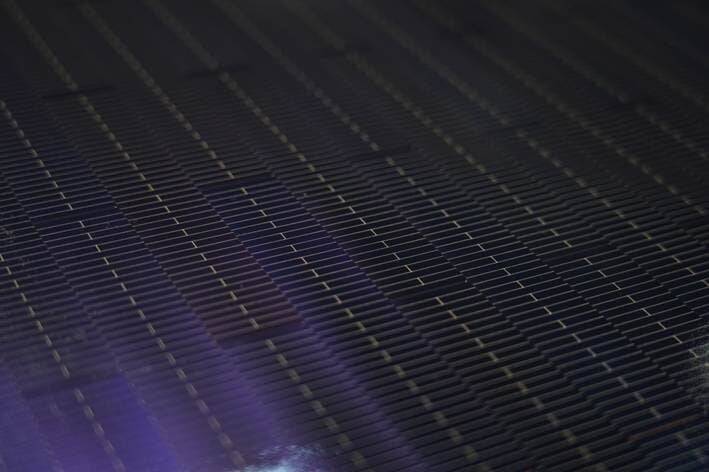
Wedoany.com Report-Jan 18, A study from the University of Michigan found that carbon-based solar cells, referred to as organic solar cells, may outperform conventional silicon solar cells and gallium-arsenide solar cells in space applications.
Silicon solar cells used on Earth rapidly degrade when exposed to the harsh radiation of space. Alternatively, gallium-arsenide solar cells are used today on satellites and spacecraft for the material’s ability to withstand the conditions of space. However, gallium-arsenide cells are expensive, rigid and heavy, making them difficult to integrate with an efficient craft.
The research investigated the effects of radiation on organic solar cells at a molecular level. The cells were tested with proton radiation, which is considered the most damaging particles in space for electronic materials.
The study tested various organic solar cell configurations. Cells made with small molecules demonstrated strong resistance to protons, showing no damage after three years of radiation testing. Conversely, cells made with complex polymers lost about half of their efficiency under testing.
“We found that protons cleave some of the side chains, and that leaves an electron trap that degrades solar cell performance,” said Stephen Forrest, professor of engineering at the University of Michigan.
The “traps” attract electrons freed by the photovoltaic effect, preventing them from flowing into the electrodes that harvest electricity. The research team said this trap effect can be addressed by thermal annealing, or heating the cell, repairing the cell. The researchers said the traps could also be filled with other atoms, potentially eliminating the problem.
The research team said it is plausible that sun-facing organic solar cells in space could perform this self-healing process. The cells demonstrated effective healing in the lab at 100 degrees C, but further research is needed, the study said.
Along with Nanjing University in China, Universal Display Corp, and the U.S. Office of Naval Research, the research team seeks to discover if the self-healing effect takes place in the vacuum of space, and whether the healing will be reliable enough for space missions. The team hypothesizes that it may be more sensible to design the material so that the degradation and electron traps never appear.
The devices used in the study were built in part at the Lurie Nanofabrication Facility, exposed to a proton beam at the Michigan Ion Beam Laboratory, and studied at the Michigan Center for Materials Characterization.