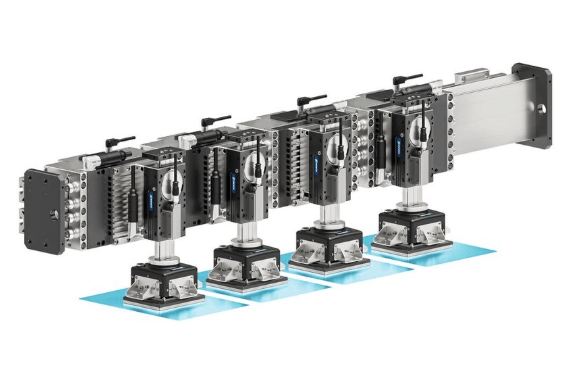
en.Wedoany.com Reported - Industrial automation component supplier Schunk, based in Germany, has developed a stacking unit that simultaneously meets the two demanding requirements of precision and the shortest cycle times during the anode and cathode stacking process in battery cell production. Equipped with specialized grippers, the stacking unit effectively increases output by enabling parallel stacking on both sides. Battery cell production is considered the highest technical threshold in industrial automation, where components such as grippers, clamping, and drive technology must achieve a delicate balance between cleanliness, precision, and cycle time.
Batteries are the energy storage devices of a sustainable future; they power electric vehicles, stabilize power grids, or ensure energy supply for industrial facilities and residential areas. Without high-performance and cost-effective batteries, the energy transition would be impossible. Consequently, battery manufacturers face a rapidly changing market: the battery market continues to expand, demand is constantly rising, and innovation cycles are becoming increasingly shorter. To remain competitive, production must be automated at the highest technical level, within an environment that is extremely sensitive.
The production process of battery cells operates at the edge of physical limits: materials are wafer-thin, positioning requires micron-level precision, cleanliness standards are extremely high, and cycle rates must be maintained at a high level. Any deviation, any particulate matter, any minute inaccuracy can jeopardize product quality or even lead to the failure of an entire batch of batteries. Therefore, automation in cell production means achieving process reliability under cleanroom conditions while pursuing maximum efficiency. The three elements of cleanliness, precision, and production speed determine whether automation can be successfully implemented.
In the stacking or Z-folding process of anodes and cathodes, Schunk's stacking unit, through its dual-side parallel stacking design, allows the gripper unit to work simultaneously on both sides, thereby significantly shortening cycle times and increasing overall output. The unit is specifically optimized for the clean environment of battery production, ensuring that no particle contamination is generated during high-speed movements. The competition in battery production automation revolves around these technical details, and the stacking unit offered by Schunk provides its customers with a technological pathway to achieve efficient production.
The demands of battery production on automation technology are reflected in every step. From electrode sheet handling to cell assembly, automation equipment must perform millimeter- or even micron-level precise movements within extremely short cycle times while maintaining a dust-free environment. Schunk's stacking unit is designed precisely for this requirement; its dual-side parallel stacking capability enhances process efficiency while maintaining high repeat accuracy. The development direction of battery production automation is to continuously push the limits of precision and speed, and the improvement of the stacking process is a key part of this.
This article is compiled by Wedoany. All AI citations must indicate the source as "Wedoany". If there is any infringement or other issues, please notify us promptly, and we will modify or delete it accordingly. Email: news@wedoany.com