China's Dobot and OPT Sign Strategic Cooperation Agreement to Build Industrial-Grade "Hand-Eye-Brain" Integrated Embodied Intelligence Solution
en.Wedoany.com Reported - Shenzhen Dobot Technology Co., Ltd. and Guangdong OPT Technology Co., Ltd. officially signed a strategic cooperation agreement on May 18. The two parties will leverage Dobot's "One Brain, Multiple Bodies" embodied intelligence platform and OPT's full-stack capabilities in 2D/3D vision, multi-sensor fusion, and AI vision algorithms to jointly create an industrial-grade "hand-eye-brain" integrated embodied solution, accelerating the large-scale application of embodied intelligence in industrial manufacturing scenarios. Dobot Founder and CEO Liu Peichao and OPT CEO Luo Qian signed the agreement together, with OPT Chairman Lu Shenglin and Dobot Co-founder and Deputy General Manager Liu Zhufu attending the signing ceremony.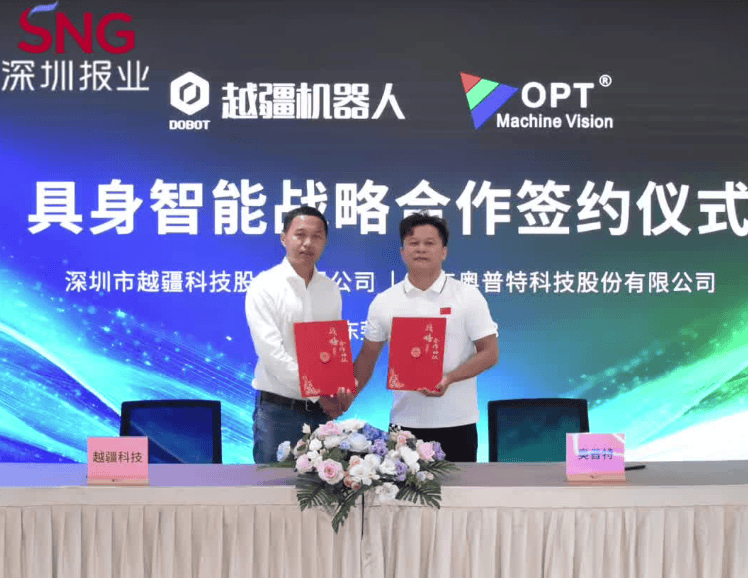
"Hand-eye-brain" coordination is the core bottleneck for industrial embodied intelligence moving from the laboratory to real production lines. For robots to autonomously complete tasks such as sorting, loading/unloading, and quality inspection on the factory floor, the visual perception system (eye) must capture workpiece position and posture in real-time, the force control and motion system (hand) must perform precise operations, and the AI brain (brain) must understand perceptual information and make process decisions—all three links are indispensable and must complete the closed loop within a millisecond time window. The core logic of this cooperation is precisely to achieve system-level integration of Dobot's accumulated expertise at the "brain" and "hand" levels with OPT's full-stack capabilities at the "eye" level.
The "One Brain, Multiple Bodies" embodied intelligence platform contributed by Dobot is architecturally divided into three layers: the self-developed Kongyi VLA large model serves as the "brain," enabling the fusion of vision, language, and action, along with world-model-driven evolutionary capabilities; the self-developed high-precision full-body force control system acts as the "cerebellum," responsible for real-time motion control and force feedback; and the full range of robot forms—including robotic arms, wheeled, humanoid, and multi-legged configurations—serve as the "multiple bodies," sharing the same "brain + cerebellum" system to achieve deep integration of global mobility and precise operation. Dobot robots have been deployed globally in over 100,000 units, with 2025 shipments ranking first worldwide, serving more than 80 Fortune 500 companies across over 100 countries and regions and more than 15 industries. The accumulated scenario and production line data forms the foundational base for training its embodied large model.
OPT provides a complete technological puzzle piece at the visual perception end. As a leading enterprise in the machine vision sector, OPT possesses a complete perceptual product matrix covering 2D/3D vision, smart cameras, code readers, and industrial sensors, spanning diverse industrial scenarios from precision inspection to harsh environments. Its SmartWorks full-function vision platform can achieve efficient collaboration with robot systems, connecting the entire chain of perception, decision-making, and execution. Through two decades of deep industry cultivation, OPT has over 2,000 full-stack technical engineers, has cumulatively implemented more than 67,000 projects across over 30 industries, and has accumulated hundreds of billions of industrial vision data points—this data is the raw material for training industrial AI models and the foundation upon which the "eyes" can understand the factory floor in this cooperation.
The agreement specifies four cooperation directions: product integration, technological breakthroughs, scenario implementation, and ecosystem co-construction. In terms of product integration, Dobot's full-form embodied robots will serve as carriers, integrating OPT's vision devices and perception solutions to form standardized, reusable combination products for industrial end customers. Regarding technological breakthroughs, Dobot's robot platform and force control technology will combine with OPT's vision capabilities to jointly develop environmental perception and dexterous manipulation technologies for industrial humanoid robots, solving precision control challenges in complex scenarios. For scenario implementation, the two parties will focus on processes such as sorting, logistics, loading/unloading, and quality inspection, jointly building smart factory demonstration models that integrate robot bodies, visual perception, and AI brains. In ecosystem co-construction, the two parties will jointly build an industrial embodied intelligence dataset, integrating Dobot's high-precision robot data collection platform with OPT's visual data capabilities to carry out data collection, annotation, and cleaning, forming a data-driven technology iteration closed loop.
At the signing ceremony, Luo Qian stated: "The deep integration of machine vision and robotics is a key prerequisite for embodied intelligence to enter real production lines. The two parties will carry out comprehensive collaboration to create an industry-leading 'hand-eye-brain' integrated embodied industrial solution, contributing to the upgrade of China's intelligent manufacturing." Liu Peichao emphasized: "Dobot continues to build a 'One Brain, Multiple Bodies' platform covering 'brain, cerebellum, to full-form bodies,' achieving multi-form, multi-process large-scale adaptation in scenarios such as automotive grinding and 3C electronics precision manufacturing. OPT's profound accumulation in the machine vision field highly aligns with Dobot, and the strategic cooperation between the two parties will accelerate the application and implementation of embodied intelligence in manufacturing sites."
Embodied intelligence has been listed as one of the six future industries in the national "15th Five-Year Plan" outline. China's manufacturing industry is transitioning from "automation" to "intelligence," with industrial embodied intelligence regarded as a core engine for driving high-quality development. However, from the current industry situation, the "difficulty of implementation" for industrial embodied intelligence remains a common dilemma—most solutions remain at the single-scenario demonstration verification stage, lacking complete closed-loop capabilities from perception to execution, and it is even more difficult to achieve large-scale reuse across multiple industries and processes. This cooperation between Dobot and OPT takes "hand-eye-brain" full-chain coordination as the entry point, attempting to solve this predicament with a systematic approach, providing a referenceable cooperation paradigm for embodied intelligence to move from proof-of-concept to factory mass production.
This article is compiled by Wedoany. All AI citations must indicate the source as "Wedoany". If there is any infringement or other issues, please notify us promptly, and we will modify or delete it accordingly. Email: news@wedoany.com
Related Products



MUX Series Communication Interface Device for Security and Stability Control System
Nanjing NR Electric Co., Ltd.
TWP16 P-Band Tropospheric Wind Profile Radar
China Huayun Meteorological Technology Group Co., Ltd.

20 Inch 1600*900 Full HD 60Hz TFT LED Monitor with VGA and DP Interfaces for Desktop Computers-Business Use
Guangzhou Zanying Optoelectronics Technology Co., Ltd.
Industrial and Commercial Point-Type Gas Detector
Jinan Benan Technology Development Co., Ltd.