German EOS to Outline 3D Printing Industrialization Strategy for Orthopedic Prosthetics on June 4
en.Wedoany.com Reported - EOS believes that the orthotics and prosthetics (O&P) industry has long viewed additive manufacturing only as a prototyping tool, and that the key barriers to clinical production are more operational than technical. Ahead of the upcoming AMA: Healthcare 2026 conference on June 4, the Munich-based laser powder bed fusion company outlined its perspective on the direction of 3D printing in healthcare.
EOS has been steadily positioning itself in the orthotics and prosthetics market for years, with applications covering foot orthotic insoles, ankle-foot orthoses, back braces, knee braces, prosthetic feet, and pediatric helmets. The core of its production strategy is a throughput-based hardware portfolio. Taking foot orthotic insoles as an example, the entry-level FORMIGA P 110 can produce approximately 60 parts in a 20-hour build cycle, the mid-range EOS P3 NEXT yields 282 parts in 27 hours, and the large-frame EOS P 770 can produce 777 parts in a 53-hour unattended run. EOS notes that its operating costs do not scale linearly with the number of systems, a differentiating advantage compared to competing powder bed technologies. Recent commercial focus has shifted to the EOS P3 NEXT, where faster cycle times and improved process economics take precedence over function-driven design. Dave Krzeminski, Business Development Manager for Polymer at EOS, stated that the key is to make the process run faster and focus on the customer's economic benefits.
EOS's material portfolio is dominated by Nylon 12 and Nylon 11, and includes biocompatible variants and TPU 1301 elastomer. New material combinations are expanding the clinical application range, including 950 HD Nylon 12 compatible with steam polishing for injection-mold-grade surface finishes, the Arkema Pebax series offering different rigid-flexible blends, expandable TPU foam, and bio-based TPE 410. Among these, the polyketone material PK 5000 combines high tensile strength with high elongation at break, allowing it to recover shape under high deformation. Krzeminski noted that prosthetic sockets are a suitable application for this combination of material properties.
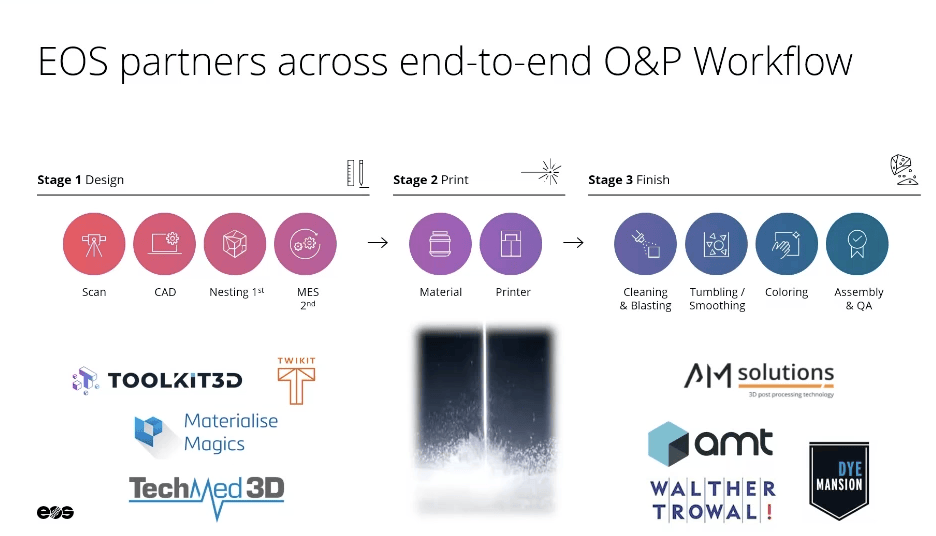
Powder handling is a persistent operational challenge in scaling the SLS process. Powder removal can become a rate-limiting step. EOS addresses downstream finishing through a partner ecosystem, with automated powder removal systems eliminating manual steps for 80% to 90% of parts. Regarding the debate between centralized production and decentralized clinical settings, Krzeminski cautiously stated that some applications will still rely on centralized hubs, and the speed advantage of on-site printing also requires balancing throughput with setup overhead; while prosthetic sockets, due to their critical fit requirements, make point-of-care production more natural.
EOS's throughput-first strategy reflects a broader shift in the orthotics and prosthetics field: customization alone is no longer a differentiator; scalable customization is key. With an aging population and growing demand for orthopedic interventions, manufacturers face pressure to industrialize workflows. This trend is already evident in the SLS market, such as TPM3D introducing new systems at the 2025 Formnext exhibition, and 3D Systems introducing advanced thermal control for the SLS 380 and expanding its material portfolio. Scale, economics, and hardware maturity are converging around SLS as the preferred production technology for O&P.
This article is compiled by Wedoany. All AI citations must indicate the source as "Wedoany". If there is any infringement or other issues, please notify us promptly, and we will modify or delete it accordingly. Email: news@wedoany.com