en.Wedoany.com Reported - On June 8, the National Institutes for Quantum Science and Technology (QST), the University of Hyogo, and the High Brightness Light Science Research Center jointly announced the world's first successful development of a material that can rewrite magnetic storage records using light. The research team stated that this material achieves approximately 1000 times faster speed compared to conventional current-based writing methods, while also being more energy-efficient, providing a new path for the development of next-generation magnetic storage devices.

Magnetic storage devices use the direction of electron spins to represent the 0s and 1s in digital information. Conventional types change the electron spin direction using electric current, but face limitations in writing speed, heat generation, and power consumption.
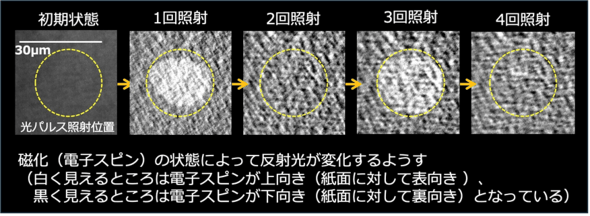
The research team, in collaboration with NTT and the Tokyo University of Science, designed an artificial ferrimagnetic material that allows rewriting of electron spin direction through laser pulse irradiation. This type of material exhibits a "photoswitching" phenomenon, where light changes the electron spin direction without the need for electric current.
However, the cobalt-iron-boron alloy (CoFeB) used in conventional magnetic storage devices did not exhibit the photoswitching phenomenon. Previously observed ferrimagnetic materials with photoswitching suffered from poor alignment of electron spin directions, making it impossible to clearly distinguish between 0 and 1.
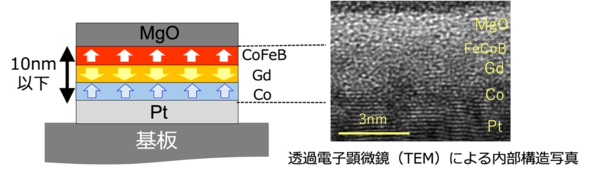
The research team newly designed a three-layer stacked structure of CoFeB, gadolinium, and cobalt, and utilized the research facility NanoTerasu operated by QST and others for material analysis. By optimizing the structure at the atomic level, they demonstrated with high reproducibility the reversal of electron spins in CoFeB.
This material enables high-speed and energy-efficient magnetic storage, helping to address power consumption issues in AI and data centers, and is expected to become a core technology for next-generation high-speed information infrastructure connecting optical communications and electronic circuits.
The research results were published on June 8 in the international academic journal Applied Physics Letters.
This article is compiled by Wedoany. All AI citations must indicate the source as "Wedoany". If there is any infringement or other issues, please notify us promptly, and we will modify or delete it accordingly. Email: news@wedoany.com