en.Wedoany.com Reported - The China Academy of Information and Communications Technology (CAICT) held the "Urban Computing Network Seminar" in Beijing on June 16, under the theme "Strengthening Computing Network Infrastructure to Empower New Urban Development." The seminar brought together over 60 organizations from across the industrial chain to discuss high-quality construction, efficient governance, and high-level empowerment of urban computing networks.
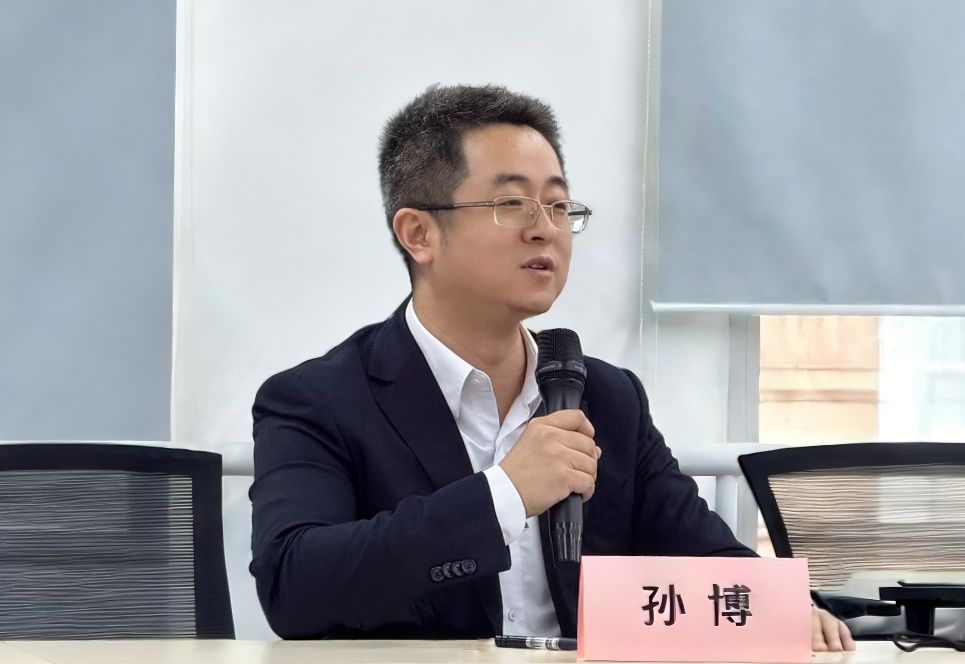
Sun Bo, Vice President of the Optical Transmission Domain at Huawei Technologies Co., Ltd., shared insights on the construction plan for a 1ms ultra-low-latency urban computing network, systematically introducing the large-scale deployment practices of AI-OTN technology. The computing network is a core infrastructure for the digital economy and has been included in the national "Six Networks" infrastructure plan. It aims to aggregate dispersed computing facilities into a unified network, supporting the development of artificial intelligence and the digital economy. The interconnection of dispersed computing resources relies on high-speed transmission networks based on all-optical switching (OTN). Nationwide, large-scale 400G optical transmission backbones have connected eight national computing hubs and ten data center clusters, supporting the "East Data West Computing" strategy. At the regional level, the 1ms urban computing network leverages local high-speed optical networks to coordinate computing resource scheduling within cities and metropolitan areas, forming the core foundation of an integrated urban computing network.
Huawei, together with industry partners, has defined the next-generation optical transmission network AI-OTN for the computing era. Its goal is to achieve millisecond-level interconnection between computing resources, facilitate the pooling of computing power, and provide users with millisecond-level computing access, ensuring a high-quality computing service experience. This solution encompasses two aspects: OTN for AI and AI for OTN.
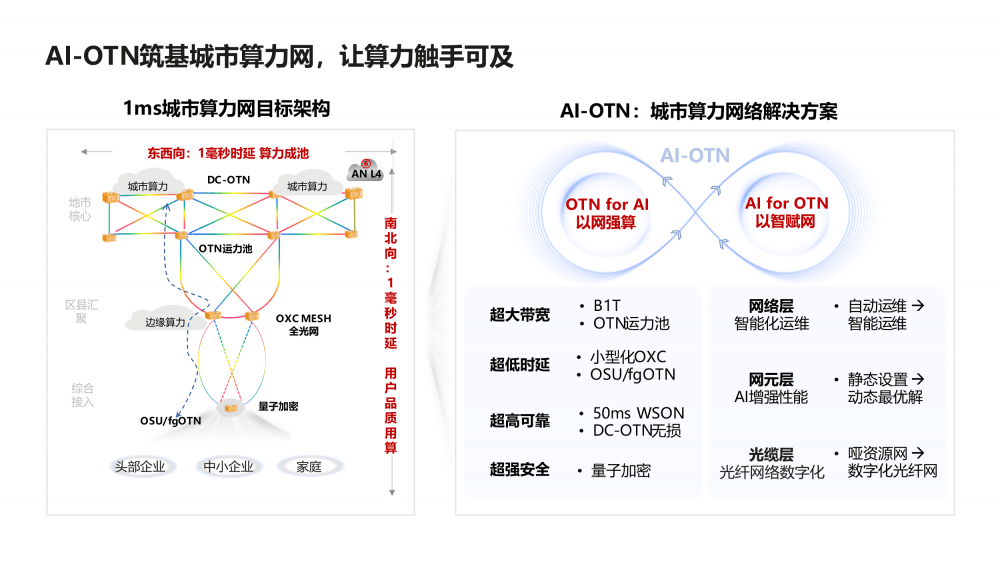
OTN for AI focuses on innovation across four dimensions: ultra-large bandwidth, ultra-low latency, ultra-high reliability, and ultra-strong security. In terms of ultra-large bandwidth, technologies such as Beyond 1T and OTN clusters are used to build ultra-wide, non-blocking interconnection channels, ensuring efficient computing resource integration and flexible scheduling. For ultra-low latency, end-to-end all-optical switching and fgOTN technologies provide users with low-latency computing connections. In ultra-high reliability, the AI-enhanced WSON solution can restore services within 50 milliseconds. Combined with the DC-OTN solution, it creates zero-packet-loss transmission channels, ensuring uninterrupted large-scale distributed training and inference tasks. For ultra-strong security, the AI-OTN integrated throughput solution innovatively combines quantum light and conventional light transmission over the same fiber, providing end-to-end data protection for scenarios such as high-value model training and sensitive business inference.
AI for OTN introduces intelligent capabilities at three layers—fiber layer, network element layer, and network layer—to enable dynamic network adjustment. At the fiber layer, embedded sensing hardware works in coordination with AI sensing models to achieve real-time, precise perception of fiber link status. At the network element layer, built-in AI models in optical modules, combined with the AI optical routing computation engine, enhance network survivability. At the network layer, based on performance data modeling, a transmission operations and maintenance intelligent agent is created to enable cross-layer collaborative planning and intelligent provisioning of optical and electrical services, shifting the network from passive response to proactive prediction.
The 1ms urban computing network based on AI-OTN has been deployed in multiple locations. In Jiangxi, the solution has empowered the upgrade of the intelligent manufacturing industry chain, improving operational efficiency by 60% and achieving an AI quality inspection accuracy rate exceeding 98%. In Shanghai, the solution has reshaped urban governance paradigms, enabling minute-level business closure and achieving a risk prevention and control positioning accuracy rate exceeding 95%. Additionally, more computing network application scenarios are being deployed in Zhejiang, Sichuan, Hubei, and other regions. Huawei stated that it will continue to advance AI-OTN technology innovation and collaborate with industry partners on technical standard development, application scenario implementation, and business model exploration.
This article is compiled by Wedoany. All AI citations must indicate the source as "Wedoany". If there is any infringement or other issues, please notify us promptly, and we will modify or delete it accordingly. Email: news@wedoany.com