en.Wedoany.com Reported - The U.S. Federal Energy Regulatory Commission (FERC) recently issued directives to six major regional grid operators under its jurisdiction, requiring reforms to grid interconnection rules for large energy users such as data centers, in response to surging electricity demand and challenges posed by traditional queuing mechanisms.
Acting under Section 206 of the Federal Power Act in Docket RM26-4-000, FERC issued tailored "Orders to Show Cause" to PJM Interconnection (PJM), Midcontinent Independent System Operator (MISO), Southwest Power Pool (SPP), California Independent System Operator Corporation (CAISO), ISO New England (ISO-NE), and New York Independent System Operator (NYISO). These regional transmission organizations (RTOs) and independent system operators (ISOs) are required to demonstrate the justness and reasonableness of their existing tariffs within 60 days, or submit tariff changes to address the issues identified by the Commission.
FERC Chair Laura V. Swett stated that this action represents one of the most significant initiatives in FERC's history to modernize U.S. electricity markets, aiming to accelerate economic development by speeding up grid access for large energy users, while ensuring grid resilience, reliability, and forward-looking planning, providing certainty for investors, and protecting consumers.
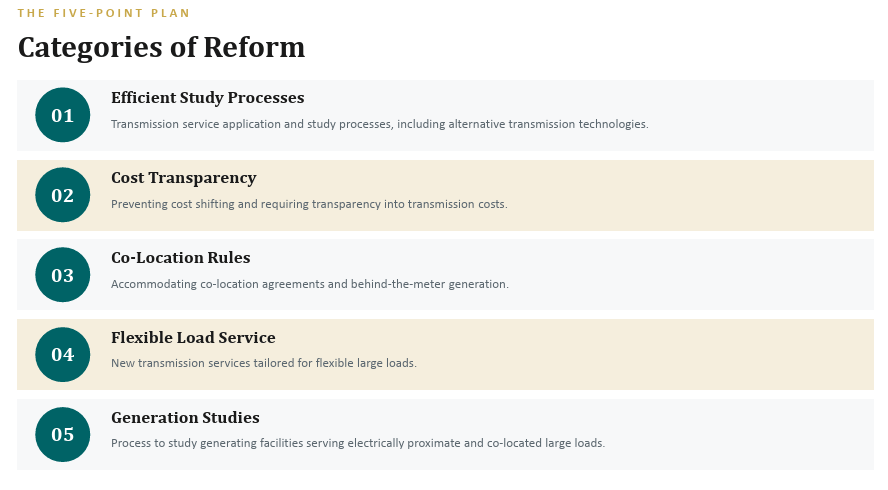
The order focuses on five major reform categories: establishing efficient transmission service application and study processes, including consideration of alternative transmission technologies; preventing cost shifting and requiring transparency in transmission costs; accommodating co-location arrangements and behind-the-meter generation; offering new transmission services for flexible large loads; and developing processes to study generation facilities serving electrically proximate large loads and co-located loads.
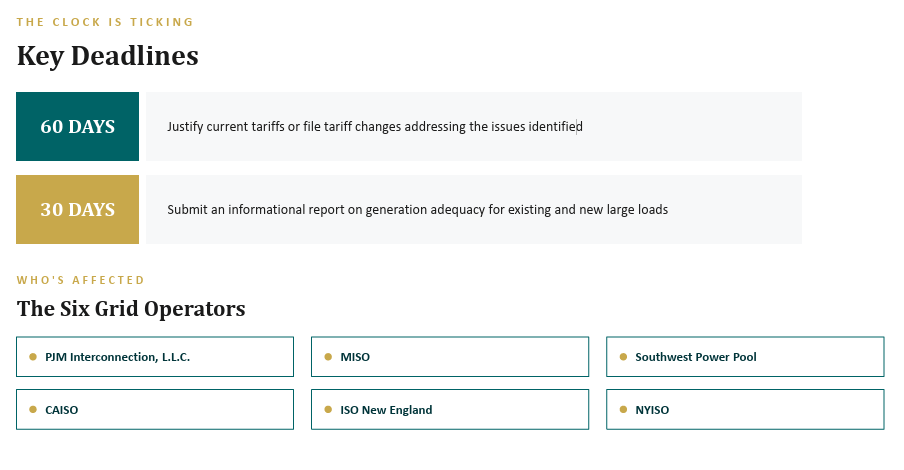
Within 30 days, each grid operator and its transmission owners must submit informational reports detailing how they will ensure sufficient generation capacity to serve existing and new large loads. The reports must include relevant proposals from stakeholder processes, detailed timelines for key milestones, and estimated dates for submitting any related proposals to FERC.
Industry group Advanced Energy United stated that these reforms will create regulatory certainty and transparency. Caitlin Marquis, Managing Director of the organization, noted that FERC's order achieves meaningful progress in speed, clarity, and transparency, emphasizing that grid flexibility, advanced transmission technologies, and co-located generation resources are critical to addressing large load challenges. Marquis also mentioned that deploying more advanced energy technologies, coupled with fixes to generator interconnection processes, is essential to meeting rapidly growing demand.
In the order, FERC acknowledged differences among grid operators, stating that a one-size-fits-all solution would not be most effective. The order reflects and allows for regional variations; for example, SPP has already accelerated its framework through "High Impact Large Load" and "High Impact Large Load Generation Assessment" processes. FERC emphasized that the order does not infringe upon states' authority to select, site, and permit generation resources, nor does it encroach upon state utility commissions' authority to set retail electricity rates, while leaving the responsibility for preventing cost shifting to the states.
This article is compiled by Wedoany. All AI citations must indicate the source as "Wedoany". If there is any infringement or other issues, please notify us promptly, and we will modify or delete it accordingly. Email: news@wedoany.com