en.Wedoany.com Reported - Three major UK airports—Manchester, Gatwick, and Heathrow—are tackling the dual challenges of operations and infrastructure upgrades through different approaches, with the core focus being how to carry out complex renovation works while maintaining normal airport operations.
Manchester Airport has recently completed a 10-year, £1.3 billion transformation program. The program began with a judgment that the infrastructure could no longer meet modern industry needs. Rick Wagstaffe, Director of Operational Transformation at Manchester Airports Group (Mag), described it as "open-heart surgery on the terminal." The core measure involved merging three terminals into two, relocating approximately 35 airlines from Terminal 1 to Terminal 2, creating a consolidated operation serving 54 airlines, with Terminal 3 primarily dedicated to Ryanair. After expansion, Terminal 2 doubled in size and gained independent operational capability. The project was delivered by Mag appointing Pascall + Watson to provide end-to-end architectural services. Project Director Theresa Pan called it a "decade-long transformation" involving "countless talented individuals." The design team reimagined the airport layout through digital modeling, passenger flow analysis, and predictive maintenance systems. Specific engineering measures included constructing temporary tunnels in active construction zones for safe passenger passage, which were used for over a year without causing operational disruptions; and a bridge connecting the bus gates to the second pier was installed in place within eight hours using a self-propelled modular transporter. The project faced external disruptions including Brexit, the collapse of several airlines (Monarch, Thomas Cook, Flybe), and the COVID-19 pandemic. Wagstaffe stated that 250 million passengers used the airport "safely" throughout the transformation period. In December 2025, the hub recorded nearly 2.4 million passengers, and annual passenger numbers reached 32 million for the first time, solidifying its position as the UK's third-largest airport.
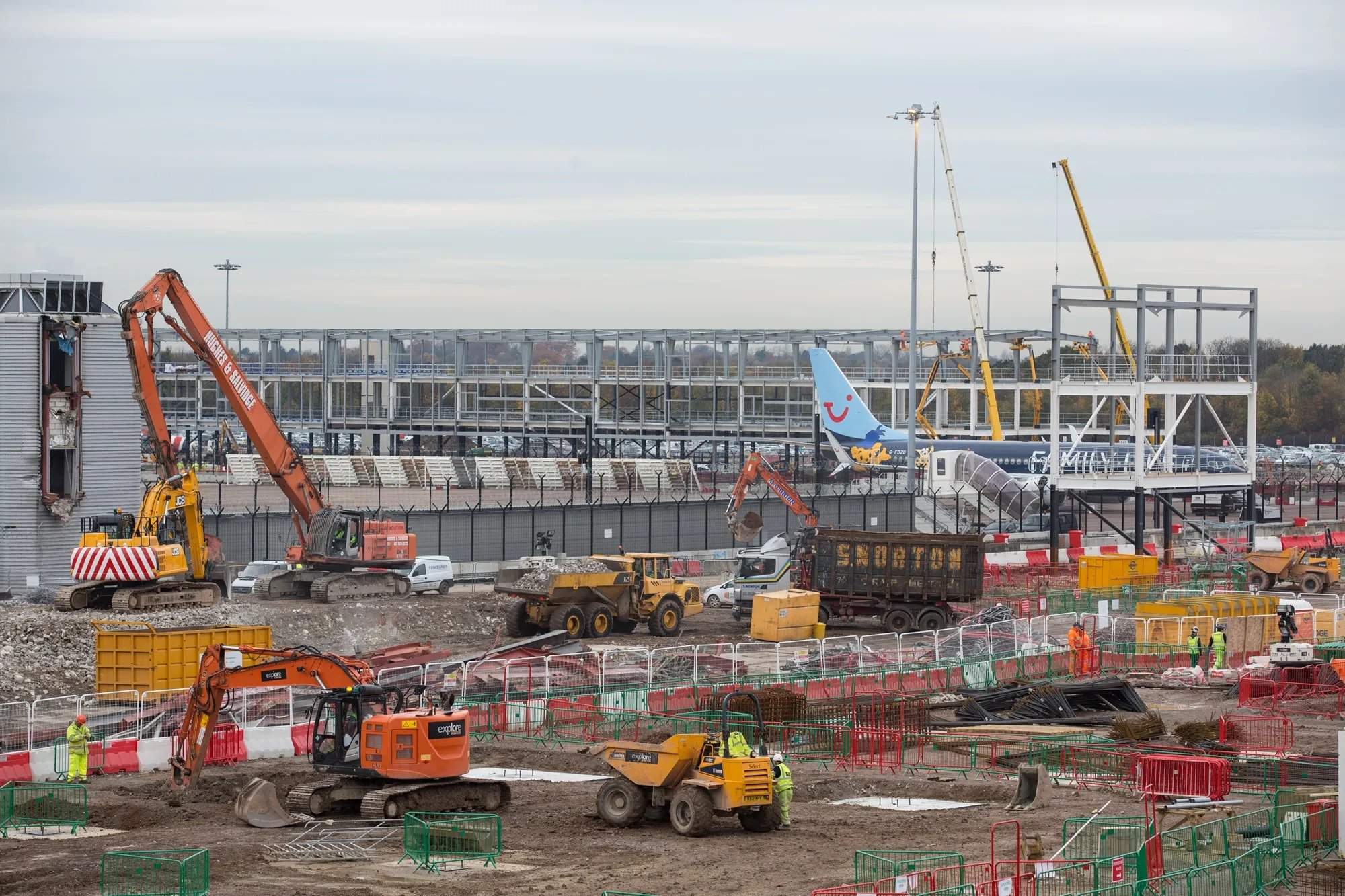
Gatwick Airport's expansion focus is the £2.2 billion Northern Runway project. Mathieu Boutitie, Chief Technology Officer at the airport, explained that the airport currently has two runways but can only use one at a time. The Northern Runway will be moved northward to enable simultaneous dual-runway operations, with total capacity expected to increase to over 80 million passengers annually. Last year, the airport handled approximately 42 million passengers across more than 220 destinations. The project received a Development Consent Order last September and is currently advancing design optimization and preliminary works under judicial review proceedings. Boutitie indicated that there may be appeals after the judicial review, "potentially going all the way to the Supreme Court." The biggest challenge is that the airport's main runway currently handles up to 57 aircraft movements per hour, considered the highest efficiency globally, and all construction must be completed while maintaining this capacity. Additionally, the airport is progressing with the Pier 6 expansion project and plans to achieve net-zero Scope 1 and Scope 2 emissions by 2030, with current initiatives including the electrification of airport vehicles and heating systems.
Heathrow Airport is preparing systems, technologies, and delivery models for future expansion. Alistair Awcock, Director of Infrastructure Solutions at the airport, stated that the airport currently invests over £1.3 billion annually in infrastructure upgrades, with this expected to increase to over £2 billion per year in the future. The airport manages approximately 450 ongoing projects, including around 150 active construction sites. During the recent South Runway resurfacing project, construction crews removed and replaced a 70-meter runway section overnight, restoring operations by the following morning. The project involved 150 vehicles and approximately 200 workers working through the night. During construction, drones, robotic surveying systems, laser-guided paving equipment, and engineering machinery equipped with 360-degree detection systems were introduced to enhance safety and efficiency. The runway project reduced carbon emissions by 26,000 tonnes through logistics adjustments, electrification, and the use of bio-asphalt materials. Specific measures included introducing a rail transfer point to transport aggregates to the airport and removing diesel-powered equipment. Awcock indicated that future expansion activities at the airport may require 4,000 to 5,000 workers on night shifts. One solution involves using prefabricated components to remove approximately 1,500 workers from the airport environment during major construction phases. Heathrow is also investing in a common data environment and a virtual control room to support operational coordination and asset management during future expansion.
The cases of the three airports demonstrate that the future development of aviation infrastructure increasingly relies on the ability to deliver complex projects in active, safety-critical environments, while meeting growing environmental and operational requirements. Relevant details were disclosed to delegates at the NCE Airport Conference held in May by project leaders.
This article is compiled by Wedoany. All AI citations must indicate the source as "Wedoany". If there is any infringement or other issues, please notify us promptly, and we will modify or delete it accordingly. Email: news@wedoany.com