Iranian research team boosts perovskite solar cell efficiency by over 20% with random textures
en.Wedoany.com Reported - An Iranian research team has systematically analyzed the impact of random interface textures on the performance of methylammonium lead iodide (MAPbI₃) perovskite solar cells using a coupled two-dimensional finite element optoelectronic simulation framework. They found that a quasi-sinusoidal texture morphology achieves the best optoelectronic balance, resulting in a power conversion efficiency improvement of over 20% relative to a planar reference device.
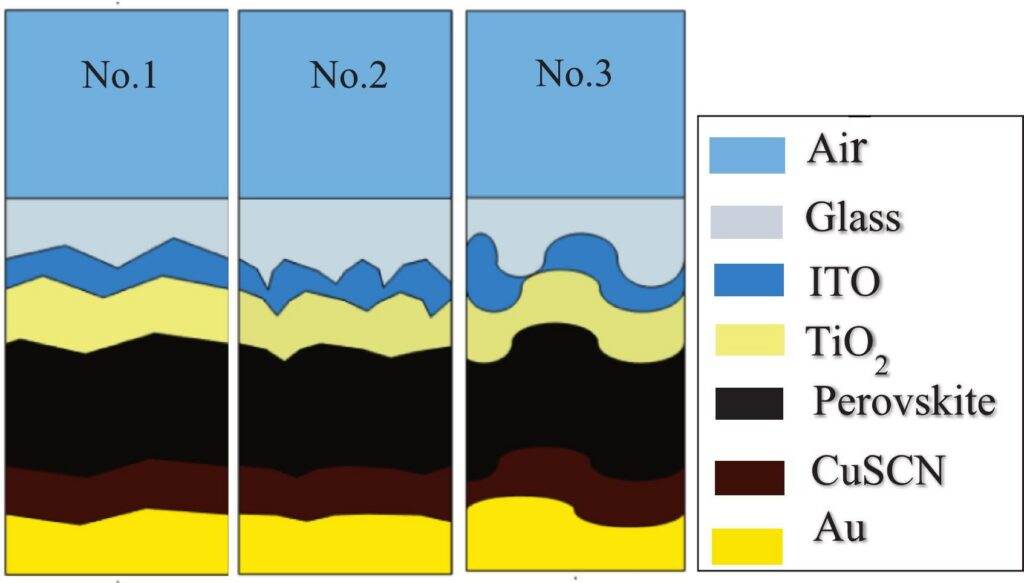
This study explores how introducing nanostructured textures across all device layers affects their behavior. The model captures the interplay between optical effects (such as enhanced light trapping and absorption) and electronic processes (including charge transport and recombination), revealing potential pathways for optimizing overall device efficiency through multilayer texturing.
Corresponding author Maryam Zoghi from Tarbiat Modares University told pv magazine: "Many studies employ random or periodic textures, but we systematically compared three different random morphologies and found that device performance is not simply determined by roughness or increased surface area. The key lies in the trade-off between beneficial absorption enhancement in the perovskite layer and transport losses caused by morphology-dependent tortuosity." She added that the team is exploring scalable manufacturing routes to reproducibly produce the morphologies identified in this work, while also planning to study the long-term stability of these textured interfaces.
The simulation study involved three representative random interface morphologies: pyramidal, bumpy, and quasi-sinusoidal. The pyramidal morphology has the lowest roughness, interface area ratio, and feature depth; the bumpy morphology offers larger interface area and deeper features but also the highest transport tortuosity; the quasi-sinusoidal morphology combines the largest interface area and deepest features with moderate tortuosity, thereby achieving the best overall photovoltaic performance.
Using a planar perovskite solar cell as a reference, all cells employed the same materials and layer thicknesses. The simulated device structure was ITO/TiO₂/MAPbI₃/CuSCN/Au, specifically comprising a 50 nm indium tin oxide (ITO) front electrode, a 90 nm titanium dioxide (TiO₂) electron transport layer, a 200 nm MAPbI₃ perovskite absorber layer, an 80 nm CuSCN hole transport layer, and a 100 nm gold (Au) back electrode.
Zoghi noted: "The most surprising result was that the quasi-sinusoidal texture, which is neither the sharpest nor the most irregular morphology, consistently outperformed the pyramidal and bumpy structures. We initially expected that more aggressive textures, such as the bumpy one, would yield the highest photocurrent due to stronger light scattering." Specific data showed that the quasi-sinusoidal morphology provided the most favorable optoelectronic balance, achieving a short-circuit current density of 25.1 mA cm⁻² and a power conversion efficiency of 21.38% for devices with a 200 nm absorber layer, with a 15% increase in Jsc relative to the planar reference.
"While the bumpy structure offered some optical advantages, it suffered greater electrical losses, likely due to increased tortuosity and series resistance. In contrast, the smoother quasi-sinusoidal shape achieved a superior optoelectronic balance, with a 15% increase in short-circuit current density and over 20% improvement in power conversion efficiency. This suggests that 'more texture' is not always better," Zoghi added.
The research findings were published in the journal Results in Physics under the title "Random textured interfaces for efficiency enhancement of perovskite solar cells," with scientists from Tarbiat Modares University and the University of Tehran in Iran contributing to the study.
This article is compiled by Wedoany. All AI citations must indicate the source as "Wedoany". If there is any infringement or other issues, please notify us promptly, and we will modify or delete it accordingly. Email: news@wedoany.com
Related Products



Oil-immersed Amorphous Alloy Core Distribution Transformer
Pinggao Group Smart Electric Co., Ltd.
NISELA Series Environmentally Friendly Gas-Insulated Ring Main Unit
XJ DELISHIER ELECTRIC CO., LTD.

CAP1400 main feedwater flow nozzle flowmeter.
Jiangsu Hongda Instrument Technology Co., LTD.