en.Wedoany.com Reported - An international research team has developed a new room-temperature crystallization process called Selective Iodoplumbate Cold Casting (SICC) for fabricating perovskite solar cells and modules with 2D/3D heterojunction structures, which is claimed to enhance device stability and efficiency.
Traditional 2D perovskite cells are more stable than 3D devices due to the protection of organic ligands, but they have larger exciton binding energies. Corresponding author Aditya D. Mohite from Rice University told pv magazine: "We have developed a new room-temperature crystallization method called Selective Iodoplumbate Cold Casting (SICC), which enables access to kinetically stabilized perovskite phases that cannot be obtained through conventional thermodynamic processing." This strategy produces uniform 2D layers that enhance out-of-plane charge transport in 3D:2D bilayer devices, achieving over 25% efficiency in small-area cells and over 22% efficiency in large-area photovoltaic modules.
The study was published in Nature Synthesis under the title "Selective Iodoplumbate Cold Casting for Kinetically Stabilized Perovskites Enabling Efficient Photovoltaic Modules." The researchers noted that SICC controls precursor chemistry through solvent design, enabling unusual low-dimensional perovskite crystal structures, including the difficult-to-obtain corrugated MA₂PbI₄ phase in the methylammonium-based system. "The SICC process selectively forms simplified iodoplumbate species, enabling rapid crystallization with high phase purity without the need for thermal annealing," Mohite added. By mixing solvents with different donor numbers, such as acetonitrile and N-methyl-2-pyrrolidone (NMP), the team selectively promoted the formation of iodoplumbate species.
Unlike conventional low-n 2D perovskites, which suffer from performance limitations due to insulating energy level alignment, SICC films provide efficient vertical carrier transport and favorable band alignment with 3D perovskites. "The SICC-grown 2D layer significantly improves the quality and uniformity of the 3D:2D heterostructure, thereby enhancing efficiency, reducing hysteresis, and improving operational stability," Mohite emphasized.
Based on this technology, the researchers developed perovskite solar cells with an active area of 0.094 cm², featuring a device structure comprising a fluorine-doped tin oxide (FTO) substrate, a tin oxide (SnO₂) electron transport layer (ETL), a 3D perovskite absorber layer, a 2D perovskite layer, a Spiro-OMeTAD-based hole transport layer (HTL), and a gold (Au) electrode. The 3D/2D bilayer structure was formed by integrating a butylammonium lead iodide (BA₂PbI₄) 2D perovskite layer through a solid-state in-plane growth process, with the bilayer pressed together under 60 MPa pressure and temperatures ranging from 60°C to 85°C.
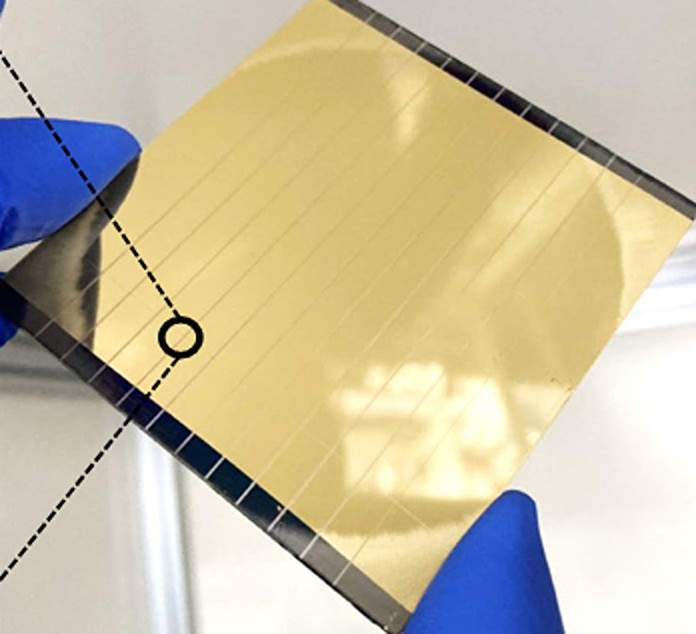
To scale up, the team fabricated mini-modules on 7.1 cm × 7.1 cm substrates, each consisting of 10 monolithically interconnected sub-cells with an active area of 25 cm². Interconnection was achieved using P1, P2, and P3 laser scribing with a 532 nm picosecond laser, with scribe widths of 25 μm, 120 μm, and 110 μm, respectively. The optimized patterning process resulted in a geometric fill factor of 94.36%. The devices were tested under standard AM1.5G illumination at 100 mW/cm², achieving a power conversion efficiency of 25.14% for small-area cells and 22.36% for 25 cm² mini-modules. In stability tests, modules encapsulated with UV-cured resin and a 1.1 mm thick glass cover retained over 90% of their initial performance for more than 1000 hours under continuous one-sun operation.
Mohite concluded: "Our findings suggest that low-dimensional perovskites should be understood and designed as kinetic products, rather than purely thermodynamic materials. Our work provides a scalable pathway for integrating stable low-dimensional perovskites into next-generation high-efficiency solar modules and tandem photovoltaics."
Institutions involved in the study include Seoul National University (South Korea), the Korea Institute of Industrial Technology (South Korea), South Korean perovskite startup Frontier Energy Solution (FES), Rice University (USA), Northwestern University (USA), and the Institut Fonctions Optiques pour les Technologies de l’Information (France).
This article is compiled by Wedoany. All AI citations must indicate the source as "Wedoany". If there is any infringement or other issues, please notify us promptly, and we will modify or delete it accordingly. Email: news@wedoany.com