3GPP Considers 6G NTN Polarization Multiplexing Technology to Enhance Spectrum Efficiency
en.Wedoany.com Reported - The 3rd Generation Partnership Project (3GPP) is deliberating on 6G physical layer waveforms and satellite internet air interface standards, with polarization multiplexing technology for Non-Terrestrial Network (NTN) satellite payloads emerging as a key solution to enhance spectrum efficiency. As China advances the construction of "next-generation communication networks," 6G is expected to move toward commercialization by 2030. Meanwhile, domestic and international projects such as StarLink, China Satellite Network, and the Qianfan Constellation are promoting satellite internet deployment, with ground user terminals, NTN satellite payloads, and gateway stations forming a global "space-air-ground-sea" coverage network. NTN satellite payloads, as core components, include signal processing and phased array antennas.
NTN satellite systems can use advanced antennas to form multiple beams on the ground. To mitigate inter-cell interference, frequency reuse schemes (with a frequency reuse factor FRF greater than 1) can be employed. While spatial frequency reuse technology can improve the signal-to-interference-plus-noise ratio (SINR), it limits the bandwidth and system capacity of each beam. For example, in the traditional frequency reuse-3 (FRF-3) scheme, each cell can only use one-third of the spectrum resources. Taking the S-band as an example, with full frequency reuse (FRF=1), each cell is configured with 30 MHz bandwidth; in FRF-3 mode, the system bandwidth is allocated to three adjacent cells, with each cell configured with only 10 MHz bandwidth.

To ensure good isolation between beams while increasing the bandwidth of each beam, a combination of polarization multiplexing and frequency reuse can be adopted: adjacent cells use different polarization modes, including Right-Hand Circular Polarization (RHCP) and Left-Hand Circular Polarization (LHCP). The Release-16 version of the NR solution for supporting NTN indicates that providing polarization mode information for NTN signals is beneficial in certain cases, especially when User Equipment (UE) can distinguish between RHCP and LHCP using circular or linear polarization antennas.
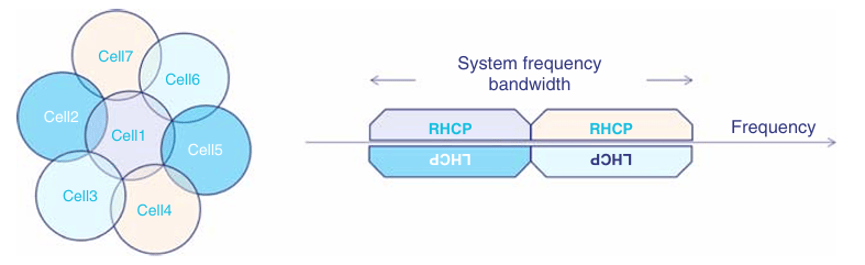
NR NTN Release-17 specifies the polarization type indication for satellite downlink transmission (ntn-PolarizationDL) and the polarization type indication for satellite uplink reception (ntn-PolarizationUL). If ntn-PolarizationUL is not specified but ntn-PolarizationDL is specified, the UE assumes the same polarization is used for both uplink and downlink. The indicated polarization information includes Right-Hand Circular Polarization (RHCP), Left-Hand Circular Polarization (LHCP), and linear polarization. Additionally, NTN Release-17 supports polarization signal transmission for the target serving cell in handover command messages and for non-serving cells in RRM measurement configurations.
According to 3GPP TS 38.306, UE support for polarization signaling in NR NTN is optional. This signaling includes the following functional components: support for receiving polarization indications in SIB, using corresponding polarization type parameters to indicate DL and/or UL polarization information (RHCP, LHCP, or linear polarization); support for polarization signals of the target serving cell in handover command messages; and support for polarization signals of non-serving cells in RRM measurement configurations.
This article is compiled by Wedoany. All AI citations must indicate the source as "Wedoany". If there is any infringement or other issues, please notify us promptly, and we will modify or delete it accordingly. Email: news@wedoany.com