Joint Report by the European Federation for Transport and Environment and the Clean Cities Alliance: European Cities Could Lose 14% of On-Street Parking Spaces by 2040
en.Wedoany.com Reported - A joint report by the European Federation for Transport and Environment (T&E) and the Clean Cities Alliance indicates that if new cars continue to grow in size, on-street parking spaces in European cities could decrease by 8.5% to 14% by 2040, posing additional road safety risks. The report analyzes the sustained growth of newly sold cars in all key dimensions and compares it with a "moderate size" scenario, where policies would restore new car dimensions to 2015 levels. The study finds that without intervention, longer and wider cars will significantly reduce the number that can be parked end-to-end along streets.
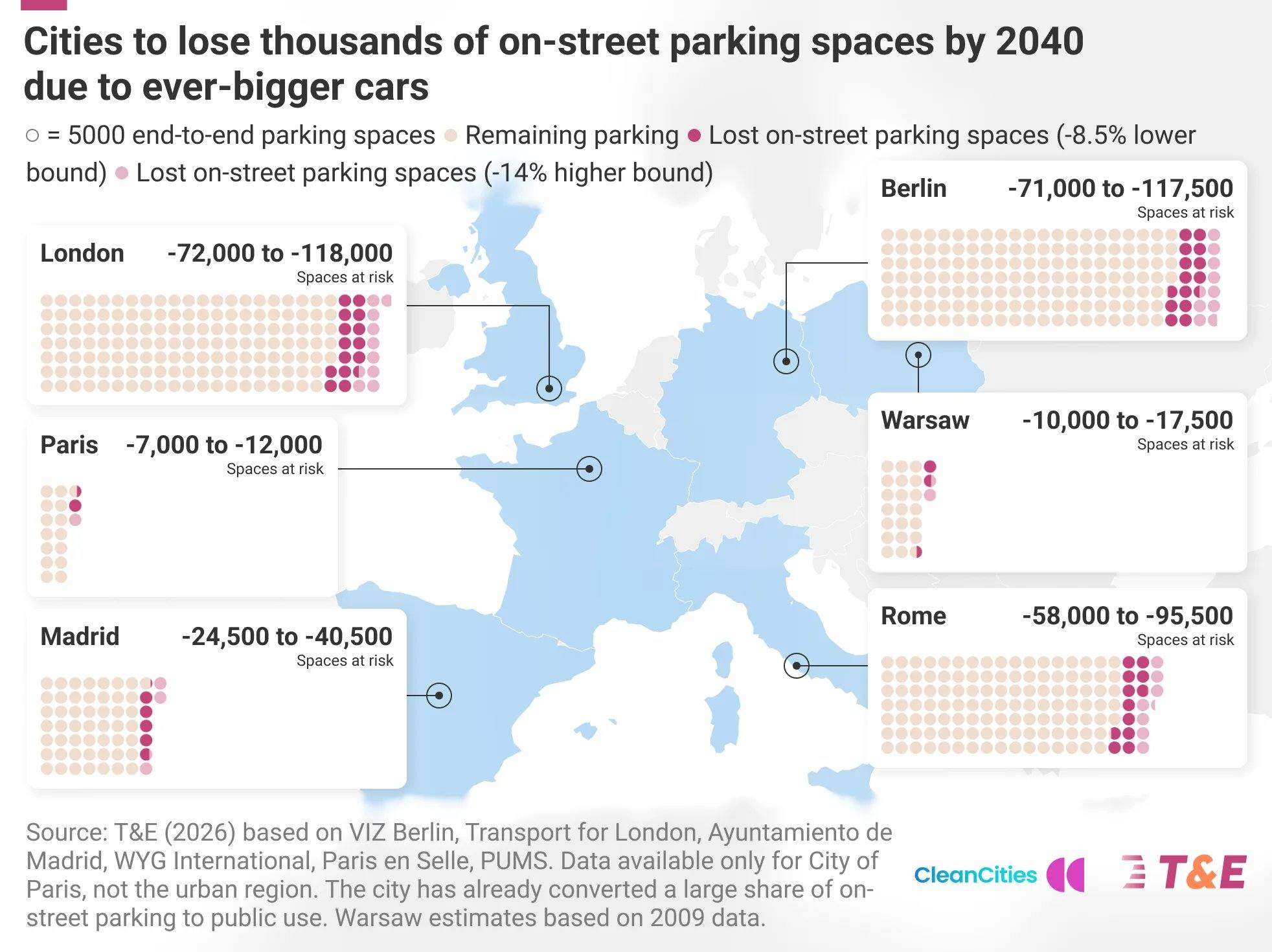
According to the analysis, due to the expansion of car sizes, London is expected to lose between 72,000 and 118,000 on-street parking spaces by 2040; Berlin faces a loss of 71,000 to 117,000 spaces; and Rome could see a reduction of 58,000 to 95,000. Madrid (up to 41,000), Warsaw (up to 17,000), and Paris (up to 12,000) are also projected to experience significant capacity reductions.
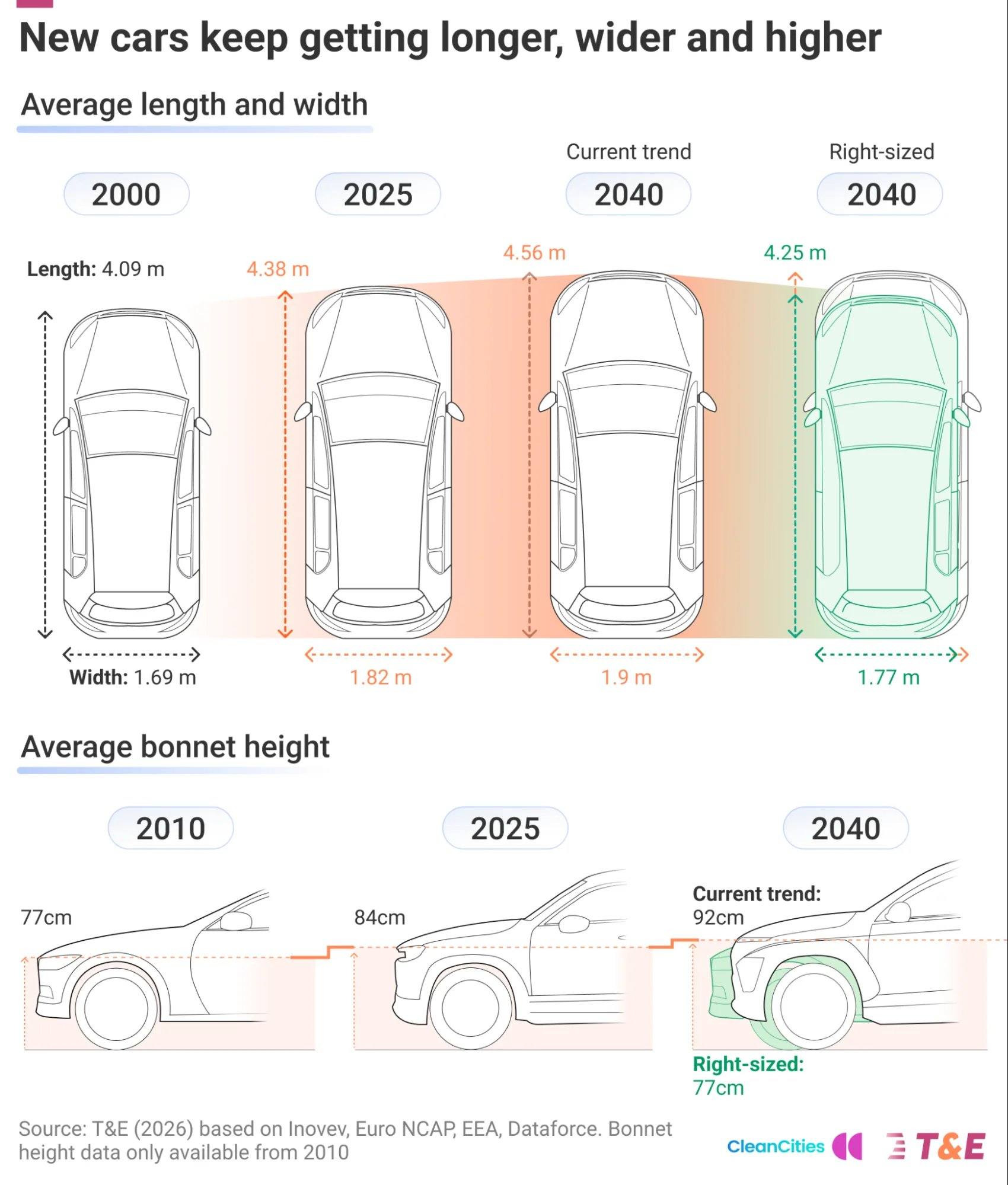
Report data shows that since 2000, the average length of newly sold cars has increased by 1.2 cm per year, and the overall height by 0.5 cm per year. Previous studies have also indicated that new cars are, on average, 0.5 cm wider each year, with hood heights increasing by 0.5 cm annually. T&E states that despite declining household sizes and car occupancy rates, automakers have shifted from producing smaller cars to extracting higher profits from larger vehicles.
Lucien Mathieu, T&E's Cars Director, stated that after 25 years of growth, European roads are increasingly dominated by SUVs that pose physical dangers to others, putting pressure on cities and towns to expand parking spaces and sacrifice public space to compensate for lost spots. The analysis also notes that while the EU has set a "Vision Zero" goal of zero road traffic deaths by 2050, the expansion of car sizes will have serious consequences. Compared to the "moderate size" scenario, under current trends, an additional 400 road user deaths are expected annually by 2040. Between 2026 and 2040, an extra 2,500 adults and 79 children could die on European roads.
Under current trends, by 2040, children will be 40% more likely to die in car crashes than in the moderate size scenario. The average fleet hood height is projected to reach 86.2 cm by then, posing a particular risk to children, as they are more likely to be struck in the head or chest than adults. Barbara Stoll, Senior Director of the Clean Cities Alliance, called on regulators to set maximum limits for new car dimensions and suggested that cities and governments adjust parking fees and taxes to reflect the risks posed by larger vehicles.
To address urban space and safety threats, T&E and the Clean Cities Alliance are calling for the implementation of several policy reforms, including: introducing a hood height cap of 85 cm and a car width limit of 192 cm for new vehicle type approvals from 2033, and applying these to all new car sales from 2036; discouraging the purchase of oversized vehicles through registration and circulation taxes; updating the Euro NCAP protocol to test driver seat visibility for young children; reforming parking fees and local taxes based on vehicle size and weight; and supporting small electric cars with a length of no more than 4.2 meters when revising EU CO2 regulations for cars.
This article is compiled by Wedoany. All AI citations must indicate the source as "Wedoany". If there is any infringement or other issues, please notify us promptly, and we will modify or delete it accordingly. Email: news@wedoany.com
Related Products

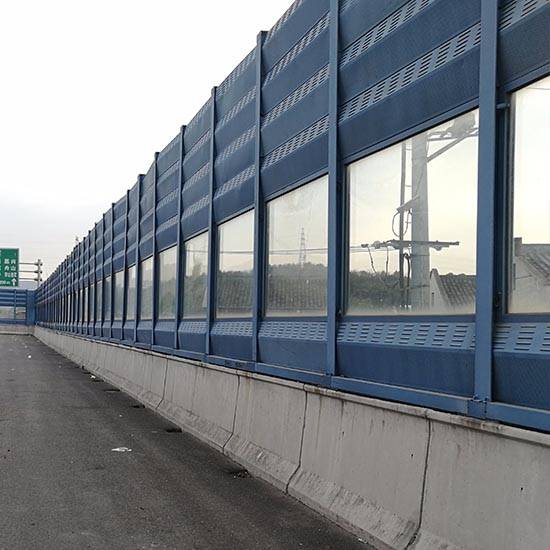
Metal sound barriers that can reduce the transmission of road noise
Hebei Jinbiao Construction Materials Tech Corp., Ltd.
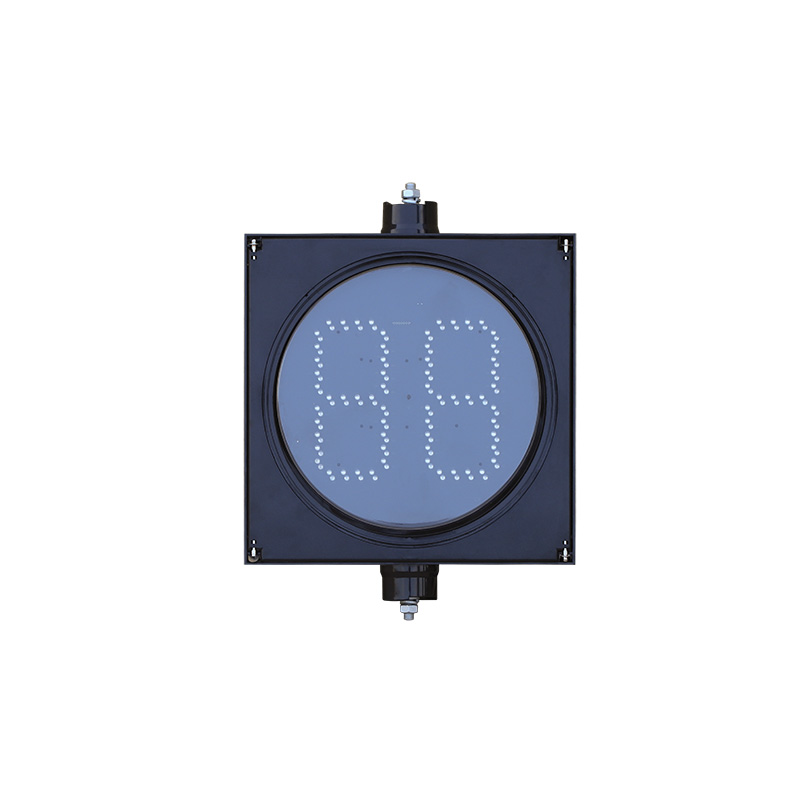
300mm Segment Type Countdown Traffic Light (Core Type)
Yangzhou FAMA Intelligent Equipment Co., Ltd.
ERW Welded Pipe (Black Pipe and Hot-dip Galvanized Steel Pipe)
Handan Zhengda Steel Pipe Co., Ltd.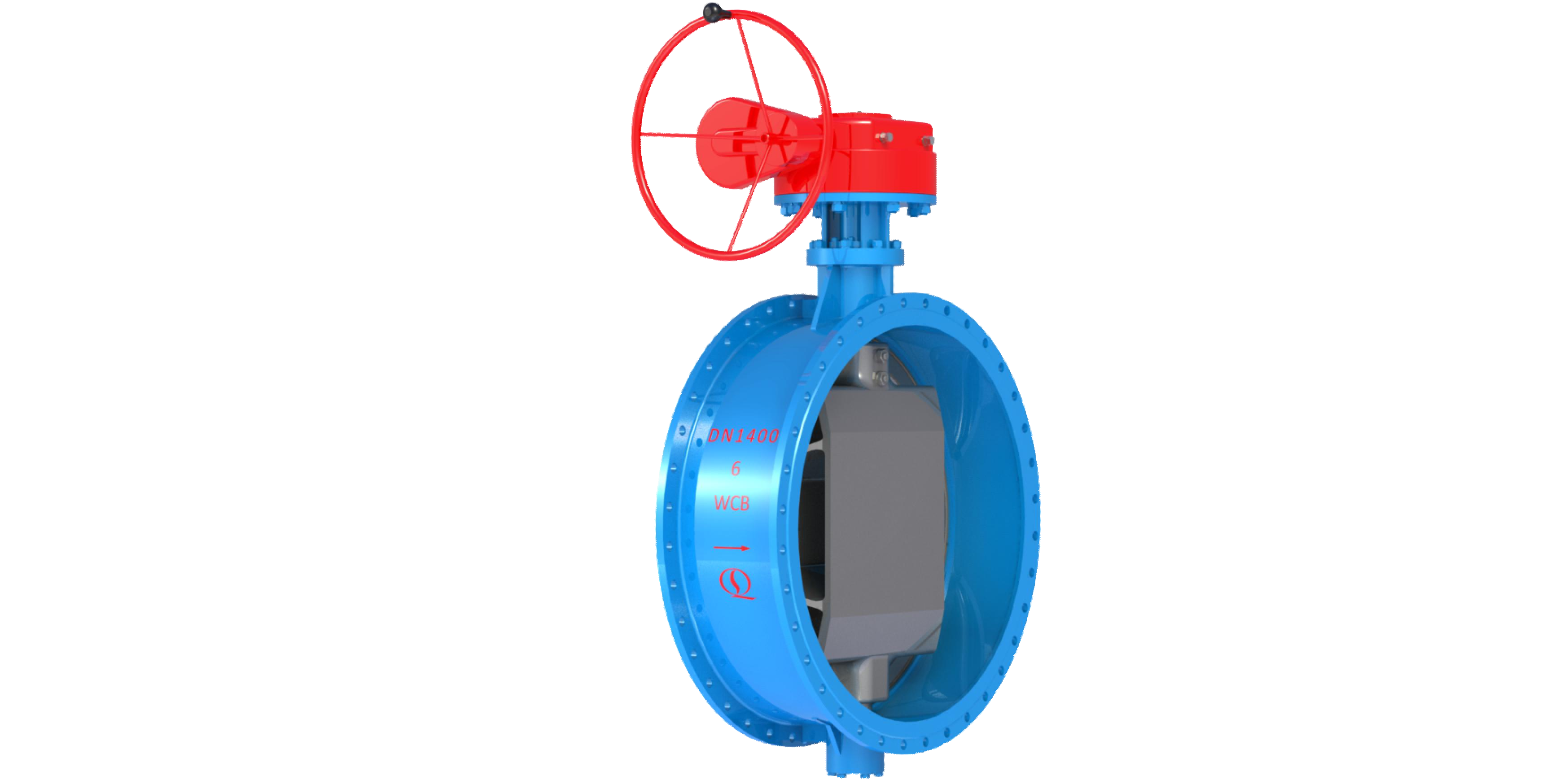
Bidirectional Metal Hard Sealed Seawater Butterfly Valve
Henan Quanshun Flow Control Science & Technology Co., Ltd.
Ceiling light | led Ceiling Light | LED Indoor light | LED Ceiling lighting
Queendom Group Technology Co., Ltd.
YHTank8400N Solvent-Free Liquid Epoxy Coating
JIANGSU YUNHU NEW MATERIAL TECHNOLOGY CO., LTD.
Acoustic Mineral Fiber Ceiling Tile 595x595x12mm
Shanxi Pano Trading Co., Ltd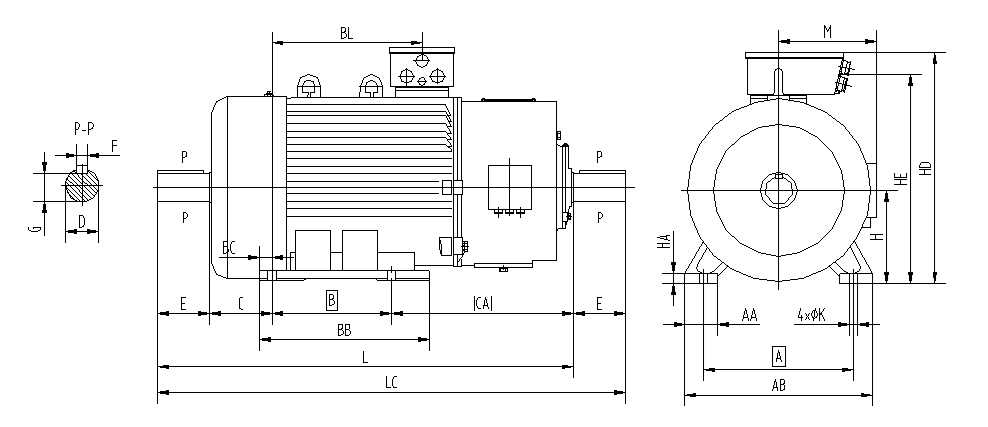
YZR (450-560) Series Wound Rotor Three-Phase Asynchronous Motors for Crane and Metallurgical Applications
Jiamusi Electric Machine Co., Ltd.

Industrial and Commercial Point-Type Gas Detector
Jinan Benan Technology Development Co., Ltd.