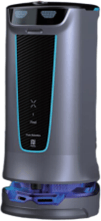
en.Wedoany.com Reported - China's industrial humanoid robots are transitioning from "being able to enter factories" to "being able to enter specific processes." On June 25, UBTech's Cruzr Y1 wheeled industrial humanoid robot made its global debut at the OPPO Technology Launch and Supply Chain Technology Exhibition in China, demonstrating the complete process of bin depalletizing and palletizing on site. This product is designed for scenarios such as industrial manufacturing, warehousing and logistics, supply chain handling, and flexible loading/unloading, aiming to address pain points of traditional automation equipment, including poor adaptability to changes in material position, long changeover and debugging cycles, and single-process capability.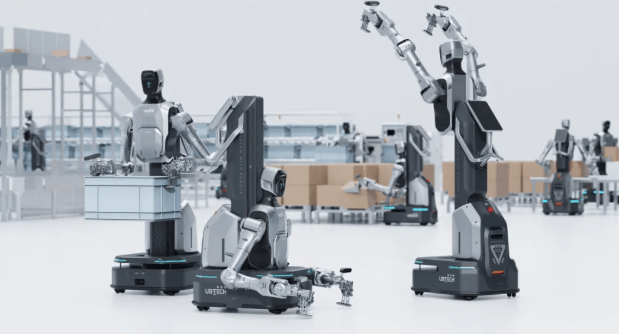
The Cruzr Y1 adopts a form combining a wheeled mobile chassis with a humanoid upper body structure, targeting tasks such as continuous handling, depalletizing, palletizing, loading/unloading, and sorting in factory and warehouse environments. Compared to bipedal humanoid robots, the wheeled structure is more suitable for prolonged operation on flat industrial floors, reducing the complexity of motion control and improving operational stability and energy efficiency. Compared to traditional fixed robotic arms, the wheeled industrial humanoid robot offers a larger working radius and can move between multiple workstations, making it suitable for task switching across production lines, storage areas, and flexible manufacturing cells.
The on-site demonstration of bin depalletizing and palletizing represents high-frequency, repetitive, and labor-intensive operations in manufacturing and logistics scenarios. Traditional automated depalletizing and palletizing equipment typically relies on fixed workstations, standard pallets, stable material postures, and preset trajectories. Even slight deviations in bin position, changes in stacking patterns, or product specification switches may require manual intervention or re-debugging. The Cruzr Y1 integrates visual perception, motion control, robotic arm operation, and a mobile chassis, aiming to complete flexible handling tasks in more complex and irregular working environments.
By defining the Cruzr Y1 as a wheeled industrial humanoid robot for industrial scenarios, UBTech indicates that its product focus is not on display, companionship, or service reception, but on entering handling and operation processes closer to the production site. Industrial customers are truly concerned with efficiency, stability, deployment cycles, maintenance costs, and replicability. A robot that can only complete a single demonstration is unlikely to generate commercial value; only by maintaining stable operation across multiple batches, materials, and workstations can it enter the procurement evaluation systems of automation integrators and factory customers.
The Cruzr Y1 is equipped with domestically produced computing chips, the Dijia S100P and S600 series, and is supported by UBTech's self-developed hardware architecture and ROSA software system as the underlying foundation. The robot needs to perform visual recognition, material positioning, path planning, grasping control, task scheduling, and anomaly handling on site, requiring high local computing power, real-time control, and software system stability. The use of domestically produced computing chips and self-developed software systems helps UBTech gain stronger initiative in supply chain controllability, product iteration, and scenario adaptation.
The VLA (Vision-Language-Action) integrated algorithm is a key technical support for the Cruzr Y1. Industrial robots have traditionally relied more on teaching and fixed programs, suitable for highly repetitive and stable environment tasks. The VLA algorithm attempts to connect visual perception, language task understanding, and action execution, enabling the robot to understand the on-site status based on the target task, and then plan grasping, moving, and placing actions. For flexible tasks such as bin depalletizing, palletizing, loading/unloading, and sorting, the robot needs to identify object positions, assess posture changes, plan grasping points, and correct deviations during execution.
This debut is also advancing in tandem with UBTech's channel expansion. UBTech has released a regional exclusive distributor recruitment policy, providing technical, after-sales, and market support to automation integrators and supply chain channel partners. For industrial robots to enter real factories, local integrators are typically needed to complete on-site surveys, workstation modifications, system integration, commissioning, delivery, and after-sales maintenance. The regional distributor and integrator system can help products enter different industry scenarios more quickly and also feed customer requirements back into the robot hardware, algorithms, and application solutions.
China's industrial robot market is moving from standard robotic arm automation to embodied intelligence and flexible operations. Industries such as electronics manufacturing, automotive parts, 3C supply chains, warehousing and logistics, food and beverages, and pharmaceutical packaging all have significant needs for handling, loading/unloading, and sorting. In the past, these scenarios either relied on manual labor or used customized automation equipment. If wheeled industrial humanoid robots can meet factory requirements in terms of cost, stability, and deployment efficiency, they will provide a new solution path for flexible manufacturing.
UBTech has previously advanced large-scale deployment in the field of industrial humanoid robots, and the launch of the Cruzr Y1 further enriches its industrial product portfolio. Compared to bipedal platforms, the wheeled industrial humanoid robot emphasizes practicality and scenario efficiency; compared to fixed robotic arms, it emphasizes mobile operation and multi-task adaptability. Whether the Cruzr Y1 can generate orders in the future will depend on customer trial results, integrator channel development, on-site operational stability, maintenance costs, and its adaptability to different materials and workstations.
This article is compiled by Wedoany. All AI citations must indicate the source as "Wedoany". If there is any infringement or other issues, please notify us promptly, and we will modify or delete it accordingly. Email: news@wedoany.com
Related Products


Automatic Aiming Laser Remote Obstacle Removal Robot
Pinggao Group Weihai High-Voltage Apparatus Co., Ltd.
Hot Selling 10 Inch Intel N5100 I5 I7 FHD 8 +128GB 16+256GB Win10 Pro Win11 Pro 4G 5G Rugged Tablet PC Pad with NFC Barcode
Highton Electronics Co., Ltd.

20 Inch 1600*900 Full HD 60Hz TFT LED Monitor with VGA and DP Interfaces for Desktop Computers-Business Use
Guangzhou Zanying Optoelectronics Technology Co., Ltd.

G.652.D Wavelength-extended Non-dispersion Shifted Single-mode Optical Fiber
HONGAN GROUP CO., LTD.
MUX Series Communication Interface Device for Security and Stability Control System
Nanjing NR Electric Co., Ltd.