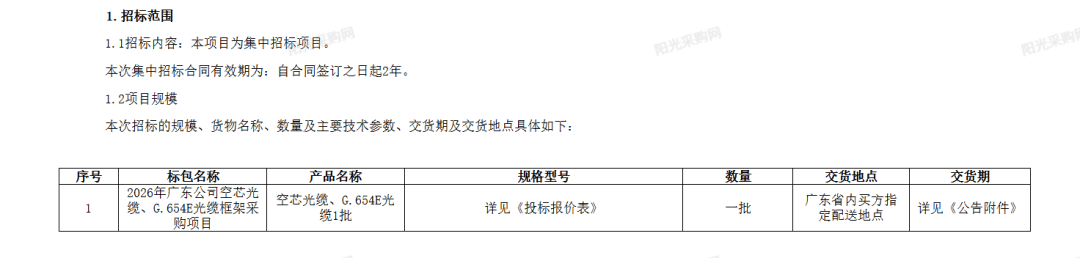
en.Wedoany.com Reported - On July 8, China Telecom Co., Ltd. Guangdong Branch officially announced the launch of the 2026 framework procurement project for hollow-core optical cables and G.654E optical cables. The project is tendered by China Telecom Co., Ltd. Guangdong Branch, with Guangdong Telecom Planning and Design Institute Co., Ltd. acting as the tender agency. The project sets the number of winning bidders at one, with a corresponding share of 100%, and also sets a maximum bid limit of 156,253,480.00 RMB (excluding VAT) as well as a unit price cap (excluding VAT). Bids exceeding the limit will be rejected.
In the past two years, emerging businesses represented by Artificial Intelligence have driven rapid growth in traffic demand, fueling the need for ultra-large capacity optical transmission systems. Hollow-core optical fiber has become one of the key transmission directions attracting industry attention. China Telecom, China Mobile, and China Unicom have all initiated pilot projects and deployments in various regions. In November 2024, China Telecom Zhejiang Branch completed the first operator procurement bid for hollow-core optical cables in China, with a procurement volume of 95 sheath kilometers. Entering 2025, all three major operators launched centralized procurement of hollow-core optical fibers, with unit prices declining compared to 2024. In 2026, the scale of a single procurement exceeded the 100 million yuan level, indicating a clear growth trend. The industry expects the next three to five years to be a critical window for hollow-core optical fiber to penetrate from high-end scenarios to broader applications.
Based on pilot projects deployed by operators, hollow-core optical cables are currently mainly used in areas such as financial securities trading, intelligent computing center interconnection, 6G fronthaul networks, quantum communication, and long-distance backbone transmission. Hollow-core optical fiber uses air as the transmission medium, confining energy within the air through a specially designed cladding structure, fundamentally reducing the impact of fiber material properties on transmission performance and avoiding the intrinsic limitations of traditional silica glass optical fibers.