en.Wedoany.com Reported - A team led by Professor Xi Kai from Xi'an Jiaotong University in China has developed a novel electron-pinning interface catalyst that significantly accelerates the solid-solid conversion efficiency of lithium-sulfur batteries under lean electrolyte conditions. The assembled 3.6 Ah pouch cell achieved an energy density of 418.6 Wh·kg⁻¹.
Lithium-sulfur batteries are regarded as a key candidate for next-generation energy storage technology due to their high theoretical energy density, low cost, and environmental friendliness. However, under lean electrolyte conditions—critical for achieving high-energy-density industrialization—the sluggish kinetics of the sulfur reduction reaction pose a major challenge. In particular, the solid-solid conversion stage from Li₂S to Li₂S exhibits high energy barriers and reaction lag, leading to polysulfide accumulation, active site blockage, low sulfur utilization, and cycling stability degradation, hindering large-scale application.
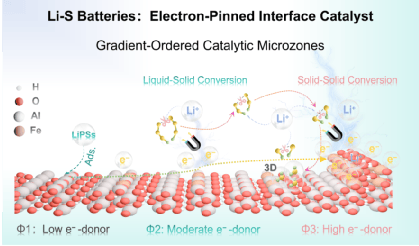
To address this issue, Professor Xi Kai's team from the School of Chemistry at Xi'an Jiaotong University proposed an electron-pinning interface engineering strategy, precisely constructing a novel catalytic system with both long-range order and local disorder. By modifying amorphous nanodomains and finely regulating local electronic structures, the team constructed gradient-ordered active sites and developed the electron-pinning interface catalyst a-FeOOH@Fe/AlOx (EPIC). This catalyst achieves catalytic enhancement through multi-level electronic interactions. Its unique structure forms efficient conductive pathways and gradient electron-donating properties, successfully decoupling the sulfur reduction reaction process and significantly accelerating solid-solid conversion efficiency under lean electrolyte conditions.
The related research findings were published in the materials journal Advanced Materials under the title "Constructing High-Energy-Density Lithium-Sulfur Batteries via Electron-Pinning Interface Engineering to Accelerate Solid-Solid Conversion Kinetics." Assistant Professor Jin Li, doctoral students Jin Zhengqian, and Deng Teng from the School of Chemistry are co-first authors, Professor Xi Kai is the corresponding author, and Xi'an Jiaotong University is the sole corresponding institution. The work received guidance from experts including Professor R. Vasant Kumar from the University of Cambridge, Professor Peng Luming from Nanjing University, Professor Pang Quanquan from Peking University, and Professor Fu Yongzhu from Zhengzhou University. It was also supported by the National Natural Science Foundation of China's "Beyond Traditional Battery Systems" Major Research Plan Cultivation Project and General Project, the National Natural Science Foundation of China Youth Fund, the China Postdoctoral Science Foundation General Fund, the Shaanxi Provincial Youth Fund, and the Shaanxi Qinchuangyuan Innovation Talent Program.