en.Wedoany.com Reported - The Advanced Nuclear Energy Materials Laboratory at the Ningbo Institute of Materials Technology and Engineering, Chinese Academy of Sciences, in collaboration with teams from Zhejiang University and the Yongjiang Laboratory, has utilized a "chemical scissors" sublayer editing strategy to "embed" lanthanide elements into the MXene lattice, creating for the first time a new two-dimensional material—lanthanide MXene—that possesses both semiconducting and ferromagnetic properties.
MXene is a class of two-dimensional transition metal carbides, nitrides, or carbonitrides, known for their excellent electrical conductivity and tunable surface chemistry, offering broad application prospects in energy storage, electromagnetic shielding, catalysis, and sensing. However, these "star players" also have shortcomings: they are almost all metallic conductors, lacking the band structure characteristic of semiconductors and rarely exhibiting magnetic ordering. This limits their further expansion into areas such as electronic devices and spintronics.
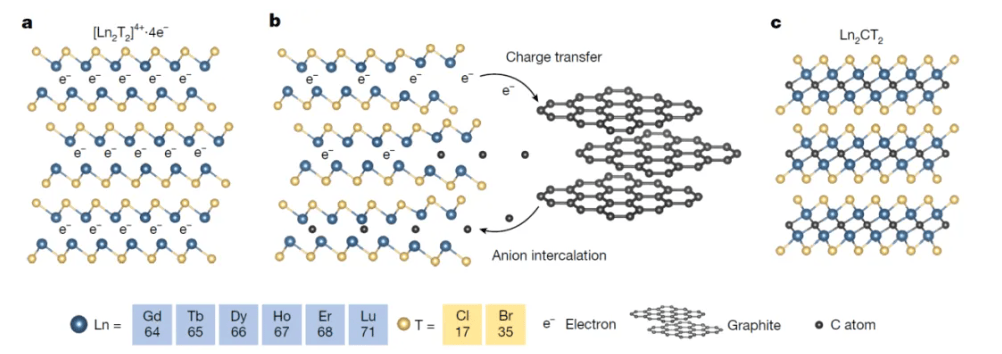
The research team discovered that lanthanide monohalides have a special layered structure similar to the sublayer structure of MXene after removing carbon atomic layers. Based on the previously proposed "chemical scissors" sublayer editing strategy, they developed a new synthesis pathway—leveraging differences in the chemical properties of sublayers within layered compounds to knock out, replace, or reconstruct specific atomic layers, akin to reassembling atomic-scale Lego bricks according to a blueprint.
The team designed a two-step mild reaction. In the first step, lanthanide metals react with copper halide in situ to produce the required monohalide intermediate. In the second step, the intermediate reacts with graphite powder, "dancing together" at high temperatures. At this point, localized electrons between the intermediate layers actively "donate" themselves, reducing carbon atoms in the graphite to tetravalent carbon anions (C4-). After losing electrons, the interlayer binding forces originally maintained by the electrons weaken, allowing the negatively charged carbon anions to insert between two metal layers, precisely occupying octahedral vacancies, ultimately forming a new MXene crystal structure with a T-Ln-C-Ln-T stacking sequence.
Test results show that the new material simultaneously unlocks both semiconducting and ferromagnetic properties. This type of two-dimensional material is a long-sought target for spintronics, holding great potential in low-power logic devices, high-frequency communications, magnetic sensors, and even quantum computing. The synthesis strategy is universal and is expected to be extended to other transition metals in the future, opening a new door to enriching the family of two-dimensional materials.