Research on the Current Status, Challenges, and Pathways of China's 6G Technology Development
en.Wedoany.com Reported - 6G has become a strategic battleground for global technological competition, with major economies worldwide having initiated their 6G strategic layouts. The period from 2025 to 2030 will be critical for standard establishment and industrial landscape reshaping. Against this backdrop, it is of significant strategic importance to clarify the technological evolution trajectory, assess the impact of global geopolitical competition on technical standards, and formulate development strategies tailored to China's national conditions. This article will conduct an in-depth discussion across four dimensions: technological evolution, China's development status, challenges, and countermeasures.

I. Overview of 6G Technology
(I) Evolution of 6G Technology
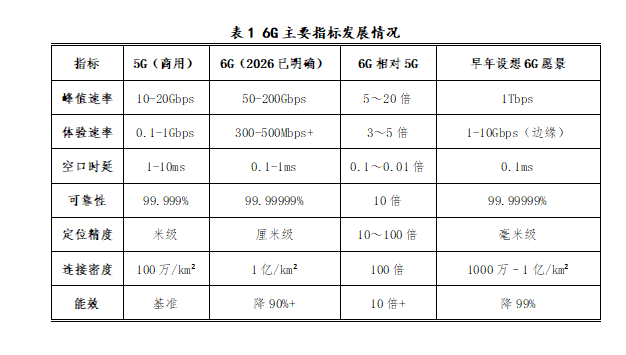
6G, or the sixth-generation mobile communication technology. Mobile communication technology started with 1G analog voice, underwent the digital transformation of 2G, the enlightenment of 3G mobile internet, the widespread adoption of 4G high-speed networks, and the commercial deployment of 5G in 2019. Its evolution has consistently maintained a "decade-per-generation" rhythm, with peak rates achieving thousand-fold improvements. Similarly, the development vision for 6G is to achieve an order-of-magnitude leap over 5G in key performance indicators, such as a hundred-fold increase in peak rate to 1 Tbps and an experienced rate of 1-10 Gbps. According to relevant indicators recently released by the International Telecommunication Union (ITU), the current actual peak rate of 6G is 50-200 Gbps, a 5 to 20 times improvement over 5G; the experienced rate is 300-500 Mbps+, a 3 to 5 times improvement over 5G (see Table 1). Although some rate indicators have been moderated compared to earlier visions, 6G still achieves ten to hundred-fold breakthrough improvements in core dimensions such as air interface latency, positioning accuracy, connection density, and energy efficiency, laying a solid network foundation for fully supporting the "Intelligent Connectivity of Everything" digital ecosystem (Wu Hequan, 2026).
(II) Key Technical Features and Application Scenarios of 6G
Currently, global 6G research has moved from the early vision phase into the critical stage of system design and key technology development. According to the authoritative white paper released by China's IMT-2030 (6G) Promotion Group, the overall vision of 6G is to achieve "Intelligent Connectivity of Everything and Digital Twin." 6G is no longer limited to enhancing single communication capabilities. The ITU's "IMT-2030 Framework Recommendation" defines six typical scenarios for 6G: immersive communication, massive connectivity, ultra-reliable low-latency communication, integration of artificial intelligence (AI) and communication, integration of sensing and communication, and ubiquitous connectivity. Aligned with these frameworks and scenarios, the key technical features of 6G are primarily reflected in the following five core dimensions:
First, ubiquitous connectivity and three-dimensional coverage. 6G will break through the physical limitations of traditional terrestrial cellular networks. For ubiquitous connectivity scenarios, the 6G system aims to achieve seamless, dead-zone-free three-dimensional coverage globally. Through the deep integration of space-air-ground integrated networks, communication capabilities will be extended to remote areas, oceans, and broader physical spaces.
Second, Integrated Sensing and Communication (ISAC). Traditional communication networks are used only for data transmission, while "integration of sensing and communication" is a core new scenario defined by the ITU for 6G. 6G networks will possess capabilities for activity detection and motion tracking (e.g., posture and gesture recognition, fall detection, vehicle and pedestrian detection) and environmental monitoring (e.g., rain and pollution detection). The underlying integration of communication and sensing capabilities will directly provide high-quality environmental reconstruction and sensing fusion data for AI, XR, and digital twin applications.
Third, native AI and computing-network convergence. 6G proposes native AI communication technology and communication-computing architecture convergence technology. 6G networks will deeply integrate the three elements of "dynamic intelligence, multi-dimensional collaboration, and ubiquitous security," transforming from a traditional transmission pipeline provider into a trinity role of "network-business-computing collaborative hub, ubiquitous intelligent sensing carrier, and secure and trustworthy cornerstone," enabling intelligent scheduling of air interface resources and network self-evolution.
Fourth, enhanced wireless air interface and new physical layer. To break through the limits of existing networks, 6G will introduce new multi-dimensional physical transmission and high-frequency band technologies, specifically including Reconfigurable Intelligent Surface (RIS), Holographic MIMO, Orbital Angular Momentum (OAM), and Terahertz communication. Advanced antenna technologies and full-spectrum utilization schemes will significantly enhance the transmission limits, positioning accuracy, and spectral efficiency of the 6G system.
Fifth, endogenous security and sustainability. Facing the massive number of nodes brought by the Intelligent Connectivity of Everything, 6G highly emphasizes sustainability, security, privacy, and resilience in its system design principles. In terms of network security, 6G will build an end-to-end, sustainably evolving security technology system, evolving from traditional "add-on defense" to a "network gene"-type endogenous security system, providing a secure and trustworthy digital foundation for thousands of industries.
II. Current Status of China's 6G Development
(I) Top-Level Design and Organizational Coordination: Building Policy and Institutional Advantages
China places high importance on 6G technology R&D and forward-looking deployment, viewing it as a key support for building a cyber power and digital China. At the policy level, from the "14th Five-Year Plan" to the "15th Five-Year Plan," 6G has been incorporated into the national top-level design and listed as a core future industry. The "Outline of the 15th Five-Year Plan for National Economic and Social Development of the People's Republic of China" explicitly proposes promoting "the sixth-generation mobile communication, etc., to become new economic growth points." The Ministry of Industry and Information Technology has also clarified key tasks such as deepening standard development and building test networks. At the organizational coordination level, China fully leverages the advantages of the new nationwide system. As early as 2018, China took the lead in initiating 6G technology research; in June 2019, the Ministry of Industry and Information Technology guided the establishment of the IMT-2030 (6G) Promotion Group, bringing together Huawei, ZTE, China Mobile, CASIC, universities, and leading vertical industry players to build an integrated innovation system of "government, industry, academia, research, and application," avoiding fragmentation of R&D forces and systematically coordinating national scientific research resources and technical routes.
(II) Patent Portfolio and Basic Research: Firmly in the Global First Tier
In terms of key technology breakthroughs and intellectual property portfolio, China has established a clear leading position. As of June 2025, China's 6G patent applications account for approximately 40.3% globally, surpassing the United States (35.2%) by nearly five percentage points and far exceeding Japan (9.9%), ranking first in the world (China Academy of Cyberspace Studies, 2025). In basic research, China, guided by application orientation, has formed a reserve of over 300 key technologies, with patents precisely laid out across the entire industrial chain, including terahertz communication, integrated sensing and communication, and space-air-ground integration (Zhang Yunming, 2025). It is noteworthy that over 90% of China's 6G patents are high-quality invention patents with strong potential for implementation. In terms of innovation entity distribution, enterprises account for as high as 87.2%, far exceeding universities and research institutions. This enables deep linkage between basic research and the base station R&D of companies like Huawei and ZTE, forming an "end-to-end closed loop" from standards to equipment, ensuring that technological evolution stays close to application scenarios (CCID Consulting, 2026).
(III) Test Network Construction and Scenario Verification: Accelerating the Leap from Theory to Live Network
Technology maturity relies on rigorous verification in field environments. As of February 2026, China has fully completed the first phase of 6G technology trials and officially launched the second phase in January 2026 (State Council Information Office, 2026). In terms of infrastructure and verification platforms, China has not only built the world's first 6G integrated communication, intelligence, and sensing field trial network, achieving a dual breakthrough in technology verification and scenario implementation. Simultaneously, targeting the core vision of 6G "space-air-ground integration," China is accelerating the construction of a low-orbit broadband satellite internet system. Currently, multiple low-orbit satellite constellation plans are underway, including the GW constellation plan consisting of 13,000 satellites and the Qianfan constellation plan consisting of 15,000 satellites (Deng Zhongliang, 2026), providing critical physical payloads and network environments for achieving satellite-terrestrial integrated communication. Next, China will focus on promoting industrial R&D during the "15th Five-Year Plan" period, aiming to initiate commercial applications around 2030 and achieve large-scale commercial deployment by 2035, cultivating a trillion-yuan level 6G industry track (China Academy of Information and Communications Technology, 2026).
(IV) Deep Participation in International Standard Setting: Enhancing Global Industry Discourse Power
During the global transition from "5G evolution" to "6G standard setting," China is actively converting its technological advantages into standard advantages. Relying on the IMT-2030 (6G) Promotion Group, China has led the release of multiple 6G vision and technology white papers and contributed a large number of "Chinese solutions" during the formulation of the ITU's "IMT-2030 Framework Recommendation." Domestic major operators and communication equipment vendors deeply participate in international standardization organizations like 3GPP, playing key leading roles in the initiation of core standard projects such as network architecture and wireless air interface, playing an irreplaceable leading role in the formation of global unified 6G standards.
III. Challenges Facing China's 6G Development
Currently, global 6G competition has evolved from a purely technological contest into a comprehensive game involving national strategy, geopolitics, and industrial ecosystems. Although China has achieved phased first-mover advantages in patent quantity, test network construction, and verification of some key technologies, it also faces an unprecedented complex situation. Externally, the US, Europe, Japan, and South Korea attempt to neutralize China's first-mover advantages through "small yard, high fence" technology blockades and "alliance-building" standard encirclement. Internally, structural contradictions are becoming increasingly prominent, such as the difficulty in achieving original theoretical breakthroughs, the low localization rate of core underlying devices, and the unclear path to a closed-loop business model. China's 6G development has entered a critical period where it must advance or retreat. It is imperative to systematically identify and precisely resolve internal and external challenges to achieve a fundamental leap from "running alongside" to "leading" in the new round of global technological revolution.
(I) External Environmental Challenges: Geopolitical Competition Spurs "Technology Containment"
The United States adopts a dual-track strategy of "whole-of-government approach" and "ally exclusion," aiming to reshape global communication hegemony. The US regards 6G as a strategic high ground to maintain its global geopolitical advantage and has built a cross-departmental "American-style whole-of-government approach" mechanism. At the strategic and policy level, it has established national will through the Presidential Memorandum "Winning the 6G Race" and the "National Spectrum Strategy," intensively issuing policies like the "Promoting United States Leadership in Wireless Act" and the "Future Networks Act" to ensure funding and policy continuity from a legislative height, striving to seize industrial leadership (Wang Xinwei et al., 2023). At the military and technical level, the US released the "Future Generations Wireless Technology (Future G) Roadmap," explicitly embedding military requirements into the 6G standard system and planning to initiate 7G forward-looking research by 2034, attempting to ensure the US military's absolute lead in communication through generational leaps (Beijing Lande Information Technology Co., Ltd., 2025). Simultaneously, the US is focusing on studying the migration strategy for the 6G "golden band" within the federal system to ensure high speed and wide coverage for commercial networks. At the diplomatic and alliance level, the US leads the "de-Sinicization" Open RAN architecture and convened a closed-door meeting in Tokyo in December 2025 with Japan, Australia, Canada, and the UK to build an exclusive technology alliance. This deployment centered on "exclusive competition" aims to weaken the leading advantages Chinese companies have already gained in 3GPP R20 and future 6G standards by controlling key frequency bands and standard interfaces.
The European Union adheres to a strategy of "vertical industry empowerment" and "ecological barriers," attempting to redefine the rules of the game. Relying on its strong industrial base, the EU has established a unique path of defining 6G technology based on vertical industry needs. The European Commission and the 6G Smart Networks and Services Industry Association (6G-IA) jointly lead the initiative, each injecting 900 million euros to establish the SNS JU project and launching the flagship "Hexa-X" project, bringing in cross-industry giants like Siemens, Sony, and Apple to build a highly open but strictly regulated industrial ecosystem. In terms of technological evolution, the EU places high importance on the deep integration of AI and communication. In 2025, the EU intensively invested special funds, focusing on tackling terahertz communication, intelligent reflecting surfaces, and AI-native network technologies; in December of the same year, it solicited public comments on software bill of materials and security guidelines. In terms of institutional development, the EU proposed the legislative act "Digital Networks Act" in January 2026, aiming to strengthen network security and system resilience. This "demand-driven technology" path of the EU may form a differentiated standard system different from China's "technology-driven" route.
Japan deeply cultivates "core underlying technologies" and "supply chain positioning," implementing an asymmetric competition strategy. Japan regards 6G as key infrastructure for realizing the "Society 5.0" vision and addressing the crisis of a declining birthrate and aging population, aiming to enhance international competitiveness and ensure economic security (Han Kaifeng et al., 2026). In terms of strategic layout, Japan, through the "Beyond 5G Promotion Strategy 2.0" and the "Digital Infrastructure Development Plan 2030," has established special funds to focus on promoting the integrated construction of AI and communication facilities. In key technologies, Japan focuses on terahertz communication, low-orbit satellites, and key electronic materials, planning to complete terahertz commercialization verification around 2025 and achieve formal deployment by 2030. Leveraging its long-term accumulation in high-end electronic materials, RF devices, and precision manufacturing, Japan has formed a significant technological advantage in niche areas like terahertz chips (Chen Yan, 2025). Furthermore, Japan has integrated and established a promotion alliance comprising 104 members (nearly 90% domestic enterprises) including KDDI Corporation and Toshiba, building a highly closed internal ecosystem (Meng Fanrong et al., 2025). Japan's advantages in core devices, electronic materials, and terahertz technology further highlight the shortcomings in China's 6G underlying hardware. Its technological synergy with economies like the US may also exacerbate the risk of China being "choked" in key component areas.
South Korea races ahead in "commercial nodes" and "satellite communication," aiming to seize market opportunities through a time window. South Korea aims to replicate its first-mover experience from the 5G era, attempting to use time to gain space and capture the global high-end market. In terms of funding and projects, the South Korean government released the "K-Network 2030" strategy, and the Ministry of Science and ICT (MSIT) released the "Future Mobile Communication R&D Strategy Leading the 6G Era," proposing to achieve 6G commercialization by 2028, earlier than the 2030 commercialization vision proposed by 3GPP. In 2024, South Korea launched the "6G Society" plan, focusing on advancing preparatory work such as frequency allocation and related legal adjustments required for low-orbit satellite communication services; in 2025, South Korea proposed a low-orbit satellite communication technology R&D project, investing 320 billion Korean won in the development of ground stations, antennas, and other equipment (Meng Fanrong et al., 2025). This government-led, forward-deployment strategy aims to form a de facto "South Korean definition" in terminal forms, application scenarios, and international standards by achieving commercial implementation first. This will directly compress the window of opportunity for China's 6G industry to go global, leading to fiercer competition and market squeeze for Chinese companies in international market expansion.
(II) Internal Development Bottlenecks: Multiple Dilemmas in Core Technology Breakthroughs, Standard Unification, and Business Closed Loop
First, the difficulty of original innovation has surged sharply, coexisting with the hidden worry of "bottlenecks" in the underlying industrial chain. Unlike the 5G era, which had mature paths to follow, 6G R&D has delved into the "uncharted territory" of basic theory. At the physical layer, the performance of terahertz communication systems depends on the parameters of front-end and baseband devices. Existing technologies need to overcome bottlenecks such as efficiency, noise, and power degradation caused by high frequencies. At the network architecture layer, core issues like "wide-area resource awareness, dynamic topology management, and resource orchestration and scheduling" for space-air-ground integration currently lack a unified theoretical framework (Tian Lifeng et al., 2025). Furthermore, Integrated Sensing and Communication (ISAC) technology is achieving the fusion of high-precision sensing and high-speed communication through innovative waveform design and prototype system verification, but still faces numerous technical challenges requiring further research to meet diverse 6G application needs.
Second, core devices face "bottlenecks," and shortcomings in the basic industry limit performance ceilings. China has obvious advantages in system integration and application, but the weakness of "lack of core chips and operating systems" is more prominent in the 6G high-frequency era. The performance of terahertz communication systems is highly dependent on front-end device parameters, while China has long relied on imports for core underlying devices such as high-performance RF chips, high-end AD/DA converters, and optical communication modules. This shortcoming in the basic industry limits the system performance ceiling. If the constraints of basic materials and high-end processes cannot be overcome during the "15th Five-Year Plan" period, China's 6G system may face a passive situation of "having technology but no devices, having solutions but difficulty in implementation," with the system performance ceiling being locked in.
Third, international standards face "fragmentation," and the risk of industrial ecosystem fragmentation is increasing. The scale effect of mobile communication is rooted in globally unified standards, but current geopolitics is tearing apart this consensus. The US, together with its allies, promotes a "de-Sinicized" supply chain (e.g., Open RAN) and sets up separate initiatives outside 3GPP, leading to potential competition among three major standard camps: China, the US, and Europe. If the differences in interface protocols between 3GPP and IEEE cannot be resolved, coupled with a lack of consensus among countries on 6G spectrum planning, it could lead to the global 6G splitting into two incompatible systems. This would greatly weaken the scale advantage of China's communication industry, forcing Chinese companies to bear higher costs for industrial chain adaptation and face greater obstacles in going global.
Fourth, there is a "scissors gap" in the business closed loop, with challenges of high costs and high energy consumption coexisting. 6G network construction faces a severe cost and energy efficiency paradox. On the cost side, the estimated deployment cost for a single 6G base station exceeds 2 million yuan, and achieving cost reduction through scale is difficult; operators are currently trapped in a "scissors gap" dilemma of peaking traffic dividends and rising operational costs, harboring serious concerns about the payback period for huge investments. On the application side, vertical industry applications mostly remain at the basic connection level, lacking deep integration with core production processes, leading to a single business monetization model. On the energy consumption side, 5G base station energy consumption is already more than ten times that of 4G. With 6G introducing massive nodes in the future, if battery technology does not achieve a breakthrough, the enormous power consumption will become a "gray rhino" restricting the large-scale deployment of the network.
IV. Research on China's 6G Development Pathways
Facing the dual challenges of external geopolitical "technology containment" and internal innovation in "uncharted territory," based on a profound analysis of China's strengths and weaknesses, the future development pathway should synergistically exert efforts from five dimensions: international competition, theoretical breakthroughs, strengthening the foundation, standard leadership, and business restructuring, to build a systematic strategy for breaking the deadlock.
(I) Deepen International Competition and Cooperation, Build a Diversified and Synergistic Open Cooperation System
In response to the exclusive competition pattern built by the US through its "whole-of-government approach" and ally strategy, China should abandon the zero-sum mindset of "either-or," maintain "soft connections" with the US in basic theoretical areas like terahertz physics and AI algorithms, and avoid a complete "technology curtain." For partners like the EU, which emphasize ecological openness and vertical industry empowerment, China can rely on the China-EU Digital Dialogue mechanism to strengthen joint R&D in common technology areas such as AI integration and green 6G, striving for technical interoperability and standard synergy in flagship projects like Hexa-X, avoiding passive isolation. For neighboring countries like Japan and South Korea, which pose direct competition in underlying technologies and commercial pace, China should use industrial interests as a bond, exploring the establishment of "R&D-patent-market" benefit-sharing mechanisms in "bottleneck" areas like terahertz devices and key electronic materials, exchanging market space for technological cooperation space to alleviate the pressure of being constrained in underlying technologies. Furthermore, relying on the "Belt and Road" Initiative and BRICS cooperation mechanisms, China should take the lead in deploying 6G trial networks and conducting talent training in emerging markets like the Middle East and Southeast Asia, accelerating the implementation of 6G trial networks and demonstration applications. By adopting a strategy of "technology export + standard first," China can capture the mindshare and market entry points of developing countries, achieving early locking and ecological expansion of China's standard system.
(II) Strengthen Original Innovation Capabilities, Break Through the Theoretical Ceiling of "Uncharted Territory"
To address the shortcomings in basic theory, it is necessary to leverage the advantages of China's new nationwide system to achieve a leap from application innovation to core key technology innovation. First, overcome basic theories at the physical layer. Focus on the physical bottlenecks faced by terahertz communication, establish national-level special funds, and focus on tackling theoretical challenges such as terahertz waveform design, high-frequency channel modeling, and holographic MIMO, providing theoretical support for Tbps-level rates. Second, build a unified network architecture foundation. For the challenge of space-air-ground integration, accelerate the construction of a unified theoretical framework for wide-area resource scheduling and dynamic topology management, solving the collaborative orchestration problem of multi-dimensional nodes, and providing a "Chinese blueprint" for global 6G architecture design. Third, accelerate the verification of integrated communication, sensing, and computing. Encourage universities and leading enterprises to jointly tackle key problems, achieve breakthroughs in waveform design and interference cancellation algorithms for Integrated Sensing and Communication (ISAC), and shorten the transformation cycle from prototype verification to commercial deployment.
(III) Implement a Foundation-Strengthening Project, Mitigate the Risk of Device "Bottlenecks"
To address the import dependence on high-performance RF chips, AD/DA converters, and optical communication modules, it is necessary to bridge the "last mile" from basic research to industrialization. First, break through upstream key materials. Relying on national laboratories and leading industry enterprises, focus on breaking through compound semiconductor materials like Indium Phosphide (InP) and Gallium Nitride (GaN) and high-end manufacturing processes, striving to achieve independent controllability of key frequency band RF devices by the end of the "15th Five-Year Plan" period. Second, enhance high-end process manufacturing capabilities. Concentrate efforts on tackling high-end AD/DA converters and optical chips for high-frequency, large-bandwidth applications, gradually reducing dependence on the US and Japanese supply chains, and removing the physical lock on system performance ceilings. Third, establish a domestic verification platform. Encourage operators and equipment vendors to open pilot-scale verification environments to domestic chip companies, guide upstream and downstream industrial chain coordination through "first-set" policies, and use market applications to feed back the iterative maturity of device technology.
(IV) Defend Leadership in International Standards, Avoid the Trap of "Standard Fragmentation"
First, win the "spectrum defense battle." In response to global disagreements over the 6 GHz and 7-15 GHz "golden bands," jointly release authoritative spectrum research reports with the ITU, using solid experimental data to gain support from more countries worldwide for China's proposed IMT frequency band plan, laying the physical foundation for global roaming. Second, seize the "right to define" in new areas. In rule-blank areas such as AI-communication convergence and satellite-terrestrial integration protocols, increase the intensity of proposals in 3GPP R20 and subsequent versions, converting China's technological advantages into core patents in international standards, and building a solid technological moat. Third, guard against the "hollowing out" impact of Open RAN. Actively participate in technical evaluations and security standard setting related to Open RAN, neither isolating oneself nor opposing the politicized manipulation of "exclusion" under the guise of "openness," ensuring the integrity of the global communication industry chain.
(V) Innovate Business Monetization Models, Solve the "Scissors Gap" and Energy Consumption Challenges
In response to risks such as high costs, high energy consumption, and unclear business models, 6G development must return to business fundamentals and explore sustainable evolution paths. First, promote "green and minimalist" network construction. Make "green native" a core design principle for 6G, vigorously develop zero-energy terminals, AI energy-saving scheduling algorithms, and liquid-cooled base station technologies, reducing network Total Cost of Ownership (TCO) from the architectural level to solve the high energy consumption problem. Second, deepen the "CT+OT" cross-industry integration. Solve the "fragmentation" pain point in vertical industries, promoting the deep decoupling and reconstruction of Communication Technology (CT) and Operational Technology (OT). No longer stop at pipeline services, but collaborate with industry giants to create integrated solutions of "connectivity + computing + models," achieving a business closed loop first in high-value scenarios like the low-altitude economy and autonomous driving. Third, cultivate new "space-air-ground" business formats. Seize the opportunity of low-orbit satellite internet construction, explore emerging business models such as direct satellite-to-phone connectivity and wide-area IoT, extending the mobile communication market from the ground to the ocean and sky, fundamentally solving the operators' dilemma of "increasing traffic but not revenue."
Source: Mu Zhenjuan (Jiangsu Institute of Scientific and Technical Information; Jiangsu Academy of Science and Technology for Development)/Author, First published in the 2026 Issue 5, Science and Economy column of "Science and Technology China" magazine.
Related Products





G.652.D Wavelength-extended Non-dispersion Shifted Single-mode Optical Fiber
HONGAN GROUP CO., LTD.

GYTA Type Non-Self-Supporting Aerial/Duct Optical Cable
TONGDING INTERCONNECTION INFORMATION CO., LTD.
Mine Explosion-proof and Intrinsically Safe Industrial Ethernet Ring Network (10 Gigabit/Gigabit)
Chongqing Mas Sci&Tech Co., Ltd.