Japan to Begin Development of Its ‘First’ Fully Battery-Powered Tugboat
Wedoany.com Report-Aug. 17, Tokyo Kisen, a Japanese tugboat services provider, and marine software developer Marindows have launched what is described as Japan’s first pure battery-powered electric harbor tugboat development project. The vessel will operate in the ports of Yokohama and Kawasaki, supporting the ports’ net-zero greenhouse gas emissions targets under the Japanese government’s Carbon Neutral Port (CNP) policy.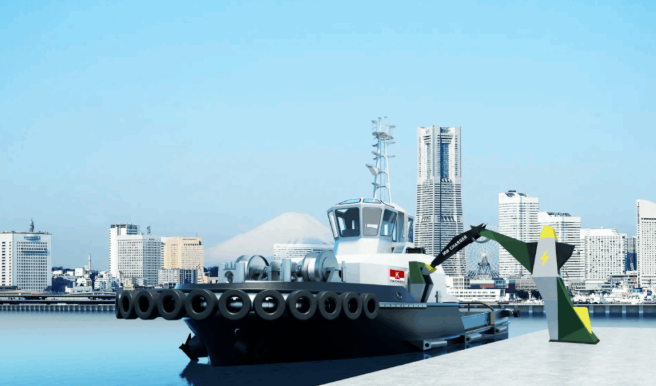
Construction of the tug is scheduled to start in 2028, with operations expected to begin in 2030. Powered by lithium-ion batteries, the vessel is designed to deliver a total propulsion power of 3,000 kW and reach a speed of 14 knots. The initiative builds on more than two years of prior work on electric tug projects.
In January 2023, Tokyo Kisen introduced Taiga, a hybrid electric-powered tug equipped with a 2,486 kWh battery. The vessel was developed in partnership with e5 Lab, a Japanese consortium focused on fully electric vessels. Built at Kanagawa Dockyard in Kobe, Taiga incorporates ABB’s Onboard DC power system platform, designed to reduce fuel consumption and environmental impact. It was officially launched in late May 2022.
Taiga is the second eco-friendly tug to enter service in Yokohama and Kawasaki, following Ginga, a diesel-electric hybrid tug launched in 2013. The new project with Marindows aims to advance this work toward “truly zero-emission operations.”
Japan holds a leading position in the global maritime sector, ranking among the top shipbuilders and operating one of the largest fleets worldwide. The Japanese maritime logistics market was valued at about $11.21 billion in 2024, with projections indicating growth to approximately $18 billion by 2033. This expansion has been accompanied by increased public and private sector initiatives to achieve net-zero emissions by 2050, in line with the International Maritime Organization’s environmental targets under the Net Zero Framework.
Electrification and automation have been central to Japan’s climate neutrality strategy, especially for coastal shipping. The government has launched a national project worth around $410,000 to establish a zero-emission coastal shipping industry, aiming to design and deploy zero-emission vessels within five years.
Other developments in this field include the 2021 launch of Asahi Tanker’s first all-electric tanker, which entered service in Tokyo Bay in March 2022 as a bunker vessel. More recently, in May 2025, Nippon Yusen Kabushiki Kaisha (NYK) unveiled e-Crea, Japan’s first battery-powered work vessel.
The Tokyo Kisen–Marindows project represents the next step in Japan’s efforts to integrate advanced electric propulsion technology into port operations, supporting both national carbon reduction policies and the maritime industry’s shift toward sustainable practices.