South Korea Amends Regulations to Support Green Shipping and Shipbuilding Efforts
Wedoany.com Report-Aug. 22, South Korea’s Ministry of Oceans and Fisheries (MOF) has revised the rules on standards and certification for environmentally friendly vessels in an effort to enhance sustainable practices in the shipping and shipbuilding industries. The updated guidelines, introduced jointly with the Ministry of Trade, Industry and Energy (MOTIE), came into force on August 21, 2025.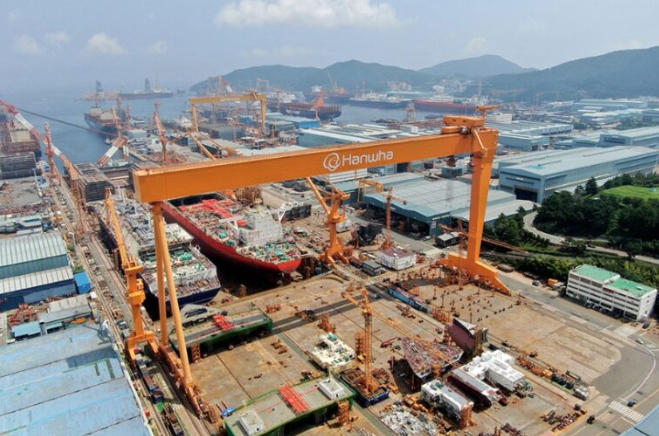
Hanwha Ocean’s Geoje Shipyard in South Korea (for illustration purposes only)
The revised framework is designed to broaden eligibility for eco-friendly certification. Unlike before, not only shipowners but also shipbuilders can now apply for certification. Furthermore, the final certification may be issued even if it differs from preliminary approval due to unavoidable factors such as design changes. The new rules also integrate internationally recognized benchmarks, including the Energy Efficiency Existing Ship Index (EEXI) and the Carbon Intensity Indicator (CII), ensuring better alignment with global standards.
Seong-yong Choi, Deputy Director of the Safety Policy Division at MOF, emphasized the significance of this move: “Following the introduction of the eco-friendly equipment certification system last February, we expect that the demand for eco-friendly certification will increase significantly with the overall improvement and supplementation of this certification system.” He added: “The government will continue to promote measures such as acquisition tax reductions for eco-friendly certified ships (up to 2 percentage points) and construction financing support (up to 30% of shipbuilding costs) to take the lead in reducing greenhouse gas emissions in the shipping sector.”
The eco-friendly vessel initiative was first enacted in December 2020, with MOF responsible for the certification process. As of July 2025, a total of 119 vessels had received recognition as environmentally forward. The February 2025 update further expanded the scope of certification to cover “green” onboard equipment such as carbon capture and storage systems and waste heat recovery technologies.
These February revisions also prioritized vessels with electric propulsion or those that produce zero emissions of air pollutants like nitrogen oxides (NOx), granting them the highest scores in certification evaluations. At the same time, the government announced an investment plan of approximately KRW 222.3 billion (around USD 152.9 million) to support the construction or conversion of 81 eco-friendly vessels. Within this program, the public sector committed to building 34 ships, including electric-powered and hybrid types, while providing financial aid to the private sector for constructing an additional 20 units.
Further adjustments followed in May 2025, when MOF introduced updated standards for electric vessels. These revisions aimed to encourage greater adoption of ships powered by electric technology, complementing earlier measures and reinforcing South Korea’s long-term vision for a sustainable maritime industry.
Through these continuous updates and financial support, the South Korean government seeks to accelerate the transition to eco-friendly shipbuilding and shipping, positioning the country to strengthen its role in advancing sustainable practices within the global maritime sector.