Wedoany.com Report-Oct. 31, India’s plans to enhance its maritime capabilities received a major boost as Dubai-based DP World and Denmark’s APM Terminals announced new investments exceeding $7 billion to expand port and logistics infrastructure across the country. The announcements were made during India Maritime Week 2025, highlighting growing international interest in India’s maritime sector as the government advances its Maritime Amrit Kaal Vision 2047.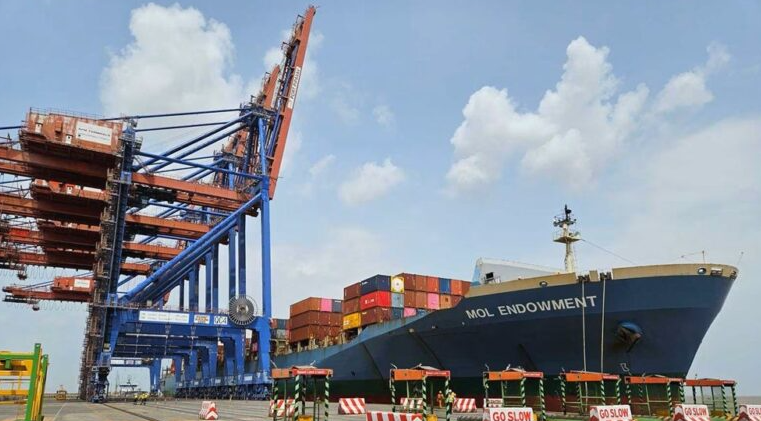
DP World will invest an additional $5 billion in India, increasing its total investment commitment to about $8 billion over the past 30 years. The company said the funding will strengthen its integrated supply chain and logistics network, improve multimodal connectivity, reduce logistics costs, and enhance India’s export competitiveness.
This new investment follows the signing of five memorandums of understanding (MoUs) between DP World and Indian maritime authorities. These cover initiatives in green coastal shipping, ship repair, freight mobility, and skill development. Under one agreement, DP World’s feeder operator Unifeeder will cooperate with Sagarmala Finance Corporation to promote sustainable coastal shipping. Another MoU between Drydocks World and Cochin Shipyard Limited will expand ship repair capacity in Kochi. DP World also signed a deal with Deendayal Port Authority and Nevomo (MagRail) to develop India’s first automated low-emission port track system.
Sultan Ahmed bin Sulayem, Group Chairman and CEO of DP World, stated: “The investment reflects a shared commitment to building a connected, confident, and self-reliant India.”
At the same event, APM Terminals Pipavav signed an MoU with the Gujarat Maritime Board to invest $2 billion in expanding Pipavav Port. The project, part of A.P. Moller – Maersk’s $5 billion India infrastructure plan announced earlier this year, aims to significantly increase the port’s container, liquid, and roll-on/roll-off (roro) handling capacity.
Jon Goldner, CEO of APM Terminals Asia & Middle East, said: “The expansion aims to unlock new opportunities for Gujarat, for India, and for global trade.” He described Pipavav as a “model of world-class efficiency and green growth.”
The upgraded facilities at Pipavav are expected to create approximately 25,000 jobs and enhance multimodal connectivity through links with the dedicated freight corridor. They will also support industries such as automotive, energy, and agriculture by improving the efficiency of trade routes and logistics networks.
The combined investments from DP World and APM Terminals underscore the accelerating pace of global port investment in India, which is positioning itself as a key hub in international shipping and logistics. These initiatives come alongside other large-scale projects under development, including the planned addition of more than 430 vessels worth a total of $26 billion to strengthen India’s maritime capacity.
Together, these developments highlight India’s growing importance in global trade networks and its strategy to establish a modern, sustainable, and competitive maritime ecosystem through strong international partnerships and forward-looking infrastructure investments.