Wedoany.com Report-Oct. 31, AWS has announced major progress in Project Rainier, a large-scale artificial intelligence infrastructure initiative developed in collaboration with Anthropic. The project has delivered Trainium2 chips in record time and aims to deploy more than one million chips by the end of 2025. Less than a year after its launch, Project Rainier is already operational, supporting Anthropic’s advanced AI model Claude with more than five times the compute power used for its previous models.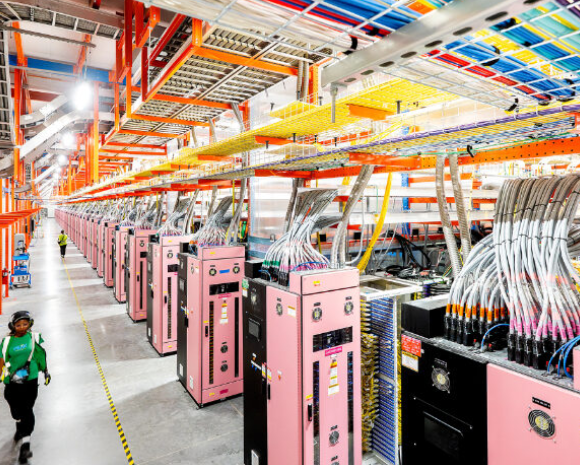
Project Rainier marks a significant step in AWS’s strategy to expand its AI computing capabilities. The enhanced compute power will be used to build and train future versions of Claude, improving accuracy and performance. The project operates across multiple data centers in the United States and represents one of the largest infrastructure deployments in AWS history.
Ron Diamant, AWS Distinguished Engineer and Head Architect of Trainium, said: “Project Rainier is one of AWS’s most ambitious undertakings to date. It’s a massive, one-of-its-kind infrastructure project that will usher in the next generation of AI models.”
At the core of Project Rainier is the Trainium2 chip, a custom-designed AI processor built for large-scale model training. It is optimized to handle the vast data volumes required to teach AI systems complex tasks efficiently. The Trainium2 infrastructure developed under Project Rainier is 70% larger than any other AI computing platform previously created by AWS. Each chip can perform trillions of calculations per second, and AWS has deployed thousands of them in its new system.
The system architecture features UltraServers—an innovation combining four physical Trainium2 servers, each equipped with 16 chips. This configuration reduces network latency by allowing faster internal data transfer and more efficient execution of complex calculations. When connected in large numbers, these UltraServers form a massive “UltraCluster,” capable of processing extensive AI workloads simultaneously.
Operating such a vast cluster requires high reliability and efficiency. To ensure stability and consistent performance, AWS builds and manages its own hardware, allowing full control of the technology stack. This integrated approach enables continuous optimization and improvement across the entire system.
AWS is also committed to sustainable operations as it expands its AI infrastructure. The company continues to invest in renewable energy projects, including nuclear power and battery storage, to meet its growing energy needs responsibly. For the past five years, Amazon has been the world’s largest corporate purchaser of renewable energy and remains committed to achieving net zero carbon emissions by 2040.
In terms of water usage, AWS highlights its efforts to minimize consumption in data centers such as those in St. Joseph County, India, one of the Project Rainier sites. The facilities maximize the use of outside air for cooling, eliminating water use entirely from October to March and limiting it to a few hours per day during warmer months.
Project Rainier is expected to set a benchmark for future AI infrastructure, providing the computational foundation to address increasingly complex global challenges while advancing innovation in sustainable technology.