Wedoany.com Report-Oct. 31, In October 2025, China achieved a significant milestone in offshore renewable energy with the launch of its first fully integrated offshore hydrogen–ammonia–methanol production platform near Yantai in the Bohai Sea. The project, developed by National Energy Group Hydrogen Energy Technology Co., Ltd. together with Yantai CIMC Raffles Offshore Engineering Co., Ltd. and Guoneng Hydrogen Innovation Technology (Beijing) Co., Ltd., successfully produced its first batch of green methanol. This 20,000-ton semi-submersible facility combines renewable energy, seawater, and carbon dioxide through advanced chemical processes to operate completely off-grid.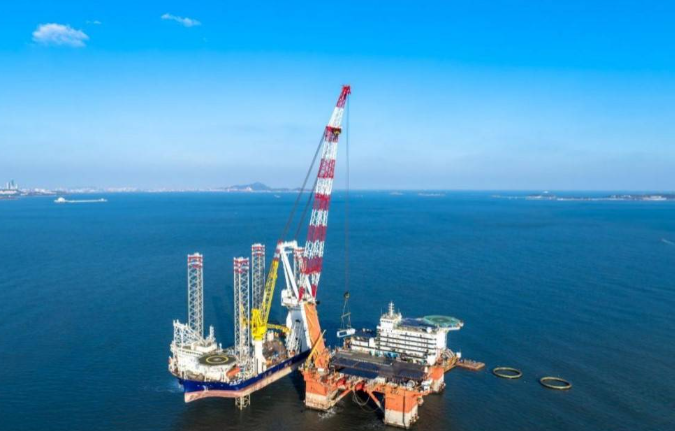
The platform is equipped with 5 MW of photovoltaic panels, several wind turbines, and robust battery systems to ensure stable operation. A desalination unit generates five tonnes of freshwater daily, supporting both the crew and electrolysis processes. It can produce up to five tonnes of green hydrogen each day at about 75% efficiency through two electrolysis systems—direct seawater electrolysis and freshwater PEM/alkaline modules. The hydrogen is then used in two synthesis lines: one for ammonia and another for methanol production. The methanol reactor, supplied by Shanghai Electric Group Guokong Universal Engineering Co., Ltd., achieves over 80% carbon dioxide conversion in a single process cycle.
A key innovation lies in its ability to perform direct seawater electrolysis, removing the need for land-based desalination. This breakthrough, jointly developed by Guoneng Hydrogen Innovation Technology and East China University of Science and Technology, enhances efficiency and simplifies operations. The system is supported by a 1 MW backup generator from Weichai, ensuring uninterrupted performance during low wind or sunlight periods. Each component is designed by Yantai CIMC Raffles to withstand harsh marine environments, including saltwater corrosion and strong waves.
Yantai, a coastal city traditionally centered on shipbuilding and heavy industry, has been shifting toward renewable energy development since 2020. Supported by provincial green initiatives under China’s 14th Five-Year Plan, the city has expanded offshore wind and solar projects. The floating hydrogen platform marks a new stage in Yantai’s advancement of the “blue economy,” emphasizing sustainable marine resource utilization.
The project addresses challenges faced by traditional renewable systems, such as grid congestion and transport costs. By locating hydrogen and e-fuel production at sea, it reduces transmission losses and increases efficiency. Developers estimate annual carbon dioxide reduction at about 36,000 tonnes, equivalent to planting two million trees. The facility can power a 10,000-ton vessel for up to ten days, offering new potential for maritime decarbonization.
National Energy Group’s strategic roadmap outlines further expansion, including a 100-ton methanol production hub in Yancheng by 2028 and a 1,000-ton facility in the South China Sea after 2030. The success of this demonstration platform may help China strengthen its position in global e-fuel production and promote sustainable energy development.
Regulators are now formulating technical standards and safety protocols for offshore hydrogen facilities, while international stakeholders are studying the Yantai model for possible adaptation. Despite challenges in costs, equipment supply, and environmental management, the project’s success underscores the potential of offshore renewable integration. As more such “energy islands” emerge along China’s coast by 2035, they are expected to play an important role in advancing clean energy transformation and supporting global carbon reduction goals.