Wedoany.com Report on Feb 11th, Vectorworks 2026 introduces the Sustainability Dashboard, providing real-time environmental performance insights for design projects, helping users make data-driven decisions as the project progresses. This tool aims to eliminate uncertainty in achieving sustainability goals by automatically aggregating design model data, tracking four key metrics—Embodied Carbon, Urban Greening Factor (UGF), Biomass Density, and Biodiversity Net Gain (BNG)—and updating them in real time as the design evolves.
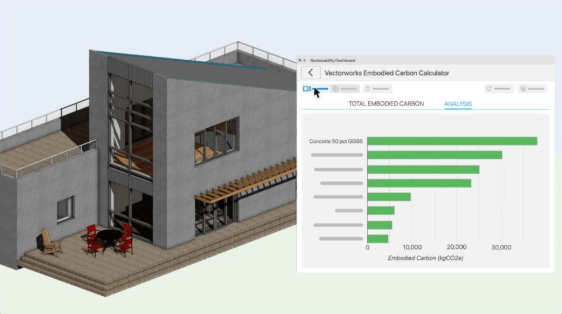
The new dashboard helps users meet regulatory requirements early, reduce the cost of late-stage modifications, and deliver compliant projects more reliably, thereby promoting smarter, more resilient designs that reflect a commitment to sustainability.
The Vectorworks Embodied Carbon Calculator (VECC) calculates and visualizes a project's embodied carbon footprint directly from the Building Information Model (BIM). It automates the carbon assessment process while providing fine-grained control over material selection and lifecycle analysis, linking material data, lifecycle stages, and carbon metrics to help optimize sustainability outcomes and align with industry standards such as the AIA and RIBA 2030 Climate Challenge. Real-time feedback allows users to immediately see the impact of design choices on carbon emissions, supporting data-driven decisions to reduce environmental impact.
The Urban Greening Factor (UGF) framework calculates and evaluates the quantity and quality of green infrastructure in developments, as required by the London Plan Policy. The Sustainability Dashboard tracks UGF scores, offering dynamic, interactive data input and testing of surface cover types. It seamlessly integrates with BIM workflows, automating surface analysis and generating detailed metrics. Early visualization and quantification of greening strategies help meet local planning and sustainability standards, optimizing site layouts to enhance environmental performance.
The Biomass Density module tracks vegetation characteristics in landscape projects by converting mapped shapes into intelligent design objects, delineating and assigning credit values to land cover types such as tree groups, lawns, and paved areas. This method incorporates quantitative measures to monitor gains; each increase in vegetation cover affects the sustainability score, enabling users to assess compliance in real time and demonstrate design impact.
The Biodiversity Net Gain (BNG) module focuses on conserving and enhancing biodiversity within design projects by providing relevant information and facilitating collaboration between designers and ecologists to track and quantify habitats, hedgerows, and watercourses. The system supports multiple survey formats and classification standards, adapting to different project types and compliance frameworks.
The Sustainability Dashboard serves as the central hub for sustainable design workflows within Vectorworks software. Through the collaborative work of the VECC, UGF, Biomass, and BNG tracking tools, it provides data clarity and control for precise design. More tools and features will be added in the future to expand the possibilities of sustainable design. Users can share ideas and suggestions via the roadmap to help shape the next generation of design technology, driving a more sustainable built environment.