Wedoany.com Report on Mar 9th, The International Energy Agency recently released the "Energy Innovation Status 2026" report, indicating that carbon capture and carbon removal technologies are becoming a focal point of global energy innovation, garnering attention from governments and investors to address industrial and atmospheric emission challenges.
Carbon capture, utilization, and storage technologies are gradually being integrated into government strategies aimed at decarbonizing heavy industry and energy infrastructure. The report notes that policy support continues to expand in areas where electrification or fuel switching is difficult. Taking Denmark as an example, the country launched a carbon capture and storage fund in 2025, with a budget of approximately $4.2 billion, providing 15-year contracts to support the capture, transport, and storage of carbon dioxide.
Although a recent tender received only two bids, this initiative is seen as partial progress, reflecting the complexity of policy design. Carbon capture technology is advancing from research to demonstration projects, but the report points out that reliance on certain large-scale applications has decreased, such as carbon capture, utilization, and storage for process emissions, whose scale has dropped by one-fifth.
Developers face funding challenges, particularly between pilot and commercial deployment, a phase known as the "missing middle" of financing. Government support, joint ventures, and long-term agreements are being used to bridge the gap and push projects into the construction phase.
Carbon removal technologies are also growing rapidly, including methods like direct air capture, which aim to remove carbon dioxide directly from the atmosphere. The report found that since 2021, emerging fields like carbon removal have attracted venture capital, accounting for about one-third of energy venture investment by 2025, indicating investors' shift toward deep decarbonization technologies.
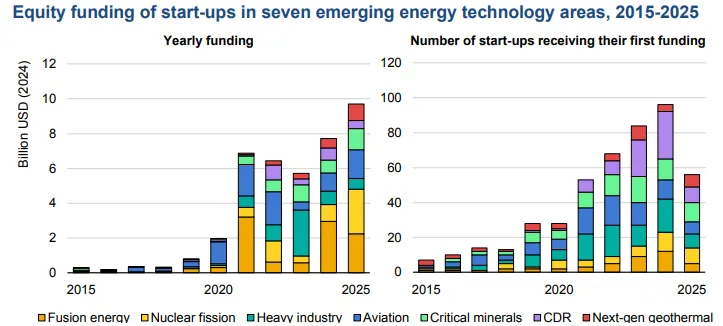
Over the past decade, nearly 400 companies have been established in these emerging technology fields, with over 60% founded after 2020, although the number of startups receiving their first funding in 2025 has declined.